
I wrote about why Wall Street is punishing Netflix, author The Media Mix and am working on a biography of Rupert Murdoch.
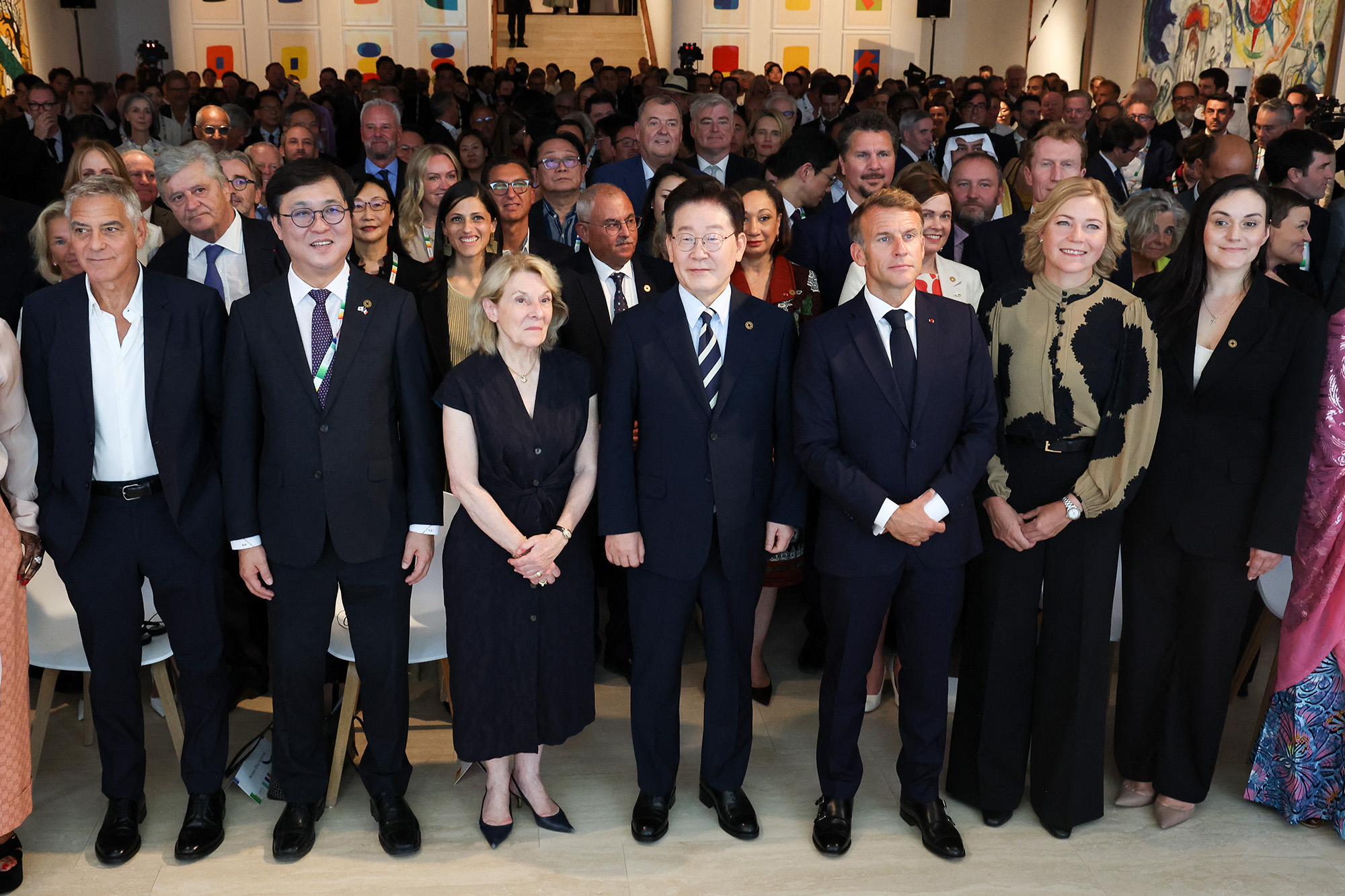
Bonjour from France, where I just attended the Lumière Summit, President Emmanuel Macron’s buzzy first-time one-day confab that convened some of the biggest names from entertainment in the world.
A murderers’ row of top Hollywood leaders from CAA’s Bryan Lourd to NBCUniversal’s Donna Langley, Disney’s Dana Walden, Sony honchos Tom Rothman and Michael Barker, Paramount’s Andy Gordon and Netflix’s Ted Sarandos ended their summer vacations (or added a stop on their way home from the Venice Film Festival) at an art institute on the outskirts of St. Paul de Vence, a remote medieval village in the South of France. Top European stakeholders who joined included Mediawan Chairman Pierre-Antoine Capton and CEO Elizabeth d’Arvieu, and Canal+ Group Chairman Maxime Saada and StudioCanal CEO Anna Marsh.

Macron had requested their presence at the Fondation Maeght, a museum known for its Giacometti Courtyard, to discuss an urgent issue — the future of cinematic storytelling in a world where consumers are increasingly turning to social media, YouTube and streamers for their entertainment. Add in the impact of artificial intelligence on creation, production and distribution, and you have the makings of a nightmare for global players also grappling with changing audience behaviors and demands. Macron is hoping to be their superman.

Donald Trump’s name was barely mentioned during the day’s packed program — though Marc Miller, Canada’s Minister of Canadian Identity and Culture, delivered a blistering rebuke of the U.S.’ trade war with his country in his onstage conversation with Ankler Media CEO Janice Min about cultural sovereignty. Among concerns related to protecting Canada’s film and TV ecosystem, he noted conflicts around American streamers’ tax revenue paid for Canadian subscribers. “People want a deal that’s fair, with consistency — that is very difficult to do in normal circumstances with the administration to the south of us,” he said. (Miller also shared that he had visited the set of Canada-made hockey romance Heated Rivalry to re-enact the Vegas skyline scene on the balcony, joking, “There was no intimacy coordinator.” And he made sure to claim Toronto-born Maggie Kang, co-director of KPop Demon Hunters, as a Canadian onstage.)
The event overall was certainly in part a response to Trump’s cultural saber-rattling, starting in May 2025, when he began threatening (but never followed up on) 100 percent tariffs on films made outside the U.S. Word among the crowd at the Summit, co-chaired by the South Korean President Lee Jae Myung, was that the seeds of Monday’s gathering were planted by those threats, with the two nations’ leaders reaching out to each other in the wake of Trump’s remarks. In recent weeks, Trump has declared his support for a national film incentive in the U.S., a measure to boost the industry that has generated much more enthusiasm in Hollywood than tariffs.

Macron told the audience of around 200 global delegates, from filmmakers and exhibitors to festival chiefs (Cannes’ Thierry Frémaux, San Sebastian’s Maialen Beloki, the Berlinale’s Tricia Tuttle and TIFF CEO Cameron Bailey) about his fears for the future of their jobs and his ambitions for extending opportunities in creativity.
George Clooney, who told me he was “just here to listen, really,” attended in a show of support for the French president’s efforts to prevent AI from replacing human-led storytelling and creative work. In my interview with him, Clooney shared his worries about what the tech could do to below-the-line workers and how AI-generated content could become a sloppy substitute for the work of cinema artists.
Read Clooney’s full, forceful interview here →
But Hollywood executives were far more taciturn. Almost none appeared on panels and seemed to avoid the press. YouTube was MIA. And then there’s the mystery of Ted Sarandos’ disappearing moment on the stage…
Macron vs. the Attention Economy

Perhaps shoring up a legacy, or thinking about a new job opportunity once he’s out of office next April, Macron opened the proceedings with a plea for people and nations to stop and think beyond their local bubbles to protect filmmaking. “We have never watched so many screens, and yet, by watching everything, we run the risk of ending up seeing nothing at all,” he said. “Our attention is an economic resource, and everybody’s scrambling to get a slice of the cake.”
Macron outlined the anxieties in a world where public and commercial broadcasters are losing their audiences and advertisers to YouTube. Joining Canada’s Miller for the panel with Janice, TF1 Group chief executive Rodolphe Belmer explained that in France YouTube is treated as “a hosting platform,” not a streaming platform, and gets tax breaks “for reasons that are totally historical,” he said. “We should make sure they don’t get advantaged by the state.” TF1 and Netflix inked a partnership in June 2025 that now sees the broadcaster’s live channels (and on-demand content from streamer TF1+) freely available to Netflix members in France as part of their subscription (Amazon’s Prime Video made a similar pact with public broadcaster France Télévisions).

While Hollywood showed up for Macron, not all invitees were eager to get the message. I learned YouTube declined the invitation (though Google executives were on the guest list). Also not on deck but invited: execs from the AI giants, OpenAI and Anthropic, which have been wrangling with global governments to be excused from copyright laws in the chase to win the tech race.

Sarandos’ Silence
Curiously, almost none of the top execs from Hollywood took the stage — save Tom Rothman, whose Sony remains independent today and under Japanese ownership — and the high-powered industry names also appeared to largely dodge the press. Several folks told me that Netflix’s Sarandos had planned to speak at the event and then didn’t at the last minute. Even as recently as the night before the event, his name was still listed as a speaker on the panel “New Perspectives on Local and Global Co-Prosperity.”

Given Trump’s recent endorsement of the national incentive, could there be some competitive behind-the-scenes geopolitics at play here? Trump, who bought millions of dollars worth of Netflix bonds earlier this year, may be trying to outfox his French rival — whom he has insulted as “brain dead” and who announced on Monday that Sarandos had been given the country’s highest honor, the Légion d’Honneur. The honor seemed to blur who exactly is friend or foe, and the Netflix chief will have to walk a line on supporting Macron’s efforts to protect French film if he wants Trump to rubber stamp any future M&A. (I’ve written about how the company is very likely to be in the deals swirl soon — or at least Wall Street wants it to be).
For their part, a Netflix spokesperson said that plans for the summit were being revised until the morning of, and Sarandos opted to attend another session rather than speak on the panel, when roundtables with both President Macron and President Lee were taking place.

Janice also moderated a very fun panel about the creator economy with AGBO founder Anthony Russo and CCO Angela Russo-Otstot along with Nigeria’s EbonyLife Group founder and CEO Mo Abudu. Anthony — in the midst of wrapping December’s Avengers: Doomsday and December 2027’s Secret Wars in London — revealed details about being discovered at Slamdance by Steven Soderbergh and the time a TV executive called him to fume about the brothers’ directing style on Arrested Development. “Tenacity is so essential,” he said, highlighting the importance of persevering even when things seem impossible and work is scarce. “No one is going to ask you to make a movie… You’re only doing it because you’re driven to do it, because you want to do it and because you won’t listen to no, no matter how many times you hear it.”
Meanwhile, Letterboxd CEO Matthew Buchanan revealed for the first time to Janice his Four Favorites (the online platform’s signature red carpet query for stars and filmmakers):
- The Ground We Won, a New Zealand-made movie about a single rugby dad and what it means to be a father.
- Australia’s Love Serenade, a 1996 comedy from director Shirley Barrett, about two women who fall for the same man.
- Badlands, Terrence Malick’s 1973 masterpiece.
- Céline Sciamma’s 2021 fantasy family drama Petite Maman, about a young girl coping with the death of her grandmother.

Where Buchanan stayed mum? Though Janice pressed him for details about Letterboxd’s potential coming buyer — Dealmakers’ Ashley Cullins has reported on A24 being in the mix along with rumored suitors from Paramount to TPG Capital — the exec kept his Kiwi lips sealed.
France’s ‘Free Cinema’ Fight

Stalking the halls for comment on Macron’s mission, I found HBO boss Casey Bloys reluctant to share even a word about the event. “No, we’re not doing that,” a woman with him brusquely said. Meanwhile, Tom Rothman told me he thought the idea of the summit was “terrific,” adding, “I thought the remarks of both presidents were very inspiring, very insightful, impressive.” He added in an on-stage session that he didn’t necessarily agree that attention spans have been destroyed, pointing to Hollywood’s hugely successful summer with Sony’s Spider-Man: Brand New Day, which has grossed more than $2.4 billion worldwide.

“It’s very rare you can find a moment where you can be in the same place with people who do what you do all over the world,” Sony Pictures Classics’ co-president Michael Barker told me. “The only other place that happens is in Cannes.”
The one-day event was filled with a flurry of announcements about delegations that have come on board to help keep the spirit of the Summit going throughout the year, with France committing €1 billion (about $1.16 billion) to a five-year effort in concert with South Korea to promote audiovisual industries. The MPA signed up to an effort to foster cooperation on piracy and other initiatives.
Regal Cinemas CEO Eduardo Acuna told me he was all for the day’s mission, welcoming the opportunity to talk to colleagues from across the industry without any agenda. “When you invest in our industry, it’s a global investment because it creates demand around the world,” said Acuna. “I think the fact that one government is trying to do this — plus the incentives for filmmaking in the U.S., it’s real momentum. It’s an industry that really needs it.”
Swedish-Egyptian filmmaker Tarik Saleh said after the event that he was impressed with Macron’s ability to “gather all the most powerful people in the film industry to say that cinema is important, because it is important, and it’s central in people’s lives. Ask anyone — they have a film that means a lot to them. Swedish politicians don’t care at all.”
The subtext of Macron’s effort, Saleh added, is to position France as “the leader of the free cinema. They all came here because he asked them to come. He’s a very smart guy, Macron.… I’m pleasantly surprised that everyone showed up.”
President Trump, your move.


Comments
Only Ankler All Access subscribers can comment
Already a subscriber?