

I wrote about Skydance’s new studio chiefs, A24’s fight with theaters and the $100M reparations musical from Trey Parker, Matt Stone and Kendrick Lamar.
Forget opening weekend. Hollywood’s biggest nail-biter is Tuesday, when political donors find out whether their election bets paid off. And judging by who’s backing whom, there could be some very awkward conversations at the Polo Lounge come Wednesday.
In Michigan, prominent Democratic donors crossed party lines to support a Republican Senate candidate before even Haley Stevens did — while other industry donors put their money behind Obama-endorsed rising star Abdul El-Sayed. In Los Angeles, the industry’s money has flowed five-to-one to Nithya Raman, who somehow still managed to squander her once-commanding lead — and even lost the support of an Oscar-winning screenwriter after failing to show up at a fundraiser her own campaign asked him to host.
But James Carville thinks the real showdown hasn’t even started.
“The Civil War starts Wednesday,” the legendary Democratic strategist told me Monday. “And it has to happen.”
He’s not talking Republicans vs. Democrats, but the simmering internecine battles within his own left vs. centrist party as the country resets for the 2028 presidential election. In other words, a circular firing squad.
First, though, there’s Donald Trump.
“It’s shaping up to be a pretty darn good night,” Carville said. “Every election between November ’24 through today has been a massive Democratic overperformance. You’d have to say, why is it gonna stop tomorrow?”

War in Iran. Gas prices. Tariffs. Inflation. ICE. Carville believes all of it ultimately comes down to one man.
“No one’s voting on anything else. To the extent that he can help in the Democratic messaging, he couldn’t be any better. He goes everywhere. He shows up and he reminds people it’s about him.”
A Reuters poll released Monday put Trump’s approval rating at a near-record low of 32 percent, with Democrats leading Republicans 46 percent to 38 percent on the generic congressional ballot.
“This referendum is a referendum on him, like most off-year referendums are, and he’s box office poison, as you guys would say,” longtime (non-MAGA) Republican strategist Mike Murphy tells me. “It’s a real send-a-message election.”
Now, get out the popcorn for today. Here are the five Election Day storylines to follow at your watch party, courtesy of Carville, Murphy and political analyst Joshua A. Cohen — and what they think happens today and yes, more crucially the day after.
Hollywood Donors Will Remain Divided

Among the Dems hoping to hold or flip seats, Georgia Senate candidate Jon Ossoff and Texas Senate candidate James Talarico have commanded boffo dollars from showbiz donors, as have Ohio Senate candidate Sherrod Brown and North Carolina Senate candidate Roy Cooper.

But while candidates like Ossoff, Talarico and a handful of others have won over the town, there are some midterm races that have Hollywood deeply divided, primarily around support for Israel. Michigan’s Senate race features Democratic candidate Abdul El-Sayed — whose positions on Israel and ties to far-left Twitch streamer Hasan Piker have caused controversy among pro-Israel factions — facing off against Republican Mike Rogers. Casey Wasserman and Teddy Schwarzman are among those who have crossed party lines to donate to Rogers, while the likes of Mike Schur, Gavin Polone and Danny DeVito gave to El-Sayed.
That contest was thrust even further into the national spotlight this past weekend when Michigan Rep. Haley Stevens, who faced El-Sayed in the Democratic primary and received a raft of Hollywood donations, suddenly endorsed Rogers. “It’s one of the great acts of political suicide you can imagine,” says Carville.

Starting tomorrow, Hollywood’s fundraising apparatus continues to splinter, as donors shift their focus to their respective presidential hopefuls. Ossoff has already commanded much of the attention, though once outgoing Gov. Gavin Newsom enters the race, the longtime Hollywood heavyweight will surely tip some kind of scale — into what direction, who knows.


The Nithya Raman Reversal

L.A.’s mayoral race has also divided Hollywood Democrats, though industry donor money has flowed to Nithya Raman at a roughly five-to-one ratio. (A lot of money also went to Spencer Pratt in the primary, with Haim Saban — arguably the biggest Democratic entertainment donor — giving to Pratt and now Karen Bass in the general.) In another blow for Raman, Oscar-winning Milk screenwriter Dustin Lance Black pulled his support for her and endorsed Bass after Raman no-showed a fundraiser the campaign had asked him to throw for her.
Now, what seemed impossible after the city’s handling of the 2025 Los Angeles fires has become highly likely. Incumbent Bass, after trailing Raman in some polls by a double-digit margin, has caught up. (Prediction markets have Bass at a 58 percent chance of victory, with the latest polls showing the duo at a dead heat of 40 percent of likely voters each.)
Murphy attributes this late turn less to a sudden surge of enthusiasm for Bass and more to Raman’s inability to manage the spotlight as the frontrunner.
Raman, he says, failed to capitalize on Bass’ vulnerability once voters began inspecting her platform more closely. “Nithya is so murky on the issues,” Murphy says, noting that voters started asking: “‘What’s she really going to do?’”
In his view, the dynamic of the race fundamentally transformed once Raman shifted from an unexamined vehicle for change into a candidate associated with uncertainty. “Nithya did not handle the spotlight well and is now associated with risk as well as change,” he says. “When she was just change, she was eight points ahead. Now that she’s risk, she’s dead even.”
Not helping Raman was Rick Caruso’s endorsement of Bass, which Murphy believes played some role in the polling margin shifting. If he had to bet, Murphy says, he’d take Raman, “but it could go either way.”
Whatever happens in the runoff, Raman faces a tough road ahead. If she wins, she’ll govern alongside a 15-member council on which no colleague endorsed her, with most backing Bass instead. If Bass prevails, Raman returns to her council seat with the same problem: She ran against the city’s political establishment, and the colleagues she’d be rejoining are its core.

The Ad That Will ‘Live in Infamy’
In the Ohio governor’s race, featuring Trump devotee Vivek Ramaswamy and Democrat nominee Amy Acton, Ramaswamy ran a $4 million attack ad using Acton’s estranged mother, who calls the candidate an untrustworthy liar. Her husband, Acton’s stepfather, was charged and indicted with sexually abusing Acton at a young age before he fled as a fugitive.
“That ad will live in infamy,” says Carville, who sees the episode as a long-term black mark for the GOP. “It’s not going to end with this cycle. It had an effect because I think other people in the country saw it, and they concluded this is exactly who these fucking people are.”
Then again, Carville can get behind hardball tactics. Take the Alaska Senate race — one of the tightest, with the NYT/Siena poll pinning Democrat Mary Peltola’s lead at 2 points over Republican incumbent Dan Sullivan — that has also made headlines. Peltola’s campaign reportedly recruited a second Dan Sullivan to run in order to confuse voters. The Trump administration tried to block the maneuver, calling it illegal.
“First of all, what they ‘tried to pull’ is legal. It has been done,” says Carville. “I worked for [former Pennsylvania governor] Bob Casey. We had to run as the ‘real Bob Casey.’ Every time he’d run, they’d put another Bob Casey in the race. I mean, come on.
“It’s called politics. It’s not a spelling bee.”
Will a Blue Wave Last?
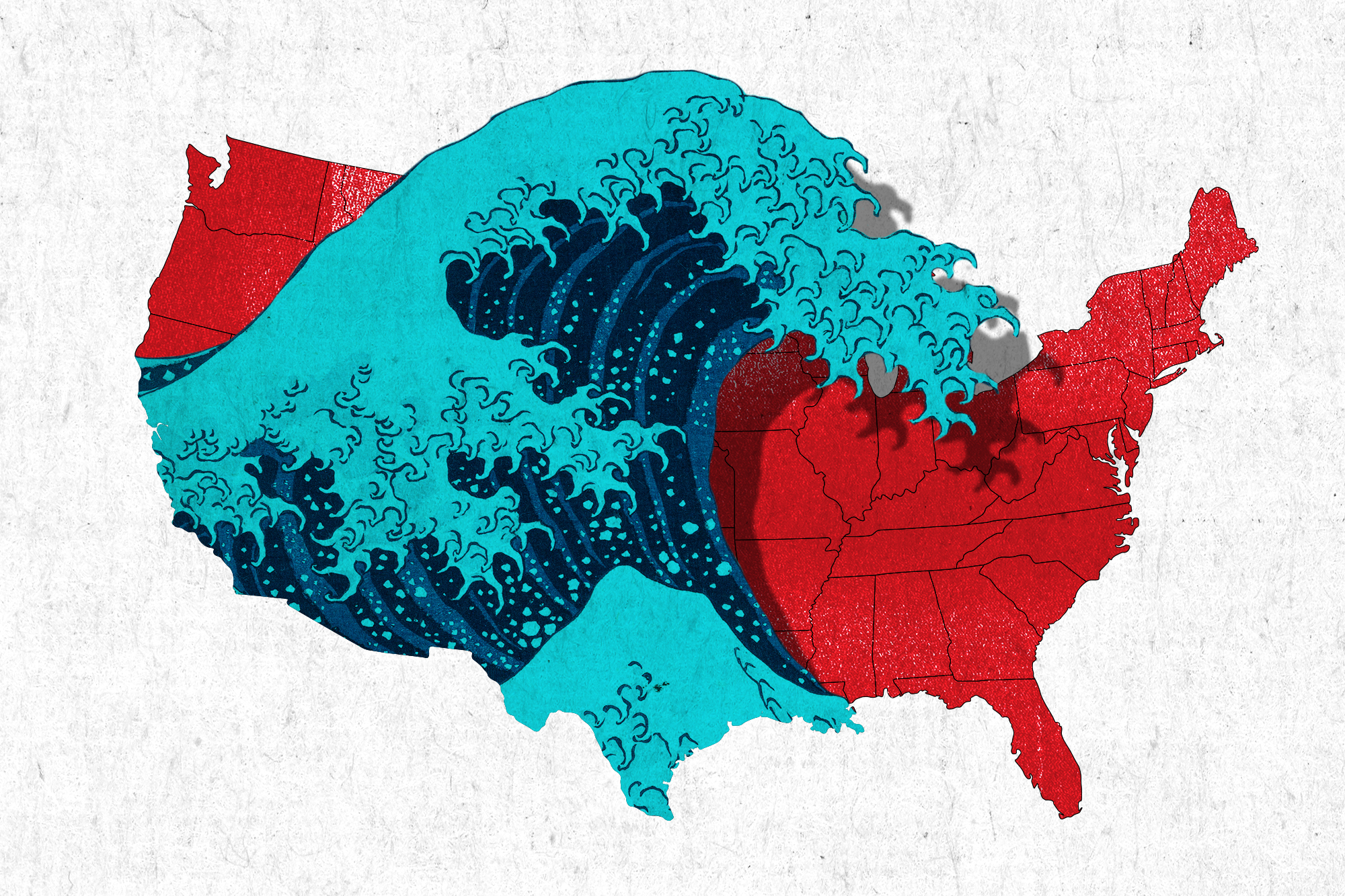
To win back the House, Democrats need to flip three seats. For the Senate, it’ll take four. The prediction markets (Kalshi and Polymarket) have it at roughly 94 percent for Dem control of the House and 74 percent for the Senate. If both go the Dems’ way, the phrase “blue wave” will be as hard to avoid as Avengers ads the next two months.
For Carville, the story of this election is going to be Black turnout and the Hispanic reversal, cutting into historic gains for the GOP with these groups in 2024. “Non-white people are going to take center stage,” he says. “The percentage of the vote that’s not going to be white is going to be higher than for any election we’ve had.”
Cohen, who authors the popular left-leaning Ettingermentum newsletter, writes that he’s most closely watching Brown’s Ohio race “both because of how directly important it is for deciding control of the Senate and what it will say about a potential larger Dem WWC [white working class] resurgence [whose] existence or lack thereof will decide races in other states like Iowa and Kansas.”
So what changes after election night? Likely more does for the Republicans than for the Democrats — and it all has to do with distancing themselves from Trump. Carville says Republicans’ reaction to the midterms will be the thing he’s “most closely attuned to” in the aftermath. A lame-duck Trump will try to govern by executive order, he adds, and how much his party supports those moves will be telling.
“What the Republicans are really going to be hoping for is to get Trump out of there and get a fresh face, because Trump has worn out his welcome,” Murphy says.
The Coming Dem Civil War
For Democrats, even a sweep across the House and Senate won’t solve the tension in the party between its growing far-left movement and moderates. If El-Sayed wins in Michigan, the DSA (Democratic Socialists of America, the progressive wing that includes Zohran Mamdani, Alexandria Ocasio-Cortez and — by a hair — Raman) “will say this is evidence that this is not just an urban coastal phenomena,” says Carville. “This is what the rest of the country is waiting for.”
Stevens’ surprise Republican endorsement caps off a slew of altogether chaotic Democratic infighting. Though El-Sayed is not a part of the DSA, he’s just been frequently been lumped in (along with facing a lot of anti-Islamic racist rhetoric).
Carville said in an interview last month with The Bulwark that he would arguably rather see Dems lose the House than win it by five “because if that happens, they’re hostage to the DSA.” Carville still calls the DSA “really naive people.”
Adds Murphy: “Whether or not (House Minority) Leader Hakeem Jeffries, who will almost certainly be Speaker, can get the Democrats unified — or they split off into different factions ideologically — is going to be the lift, and we don’t know yet. The Dems traditionally tend to like circular firing squads, but I think they can see the opportunity here is huge. So maybe that’ll bring some rare but necessary discipline.”
Whatever happens within the party, the hope is to align for the presidency in 2028. And if the Democrats take power in the House and Senate, they’ll have a record — successful or not — to run on in two years.
“People forget Obama lost 60 House seats in his first midterm, and then he won the presidency two years later. So ’28 is not ’26,” Murphy says. “But how the Democrats use and behave with their new power in ’27 and ’28 while the presidential primaries are going on, that’ll have a lot to do with their success in ’28.”
Carville expects the greatest accumulation of political talent he’s ever seen to pile into the Democratic field running for president in 2028. Of those who have stood out so far, Cohen says it’s “undoubtedly Ossoff,” whose Hollywood backers also see his presidential potential (one industry supporter called him “dreamy” last month).
Says Cohen, “I anticipate the primary season to effectively begin on Wednesday.”

Comments
Only Ankler All Access subscribers can comment
Already a subscriber?