

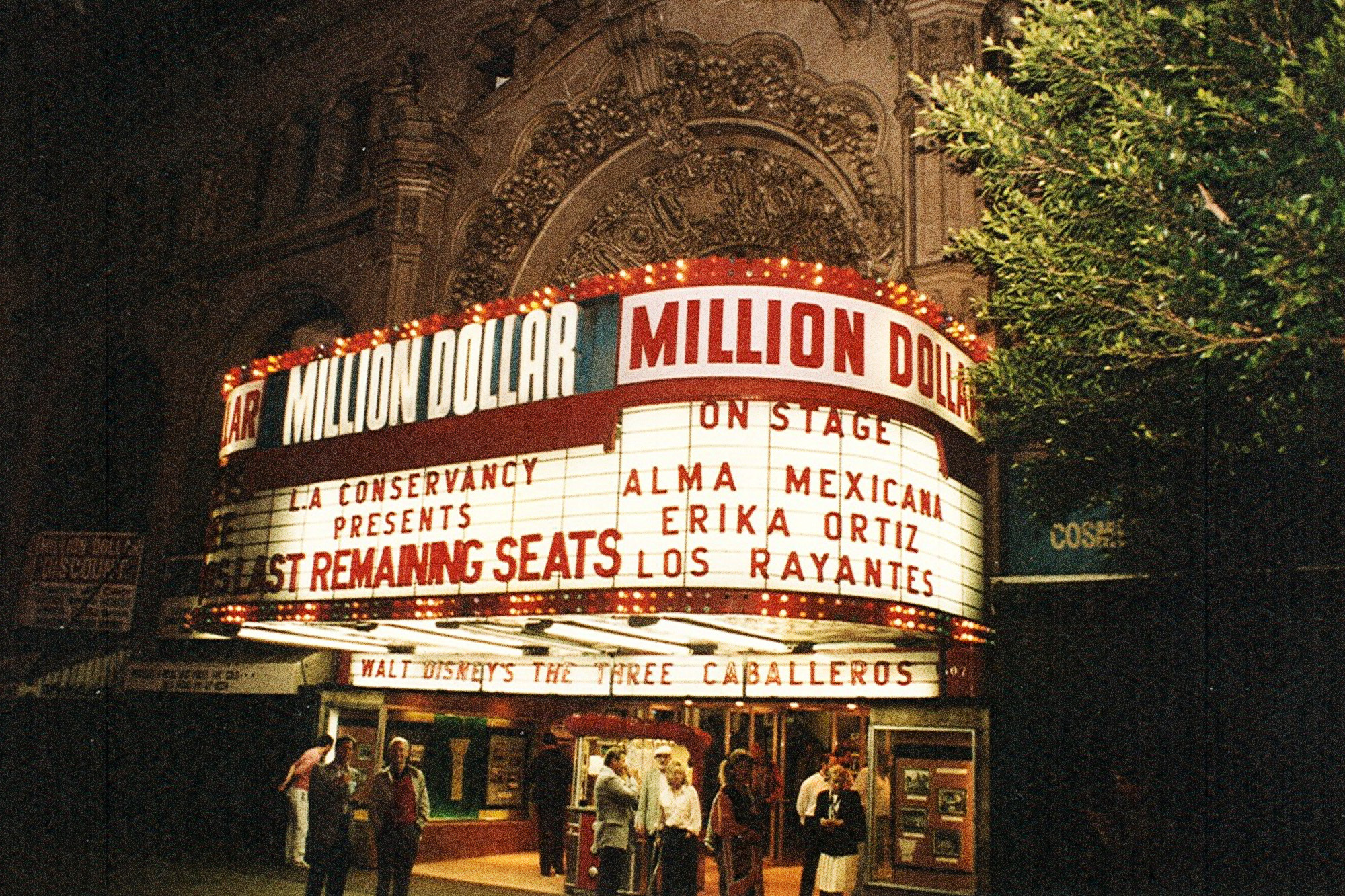
↑ A 1991 image of the Million Dollar Theater marquee, where the Los Angeles Conservancy ran — and still runs — repertory screenings. (LAC Archives)
I cover audience and moviegoing trends. I looked at the coming IP that Gen Z will make or break, dissected the struggle for films to stay memorable in the streaming era and covered the return of MoviePass as a prediction market. Email me at matthew@theankler.com

Movies once defined the culture of Los Angeles — not just the films themselves, but the red carpets, the premieres, the choreography of glamour that surrounded them.
At the center of it all were 12 movie palaces, temples to Hollywood, clustered across an eight-block stretch of Downtown L.A.: The Million Dollar, Roxie, Cameo, Arcade, Los Angeles, Palace, State, Globe, Tower, Rialto, Orpheum and United Artists.
These theaters were destinations in their own right, lionized by swarming press hoping to catch Charlie Chaplin and Mary Pickford in the silent era, Clark Gable and Marilyn Monroe in the 1950s, and Jack Nicholson and Faye Dunaway during the New Hollywood boom of the 1970s.
“For 25 cents, you could be transported to an exotic environment you could never hope to see in your actual life,” says film critic Leonard Maltin of the ornate, themed palaces that once defined Los Angeles moviegoing.
As Loew’s Theatres founder Marcus Loew famously put it: “We sell tickets to theaters, not movies.”
It’s a line worth considering today. None of L.A.’s 12 historic movie palaces still operates as a full-time, first-run commercial cinema. The State Theatre is now leased to a church. The Rialto in Downtown L.A. has become an Urban Outfitters. Elsewhere in the city, preservation battles rage on — from the petition to save the Cinerama Dome to actor-director Kristen Stewart’s effort to bring back the Highland Theatre, a cinema built in 1925 that she calls “an antidote to all the corporate bullshit.” Director Jason Reitman is also personally leading the restoration of the Fox Village Theatre in Westwood.
“We often like to think of movie theaters as churches,” Reitman said last fall. “If so, the Village is a cathedral.”
During Hollywood’s Golden Age, studios poured money into these palaces as monuments to ambition, ego and showmanship, helping drive tens of millions of weekly ticket sales and turning moviegoing into a shared ritual, a national habit as those photos circulated through newspapers and magazines, marketing Hollywood and its stars to the world. What remains now are echoes: faded marquees, cavernous ghostly lobbies and architectural splendor — frozen in time.
“When these movies would premiere at these theaters, you’d have sometimes up to 30,000 people in the street just waiting for a glimpse of their favorite movie star,” explains Marcus Lovingood, chairman of Broadway West — an organization dedicated to activating downtown L.A.’s historic theater district. “It was the epicenter of entertainment for the entire world.”
At its peak, Hollywood had eight studios, producing 300-400 films each year. Today, of course, it’s a far different story. The Big Five studios — which, pending Paramount’s acquisition of Warner Bros., will shrink down to four — produce around 80-120 films each year for theatrical release.
Since Covid, roughly 5,700 North American screens have been lost. More and more, theaters are having to pivot, hosting screenings of old movies due to a dearth of popular new ones and turning their venues into catch-all “event spaces.”
Related:

“If you think about a theater and it being reused as something else, a church is very easy,” says Alex Inshishian, program manager at the Los Angeles Conservancy. “You have a big stage, you have all the seats already set.” Following its closure as a cinema, Million Dollar served as a church for a period of time — a fate currently shared by two nearby movie palaces: the Rialto Theatre (a different one) in South Pasadena and the State Theatre on Broadway.
What follows is a look back at L.A.’s great lost movie palaces — beginning with the epic Million Dollar Theatre — and the ghosts of glamour they still hold.
Don’t stop here
Get the rest of this story — and the scoops and intelligence Hollywood reads first.
Already a subscriber?

Comments
Only Ankler All Access subscribers can comment
Already a subscriber?