

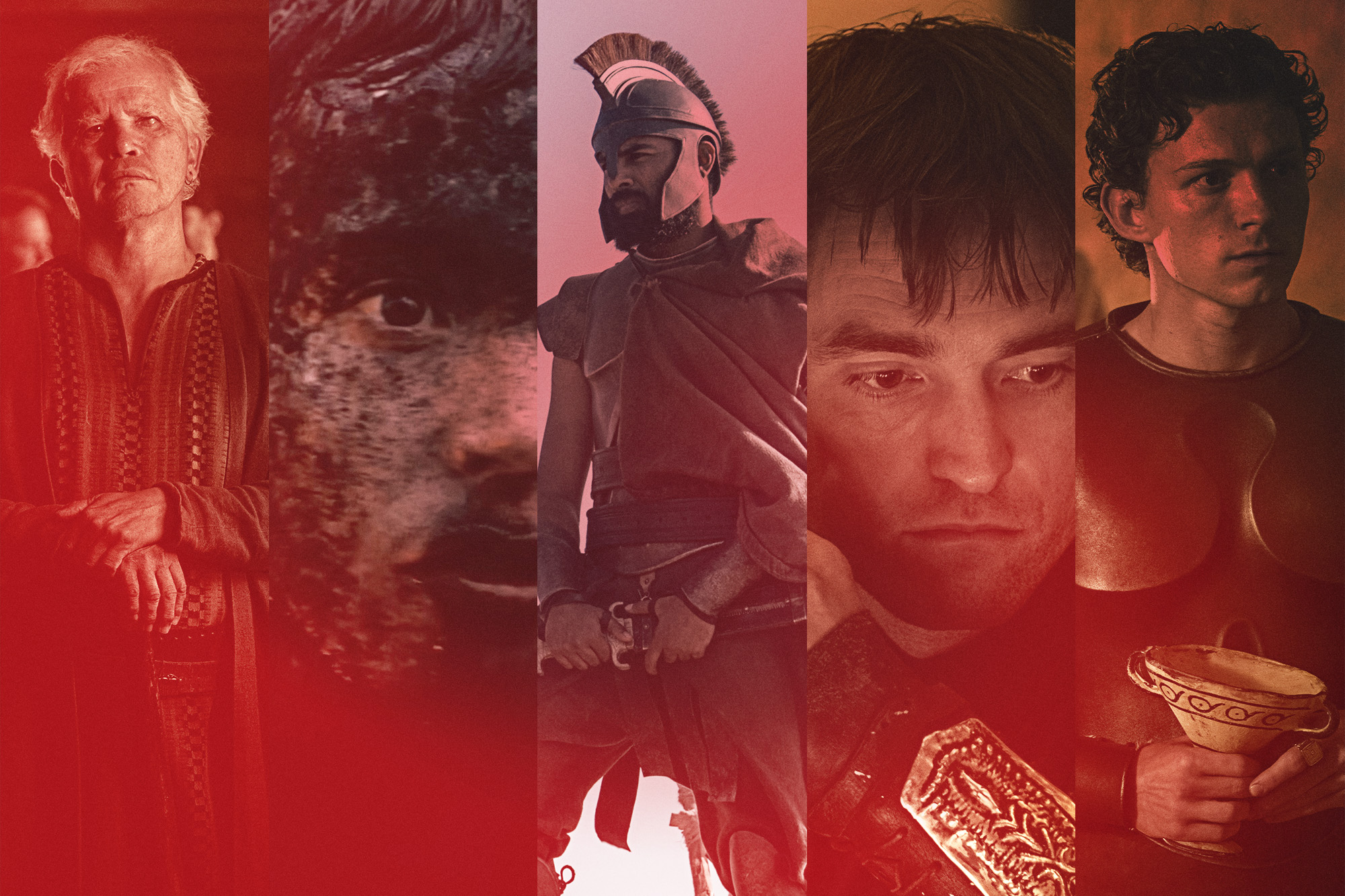
Happy Monday, and extra special greetings to the Redditors who enthusiastically (but politely!) shot down my theory, shared on last week’s Prestige Junkie podcast, that Anne Hathaway could campaign as a lead actress for The Odyssey. As of this writing, Universal’s awards team still hasn’t confirmed category placement for anyone in the cast, and probably won’t for many months yet.
But before I get into today’s interview with Sean Combs: The Reckoning director Alexandria Stapleton, an Emmy nominee whose work may have made a bigger impact than any other, I’ll throw out one other theory to consider about The Odyssey and the Oscar race. Part of the advantage of positioning Hathaway as a lead actress would be to clear more room for a supporting actress campaign for Samantha Morton, whose two scenes as Circe are among the most arresting of the film. I’d argue there’s a male supporting performance with a similar power, and one we’re not talking about nearly enough yet.
Picking a single supporting actor to campaign from the film is already an impossible task — Tom Holland has the biggest supporting role as Odysseus’ son Telemachus, while Robert Pattinson has the flashiest as the despicable suitor Antinous. There’s also the soulful supporting work from John Leguizamo as the loyal swineherd Eumaeus and Himesh Patel as Odysseus’ second-in-command, Eurylochus, both of whom are the most likable characters in the entire film.
For a performance that rivals the power of Morton’s, though, there is only Elliot Page as Sinon, the naive young soldier who confronts Matt Damon’s Odysseus during his visit to the underworld. Sinon appears in flashback glimpses throughout the film, standing watch outside the Trojan horse on the beach and dying for it, with Odysseus inside the horse grimacing just inches away. He’s sympathetic and even a little pitiable, a scrawny boy who bravely signed up for war and let Odysseus lead him to a death that wasn’t nearly as noble as promised.
In Hades, Sinon lets Odysseus have it, not just for his death but the arrogance of not even telling Sinon what was actually inside the horse. It’s a heartbreaking scene that perfectly sets up the magnificent flashback to the sacking of Troy at the end of the film, where we realize just how much guilt Odysseus holds for his role in ending the war. Without Page giving a voice to all that agony, the scene wouldn’t carry nearly the same impact.
There would be something lovely, of course, about having Page back in the Oscar race 19 years after his nomination for Juno — but this time in the category that reflects his true gender. But Sinon also feels like a continuation of the role Page played in Christopher Nolan’s Inception — Ariadne, the builder of dream mazes who is also the only person who realizes how much danger Leonardo DiCaprio’s Dom Cobb is leading the team into. Twice now Nolan has asked Page to come stare his heroes in the eye and call them on their bullshit, and both times Page has nailed it.
So before we assume that Pattinson will be the best chance for The Odyssey in supporting actor as a body of work nomination for his very busy year, and before Leguizamo gets too much farther into his already excellent press tour, take a moment to also consider Elliot Page, the true heart and soul of The Odyssey. Because hey, if any movie is going to get three actors nominated for best supporting actor, it’s this one, right?
Taking Down Diddy
Director Alexandria Stapleton knew what her most powerful tool would be in making the four-part documentary series Sean Combs: The Reckoning. It wasn’t the frank interviews with the people who have accused Sean “Diddy” Combs of assault, including Aubrey O’Day and Joi Dickerson-Neal. It wasn’t even the astonishing footage of Combs in the days leading up to his arrest, acquired by Stapleton from a filmmaker who’d been hired by Combs to follow him around.
The most effective strategy for telling Combs’ story, Stapleton tells me, was a very simple one: laying out all the facts of his life in order.
“Look, there are some really great films that play around with timelines,” says Stapleton, who is Emmy-nominated as the director as well as the producer of the doc series. “When you start with Sean Combs, when you start just laying out the timeline of him and his life — it was really interesting to see what was happening in his career, all of the allegations that are happening, and the story of hip-hop and this whole culture being created in New York. With the weaving of that, the story starts to kind of write itself.”
Sean Combs: The Reckoning, a smash hit when it launched on Netflix last December, makes a persuasive argument that Combs became a central figure in the world of hip-hop through manipulation, alleged abuse and a cold-eyed ambition that masked a lack of musical talent. Combs, whose 2025 trial on charges of racketeering and sex trafficking is covered in the documentary, called it a “shameful hit piece”; in our conversation, Stapleton alluded to the threats she and her collaborators faced while making the film, saying it was “a very harrowing experience.” (In October 2025, Combs was sentenced to more than 50 months in prison for prostitution-related offenses.)
But Stapleton remained steadfast, she says, knowing that she was in the position to “take away the emperor’s clothes.” Eschewing voiceover or re-enactments that might sensationalize the story, Sean Combs: The Reckoning finds even greater power in that straightforward timeline, showing Combs’ rise from a scrappy intern at a New York hip-hop label to a globally recognized music mogul, partly as a result of the death of his friend Christopher Wallace, aka The Notorious B.I.G. Stapleton’s documentary gets into all of Combs’s well-known controversies as well as those that have been more forgotten, like a 1993 concert he promoted that resulted in a stampede and the death of nine people.
“People were reporting about it and other docs were coming out, and they just kind of throw that out there, but I’m like no, I want to break this out to understand,” Stapleton says of the stampede. “When I have an interview, and they’re describing to me that week right after, it makes the archival footage that much more interesting when you see his first press conference.”
Publicly, she continues, he was contrite; those close to him were seeing a different person entirely. “I think that’s what hits in the film,” Stapleton continues. Sifting through the reams of publicly available footage of Combs, she says, “I’m always looking for clues of, first of all, validating what people are telling me, and then about what was happening behind closed doors.”
Netflix announced the production of Sean Combs: The Reckoning just a week after Combs’ arrest in 2024, and Stapleton was tasked with telling a story that wasn’t just being told in other TV specials but widely covered in the press and social media. It was very easy to find a quick version of the Sean Combs story — but Stapleton was ready to push further.
“We just live in a world where everything’s TL;DR,” she says. “People just want the quick fix of what happened. And I think the biggest gift of a doc is the time and space of using this craft to give you the broader story, to give you the textures and the nuances.”