

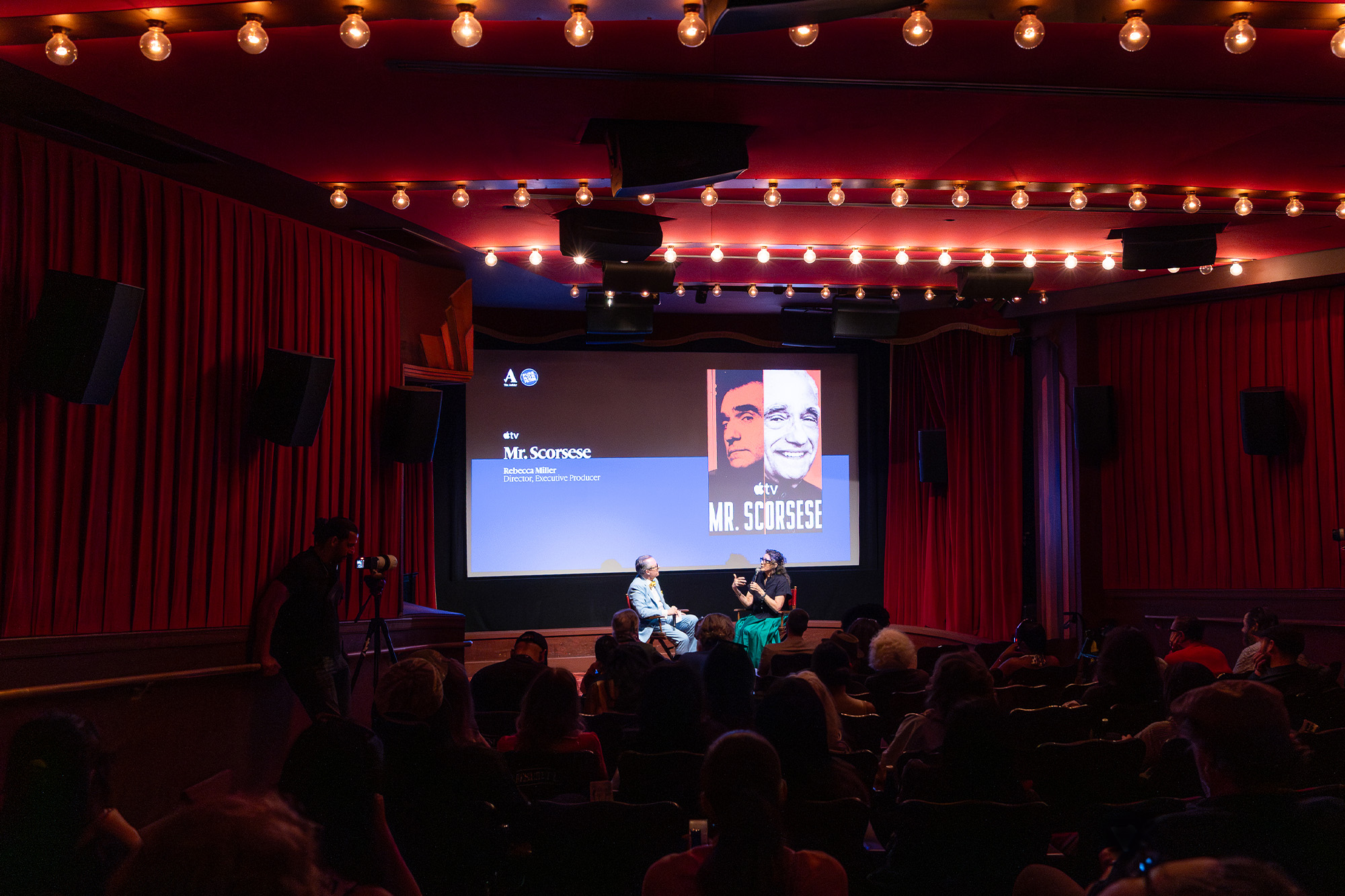
Hosted by Thom Powers, Documentary Spotlight is an ongoing partnership between Pure Nonfiction and The Ankler highlighting the best in nonfiction film and television. This edition, held in New York on June 7, was presented by Apple TV, Hulu, Netflix, Prime Video and Red Bull Studios. You can also listen to audio of these filmmakers in conversation with Thom on the Pure Nonfiction podcast.
Rafa director Zach Heinzerling conceived his four-part Netflix series as an observational chronicle of tennis legend Rafael Nadal’s final season. It was supposed to be a triumphant comeback — a return to form for an athlete with 22 major titles, including 14 French Open wins, and an Olympic gold medal — until it wasn’t.
As injuries derailed Nadal, who faced heartbreak after heartbreak on the court, Heinzerling realized the narrative needed to dig deeper into the Spanish star’s psychology.
“It went from a story about a comeback to a story of why won’t this guy stop?” Heinzerling tells Pure Nonfiction’s Thom Powers. “Which then led us to his past; the question of, is he going to stop? kept me going. And then the question of why doesn’t he stop is responsible for the archival material.”
The series juxtaposes present-day struggles with archival footage to reveal that Nadal’s legendary perseverance — and his fear of quitting — stems from a deeply ingrained desire to appease his demanding uncle.
“That’s not something he’s going to say, or the uncle’s going to say,” Heinzerling says. “There are other documentaries that have done this sort of retirement thing, but I feel like you need the weight of the past to make the audience actually emotionally feel anything. When somebody is saying goodbye, and they’re crying, are you empathizing with that, or do you understand why this is so important?”
Rafa isn’t the only documentary that managed to dig past the surface of an icon (more on those below). But Heinzerling, along with the filmmakers behind six other Emmy-eligible titles, joined Powers to discuss how their projects managed to capture the inner struggle behind a John Candy or Martin Scorsese — and the power of women uplifting one another to overcome deeply entrenched misogyny.
In the latest collaboration between The Ankler and Pure Nonfiction, held on June 7 at Roxy Cinema in New York City, Powers hosted our Documentary Spotlight event, spotlighting John Candy: I Like Me, Lilith Fair: Building a Mystery, Marty, Life Is Short, Mr. Scorsese, Rafa, Reggae Girlz and Sean Combs: The Reckoning.
Powerful Women
Reggae Girlz; Sean Combs: The Reckoning; Lilith Fair: Building a Mystery
Initiated during Covid, Reggae Girlz shines a light on the resilient Jamaican women’s national soccer team as the squad battles systemic hurdles. The team faced massive underfunding compared to men’s sports as well as deeply entrenched cultural misogyny.
“I didn’t realize until we were filming how deep a level of misogyny still exists in the culture,” Reggae Girlz co-director Trish Dalton says. “As a woman making the film, I’ve had similar experiences where you feel like shut down because you’re a woman.”
Dalton and her team partnered with Red Bull Studios, which provided funding to start filming when Jamaica qualified for the 2023 World Cup. Focused on the World Cup run, with added context about the team’s history (the squad was disbanded in 2008 due to lack of funding and resurrected in 2014), the film begins to resemble a classic sports movie as the team overcame “hurdle after hurdle” en route to the Cup — and then even during the tournament, where Jamaica challenged global giants France and Brazil.
As Reggae Girlz still seeks distribution, with the hope that the film will cultivate broader support for women’s sports globally, Dalton is buoyed by the theme’s evergreen subject: “The universal theme of women helping women.”
In Netflix’s Sean Combs: The Reckoning, the thread of entrenched systems holding down women was placed at the forefront, highlighting how Sean “Diddy” Combs built an empire of abuse and fear.
Director Alexandria Stapleton embarked on the deeply harrowing four-part doc series starting the day Cassie Ventura — the singer known as Cassie, who was in an abusive relationship with Combs for years, and testified during his trial — dropped her lawsuit. Instead of chasing salacious headlines, Stapleton’s goal was to investigate the broader ecosystem and enablers that allowed these alleged abuses to persist.
“As a documentarian, one mantra that I always have is, follow the money,” Stapleton says. “Who was allowing and enabling the behavior to take place… Those are bigger conversations that I hope continue to be of interest to the public.”
Recognizing the intense fear victims felt about their reputations and safety, the production enlisted executive producer Curtis “50 Cent” Jackson to lend the project credibility within the hip-hop community. For the victims themselves, Stapleton kept their identities completely confidential and maintained a minimal set to create what she called a “cocoon” for subjects sharing the worst moments of their lives.
“I realized that so many of these people that gave their voice to the film, no one ever talked to them and no one ever believed them. No one,” Stapleton says. “They were kind of discarded. It was just, like, this energy of them wanting to share their story for the first time.”
Stapleton reflects on the series now as a mirror to the public’s dangerous adoration of the kind of fame and wealth Combs possessed, emphasizing that not only is it important to listen to victims, “but it’s also important to study what abusers do and the patterns” they use.
The fame and power that comes from popular artistry can be a weapon for evil — or, in the case of Lilith Fair, a force for good.
In the 1990s, the music industry was plagued by the prevailing misogynistic myth that audiences would not support female headliners and that female artists could not successfully tour together.
“That was the prevailing wisdom in the ’90s,” says Ally Pankiw, the director of Hulu’s Lilith Fair: Building a Mystery – The Untold Story. “Some of the biggest stars of that era weren’t allowed to pick their own female openers, and bookers wouldn’t back financially a tour that had a female opener.”
The groundbreaking Lilith Fair, founded by Sarah McLachlan, sought to dismantle those notions. “Sarah just was like, ‘I disagree,’ and she just set out to disprove a lie,” Pankiw says. “She built this beautiful, mysterious alternative to something that we just thought we had to accept.”
Lilith Fair proved to not only be a better environment for artists than any other festival — it was more lucrative, too. The artists, who endured infantilizing and hostile questions at daily press conferences simply because they knew a percentage of ticket sales would be donated to local women’s charities, ultimately raised over $10 million.
“It was more equitable, it was safer, it was more financially successful, and it also gave back to charities,” Pankiw notes. “It was just a better music festival than all of its contemporaries in every way that you can judge a music festival.”
Bringing Legends Home
John Candy: I Like Me; Marty, Life Is Short; Mr. Scorsese
John Candy brought immense joy to audiences everywhere with his legendary body of work — including hits like Planes, Trains and Automobiles and Home Alone. But director Shane Reid had to capture a deeper truth to tell the story of the acclaimed comedian’s life.
“The humor is very much a part of John’s life. The anxiety is very much a part of John’s life,” Reid says. “And it was important to ride that wave.”
The documentary John Candy: I Like Me makes the case that Candy’s on-screen performances were direct projections of his vulnerable internal world. To convey this, the Prime Video release utilizes specific montages of his movie clips, treating them as windows into his personal evolution, such as how his family-oriented films mirrored his deep desire to be the father he never had.
“By marrying the two [clips and personal footage], you get a richer sense of what the films meant,” Reed explains. “Hopefully it leads you back into watching them again and seeing a peek behind the curtain of the man that you’re watching in the film.”
In order to take that peek behind the curtain, one major domino had to fall: getting the notoriously elusive Bill Murray, Candy’s co-star in Stripes, to agree to an interview. Just a week before picture lock, Murray sat down with Reed and provided a humorous and loving perspective that ultimately shaped the film’s opening.
“When Bill starts talking to you, you listen,” he says. “He brought a whole other humanity to John that wasn’t there.”
Like Candy, Martin Short began his career in Canada on the sketch comedy series SCTV — and had a story to tell beyond his funny on-screen roles.
Because director Lawrence Kasdan is a longtime friend of Short’s, the documentary possesses the relaxed feeling of simply hanging out with the beloved comedian. Not only that, Kasdan’s filmmaking background (he wrote Empire Strikes Back and Raiders of the Lost Ark and directed The Big Chill) translated perfectly to the doc format, allowing the film to viscerally capture Short’s unique comedic rhythm and pacing.
“You feel like a privileged person, sort of peeking in on this tight group of people who were really just enjoying themselves, and they just happened to put a camera film for the fun of it,” Marty, Life Is Short producer Sara Bernstein says.
Short gave the production over a thousand hours of his personal home video footage, offering a glimpse into his family, tight-knit friend group and his creative origins. Beyond the comedy, the Netflix documentary explores Short’s resilience in the face of immense personal tragedies, such as the loss of his parents and wife.
“There’s something about the joy in this film, the way that Marty sort of overcomes these horrible life-or-death challenges in his life,” Bernstein says. “But he just sort of barrels on with this positive outlook of, he’s going to do the best he can, and he’s going to perform to the best level that he can perform.”
First conceived as a feature film, Apple TV’s Mr. Scorsese director Rebecca Miller realized there was too much material to fit into a single documentary. So she expanded the project into a five-part doc series to chronicle the legendary director’s career.
“When it was a feature, and I kept trying to [cut] 15 to 20 minutes with my editor, David Bartner, it just wouldn’t squish down,” Miller explains. “It kept getting boring, weirdly, the shorter it was. It just needed space.”
Miller utilized what she referred to as a “cubist approach” to examine Scorsese from multiple angles — as a filmmaker, father and artist. Through extensive, unstructured interviews, Miller discovered how his childhood neighborhood — where a church sat directly across from a mafia social club — profoundly influenced the violence and anarchic characters in his cinematic universe.
“It’s one thing to know, oh yeah, he grew up in that neighborhood,” she says. “Really, I had no idea the level, the truth. … It makes you understand the violence in his films in a completely different way, I think.”
For Miller — a seasoned film director (Maggie’s Plan) and the daughter of playwright Arthur Miller — expanding the project into her first-ever series was a slightly daunting task, having to develop narrative cliffhangers across five distinct episodes. But the most nerve-wracking experience of the project was showing the final cut to Scorsese himself, who gave her tremendous creative freedom.
“All his notes were very factual and very much about not wanting to offend somebody. … It was all very doable,” Miller says. “I think what he most appreciated about it was the filmmaking itself — the detail, the imagery, the way that we used split screen, the way that we kept the story moving in music and all that.”