

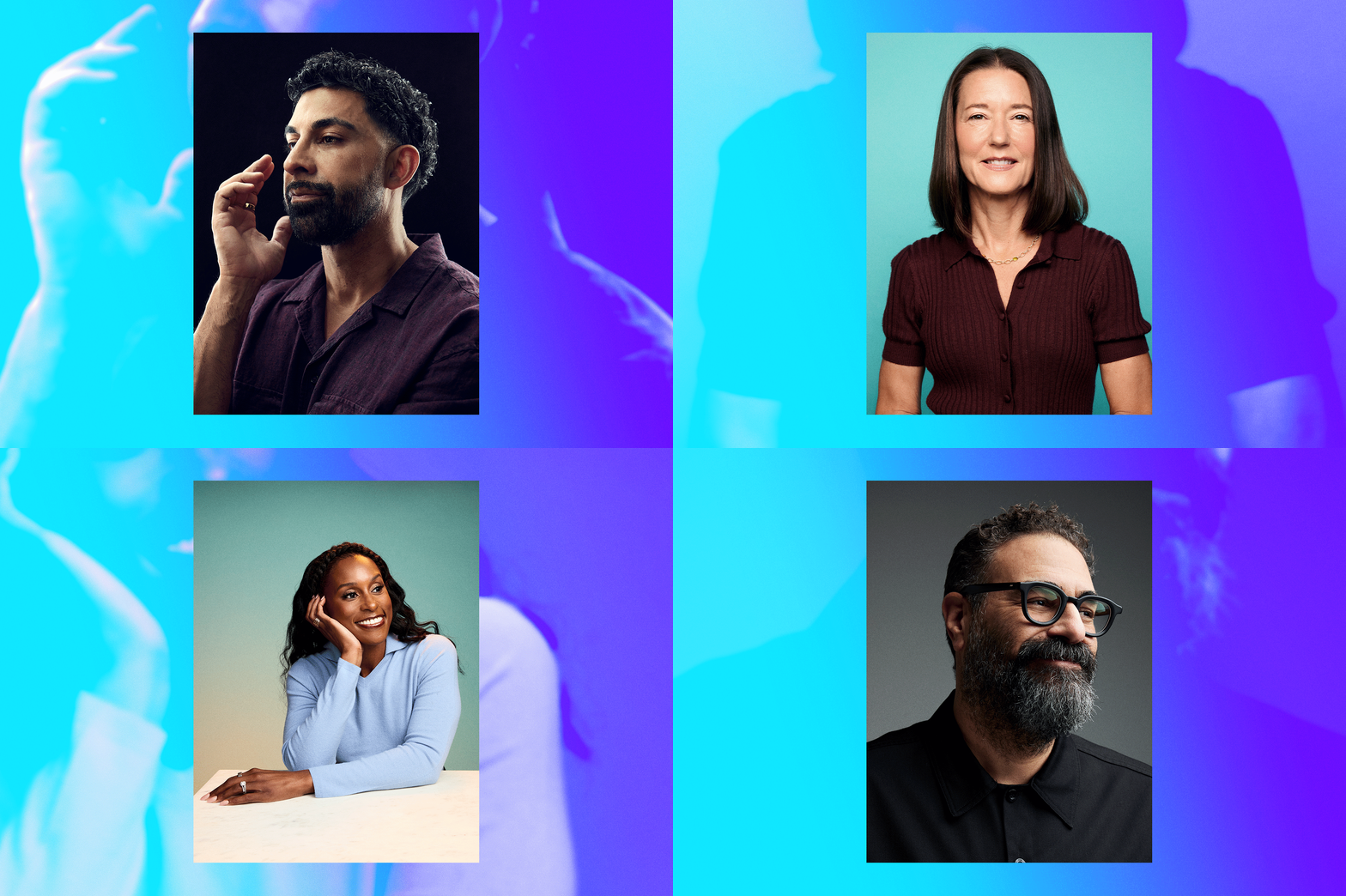
Hollywood used to know exactly what an entertainment company looked like. It owned a studio lot. Or a television network. Maybe even a record label.
That’s over.
Today, an empire can begin with a YouTube channel, a podcast, a gaming platform or a creator with a phone. It can be built in Seoul, Mumbai or San Juan without ever asking — or caring about — Hollywood’s permission. Take Dhar Mann, our Future of Entertainment Award honoree, who posted his first YouTube video eight years ago, was once snubbed hard by a legacy exec on a plane, and has since established a massive creator-first empire with hundreds of millions of views and deals with the NFL, Fox Entertainment and Disney. Or Cristóbal Valenzuela, the Runway CEO who has become one of the entertainment industry’s most vocal AI provocateurs — “AI is eating Hollywood,” he says — and yet also a valued partner to Lionsgate, AMC and Netflix.
Meanwhile, as YouTube CEO Neal Mohan, an honoree with his C-suite team below, doubles down on creator talent, Disney, Netflix and more are giving chase. But it’s Fox — leaner and more nimble after selling most of its entertainment assets to Disney in 2019 — that has innovated faster than its legacy peers: CEO Lachlan Murdoch is in the process of acquiring Roku to own distribution, while Fox Entertainment CEO Rob Wade and Fox Creator Studios head Billy Parks are betting big on digital voices, with Parks calling his 10-month-old division “a creative force multiplier.”
You’ll also find Issa Rae, who’s written her own YouTuber-to-mini-mogul playbook, developing a brand-audio-production flywheel with a strategy “to have some ownership in the things that we create.” And Ibai Llanos, the world’s No. 2 Twitch streamer whose Spanish esports empire has expanded to live events and a cultural impact far beyond gaming. It turns out the new power in entertainment isn’t simply the ability to make something, it’s the ability to build an audience, bring it with you — and turn that attention into an empire.
That’s the idea behind The Ankler’s inaugural Future of Entertainment 25: a toast to the creators, entrepreneurs and executives rewriting the rules in real time of who makes culture, how it reaches us and who profits from it.
Hear more from our honorees and go inside our photo shoots on Instagram @theankler
Jump to section:
→ The Power Platforms: Team YouTube, Spotify’s co-CEOs, Netflix’s Brandon Riegg, TikTok’s Dawn Yang and Roblox’s CEO
→ The Creator Economy Empires: MrBeast, Dhar Mann, Issa Rae, Ms. Rachel and Whalar’s co-CEOs
→ The World Builders: HYBE’s CEO & Weverse’s president, Bhuvan Bam, Bad Bunny & Noah Assad and EbonyLife’s Mo Abudu
→ Sports as Showbiz: Unanimous Media’s Steph Curry & Erick Peyton, Ibai Llanos and Goalhanger’s founders
→ The Tech Set: Runway CEO Cristóbal Valenzuela, A24 Labs’ Scott Belsky, Suno CEO Mikey Shulman and the Cosm crew
→ The Chameleons: Fox toppers, Ben Affleck, Holywater’s co-CEOs and Proximity Media’s Ryan Coogler, Zinzi Coogler & Sev Ohanian
The Power Platforms
They’re not just distributing entertainment anymore. They’re redefining what it is, who makes it and how billions experience it

Neal Mohan CEO
Mary Ellen Coe Chief Business Officer
Justin Connolly VP, Global Head of Media & Sports
Kim Larson Global Managing Director and Head of Creators
YouTube
The new royal court of TV
Traditional media and creator-led storytelling are converging, and YouTube, with over 2.7 billion monthly active users worldwide, even now still sits at the nexus of it all. No longer just a home for user-generated content, it’s the most popular streaming service in American living rooms, the world’s largest podcast platform, a live sports broadcaster and the future home of the Oscars. Yes, Netflix is playing catch-up.
Three years into his role as CEO, Google veteran Neal Mohan has rewritten the YouTube narrative, doing away with pricey original programming (YouTube Red, anyone?) and putting creators back at the center. It’s paying off. This year, Johnny Harris, who has 8 million subscribers to his independent journalism on YouTube, won a News Emmy, and Kareem Rahma was nominated for a Primetime Emmy for SubwayTakes. “It proves what we’ve known all along: Creators are the new stars and studios,” chief business officer Mary Ellen Coe tells The Ankler. And it’s not just creators enjoying the spoils. Brands want in, and so do major media companies.
YouTube’s next era will focus on solidifying its standing as a new kind of television. That’s why Coe pursued a first-of-its-kind licensing deal with Peacock to bring shows like The Traitors or Real Housewives to YouTube Premium. And why Justin Connolly, lured away from Disney last year, is aiming to bulk up on major sports rights. Meanwhile, Kim Larson and her team are busy fending off competition across Hollywood to keep top talent bringing their best stuff to YouTube.
Luckily, these execs have a major edge: Many creators already have built audiences and real businesses on YouTube, and they can launch from there while owning their content. And the company keeps innovating, updating its product to make room for microseries and adding new ways to watch with top creators. Says Coe, “The future of entertainment isn’t happening on a traditional soundstage — it’s happening right on YouTube.”

Alex Norström & Gustav Söderström
Co-CEOs
Spotify
From audio to everything, all day long
After revolutionizing the music-listening experience and galvanizing a once-nascent podcast industry, Spotify is setting out to do something even more ambitious: build an all-in-one streaming entertainment platform that mixes music, podcasts, audiobooks, fitness courses, video and AI personalization into a must-subscribe product. Leading the charge are the new co-CEOs that Spotify co-founder Daniel Ek handpicked as his successors, Alex Norström and Gustav Söderström. (If ever there was a sign that these longtime Ek acolytes — Ekolytes? — were the right guys for the job, their surnames translate roughly to North Stream and South Stream.)
Spotify just hit 300 million paid subscribers — or 3.5 percent of the world’s population — but Norström and Söderström believe that’s just the beginning. “We’ve talked about a path to a billion users,” says Norström, who previously oversaw the company’s subscriber and advertising businesses. “People doubted us every time we launched somewhere big: Europe, the U.S., Latin America. But our playbook worked, and I can’t wait to prove it again in places like India, Africa and beyond.”
To get there, Spotify wants to be “part of even more of your day,” Norström adds. And it’s barreling headfirst into an AI-driven future. “For the first time, you can just talk to Spotify,” says former product chief Söderström, who knows a thing or two about betting on new technologies, having overseen the launch of Spotify for mobile just as smartphones completely rewired the world. “There’s no media player for the generative era yet, but I can tell you it’s Spotify.”
The future of entertainment is…
Noström: “How do you feel when you put your phone down? The future belongs to entertainment that gives you more energy and more inspiration than it takes.”
Söderström: “The best song or story, exactly for you, right now. One that you can control and that learns what you love. That’s the whole game.”

Brandon Riegg Vice President, Nonfiction Series & Sports
Netflix
The “troublemaker.” Can you keep up?
Even at Netflix, the streaming titan that upended Hollywood, Brandon Riegg is a disruptor within a disruptor. As the head of nonfiction, he spent years pushing the company to explore its limits with live programming. “I would advocate or lobby for it pretty regularly as the years went on and always got shut down,” he says. Eventually, the powers saw the wisdom, and it led to massive live events, including a fight between Mike Tyson and Jake Paul that averaged 108 million live global viewers.
“Whatever that thing is, it has to feel like it can win your decision at that point in time because the live stuff really is only valuable in the moment,” Riegg says. “It doesn’t have the same shelf life, and so that’s the risk/reward. When done properly, huge audience comes.” See: BTS: The Comeback Live, The Roast of Tom Brady and more.
Netflix co-founder Reed Hastings has called Riegg a “troublemaker” — high praise around the streamer’s Sunset Boulevard offices in L.A. The nonfiction executive — who oversees reality, docuseries and video podcasts — continues to push boundaries for Netflix’s 325 million-plus global subscribers, programming Christmas Day NFL games (amid a brutally competitive sports rights environment) and a live special of Alex Honnold climbing one of the world’s tallest skyscrapers in Taipei.
Next up?
Riegg is interested in reinventing the New Year’s Eve show, Netflix-style, for one: “We could do a full day of every region that Netflix is in, and just see that countdown in every single part of the world. Nobody’s ever, as far as I’m aware, been able to sit in one place and basically see it becoming the new year in every single country around the world.” Until he leads the way.
The future of entertainment is… “A really big expansion in the pool of talent of storytellers who are coming up through less conventional ranks than we’ve seen before.”
What does Gen Alpha want in entertainment? “Wouldn’t that be great to know? They’re looking for authenticity, though, and better representation in terms of people like them on screen and behind the camera.”

Dawn Yang Global Head of Entertainment & Micro-series, Content & Product
TikTok
From scrolling to storytelling
TikTok — with its 1.9 billion users and powerful algorithm — has become invaluable for Hollywood marketers looking to spread the word about their latest release. And increasingly, now that it’s staying put in the U.S., it’s also where stories are being developed and discovered. Dawn Yang serves as a key bridge between the studios and TikTokers and their audiences — “an enabler in that journey of a creator from a consumer to creating originally on the platform,” she says.
That evolution has played out in Yang’s wins since she joined TikTok from Paramount six years ago. In 2024, she launched Spotlight, a program to help studios identify TikToks about their IP and exploit them to market to wider audiences. Then, earlier this year, she negotiated a groundbreaking deal to bring fan-made TikToks into the Disney+ streaming experience. “This was years of working and driving that recognition for our creators to not only have their content be seen on the platform, but also have a partner like Disney really embrace their content and want to further drive that fandom on their platform too,” Yang says.
Yang is also driving TikTok’s burgeoning microseries business, inking a deal with Issa Rae’s production company, Hoorae, to develop free, ad-supported shows for both TikTok and its standalone microseries app PineDrama. Their first collaboration, Screen Time, launched in two batches in April and May and had amassed 250 million views as of early June. Says Yang, “This is a golden age for creators to figure out how to finance, produce and tell their stories.”
The future of entertainment is… “The enjoyment of not only consuming, but also creating at the same time. I hope more people get to be on the creator side.”

David Baszucki CEO
Roblox
Don’t just watch. Build
“I envision a future where Roblox connects a billion people with optimism and civility,” says Roblox CEO David Baszucki, “and we’re well on our way.”
It’s a bold target for a gaming company that began in 2004 as a physics-simulation hobby project. Now, Roblox bets that the future of gaming — and media at large — won’t be watched or played so much as built. The free-to-play platform (with in-game purchases through Robux, of course) has a community of more than 120 million who, in Baszucki’s words, “come to play, build, and connect” around user-generated content and games. It’s not just a gaming engine, though — for kids, it’s a hangout.
It’s why Roblox has become invaluable to media and entertainment brands as a proving ground for virtual concerts and branded worlds that meet young audiences where they are. Ink Game, a survival game based on Netflix’s hit Squid Game, has been visited more than 3 billion times.
Ahead of the 2023 Hunger Games spinoff The Ballad of Songbirds and Snakes, Lionsgate brought the post-apocalyptic world of Panem into Roblox. The studio didn’t sell or include Academy uniforms, the clothing worn by students in Panem’s central city, the Capitol — fans created their own.
Roblox is also betting on AI to lower the barrier to creation. Its generative tools, including a 3D foundation model called Cube and an AI assistant inside Roblox Studio, let users describe what they want to make and see it come to life. The logic is tight: The more people who can build, the more content is created and the wider the platform’s cultural reach. Game on.
The Creator Economy Empires
First came the followers. Then came the businesses worth billions — built by creators and the executives betting on them

Dhar Mann Founder
Dhar Mann Studios
He made his own version of Hollywood
Dhar Mann didn’t need a legacy studio to reach hundreds of millions of viewers worldwide — the pioneering creator built his own. Now, his company averages more than 320 million views weekly across its feel-good scripted and unscripted programming portfolio, all churned out of a 125,000-square-foot, three-stage studio in Burbank, California.
“When I started, the stories were limited by what we could physically pull off,” says Mann, recipient of The Ankler’s inaugural Future of Entertainment Award at MIPCOM Cannes, of how his empire has evolved since he posted his first YouTube video, “Before Deciding To Give Up On All Your Goals,” in 2018. “More resources give us access to more locations, stronger production and talented people who bring ideas I wouldn’t have thought of myself. The biggest change is that the storytelling no longer depends entirely on me.”
Growth and optimism have been at the center of Mann’s story — and Hollywood noticed. Dhar Mann Studios has struck deals with Disney to produce 20 original episodes for its platforms, Fox Entertainment to produce 40 vertical stories for the My Drama app and Samsung TV Plus (which hosts a Dhar Mann Studios FAST channel and just greenlit Unlikely Families, the second installment of his anthology series that started with Unlikely Romances). In the week leading up to this year’s Super Bowl, Mann partnered with the NFL as its Creator of the Week and first-ever Chief Kindness Officer, releasing content on his channels and the NFL’s YouTube.
“The emotional connection we’re aiming for is consistent across platforms: People want to feel seen, get invested in a character and have a reason to keep watching,” Mann says. “What changes is the viewing context. Someone watching on their phone between activities has a different level of attention than a family sitting down together. We have to earn both.”
Up next is Creator City, his new four-acre, five-studio production campus and the permanent fully-owned home of Dhar Mann Studios in Chatsworth, California (the company is exiting its lease in Burbank). Opening during Super Bowl weekend next year, it’s an entirely new kind of community for creators — veterans and newcomers alike — to produce, podcast, host live events and collaborate alongside brands. Having forged a unique path, he’s pointing the way for more original voices to be heard. “Knowing how to write, produce, edit or move an audience has value across many kinds of businesses,” he says. “The creator economy needs that talent. Sometimes the next opportunity looks very different from the career you thought you were building.”
What does Gen Alpha want in entertainment? “To feel seen. They don’t want to be talked at. They want to be talked to.”
The most analog thing about my workday: “Once in a while I’ll still print out my scripts and make my edits with hand notes. It makes me feel like I was just starting out when I would write all my stories on paper napkins.”

Jimmy Donaldson Founder
MrBeast & Beast Industries
The $5B YouTuber
First, he built his MrBeast YouTube channel — filled with videos featuring outlandish stunts — into the most popular in the world with 520 million subscribers. Then, he layered in premium storytelling with Amazon Prime Video’s Beast Games, consumer products with Feastables, toy licensing business MrBeast Lab and experiences like pop-up theme park Beast Land. There’s also a financial services app, a novel co-authored with James Patterson, plans for a MrBeast-branded mobile phone plan and a philanthropy arm that’s provided $3 million in aid to refugees. Now with 750 employees and a $5 billion valuation for his Beast Industries, Jimmy Donaldson has clearly made the case that the next major entertainment brand can be built entirely outside of the legacy Hollywood system.
It’s not just Donaldson’s business deals that can have ripple effects. As YouTube’s most visible creator (combined, his channels have more than 720 million subscribers), his every move on the platform is scrutinized, from his choice of thumbnail to the length of his videos, and can set a new standard for how to optimize a channel at a moment when it’s harder than ever for digital talent to break through. But his biggest success, he tells The Ankler, “is proving you can build a real, sustainable media company that does good at a massive scale.”
Two years ago, Donaldson brought in former Shutterfly CEO Jeff Housenbold to run Beast Industries, a move that “has made me better in everything I do,” he says. “I started this whole thing really young, and to be honest for a long time all I cared about was making the best content and being the best YouTuber I could be.” Now he’s focused also on being a good leader for his massive enterprise. The company is expected to turn a profit this year amid whispers that Donaldson’s next big show-stopping move is an IPO. If successful, he’ll blaze a new path — again — for every creator with a camera and a dream.
What does Gen Alpha want in entertainment? “Authenticity. Give them something real.”
The first app I open on my phone each day: “YouTube!”

Issa Rae, Founder & CEO
Hoorae Media
The creator comes home — as boss
Issa Rae is the model for creators who aspire not only to make it to Hollywood’s big leagues, but to never abandon the OG milieu that made them famous.
First breaking out with her YouTube series Awkward Black Girl in 2011, Rae springboarded that success into a New York Times-bestselling memoir and the Emmy-winning HBO comedy series Insecure, which ran for five seasons until 2021. While she’s working on a new HBO pilot right now, she’s also fresh off a hit vertical TikTok series she produced called Screen Time.
Made for less than $300,000 and shot in just over a week in L.A., the microdrama looks as posh as a cable drama at a fraction of the cost. “Having come from the internet and wanting to reestablish our presence on the internet — this is what we should be doing,” says Rae. “We should be creating these things to use as a pipeline for talent, and to be able to tell the stories that we can’t tell at rapid speed via television and film. To be able to just create something again felt exciting, and to be able to hopefully elevate the medium.”
Under her Hoorae Media banner, the writer-actor-producer has taken on a few more hyphens, stepping into the role of entrepreneur, talent cultivator and champion of Black and female voices. Management firm ColorCreative, brand studio Ensemble and Raedio, an audio company with a record label, publishing and podcasts, are all part of Hoorae.
Returning to her digital roots, Rae wants to stay “story focused,” with an emphasis on building an IP footprint after years of creating for networks and studios. “I’d love to have some ownership in the things that we create.”
That includes Unrivaled, the professional women’s 3-on-3 basketball league in which she invested. “It just all fits into what’s generally important to me, which is the hyper local, and the audience that I prioritize, which is also Black women,” says Rae. Sounds like another slam dunk.
What does Gen Alpha want in entertainment? “Community, consistency and comfort.”
The most analog thing about my workday: “I proudly write in a journal of scripts. Scripts, they start written handwritten for the drafts — and then I transfer them, but always handwriting first.”

Rachel Accurso Founder
Ms. Rachel
Gen Alpha’s early idol
Building an enduring kids franchise is hard, even with support from a major television network or film studio. Rachel Accurso and her husband, Aaron, did it entirely on their own from their New York City apartment — turning the character of Ms. Rachel, with her iconic headband and soft voice, into an obsessively beloved brand for the toddler set. In seven years, her YouTube channel has grown to more than 21 million subscribers, and her empire doesn’t end there. Compilations of her videos were viewed 126 million times last year on Netflix, paving the way for the streamer to dive head-first into the creator-verse. Ms. Rachel toys now line the shelves of Target and Walmart; and a Ms. Rachel album, I’m So Happy, debuted last month.
The mother of two also remains steadfastly outspoken about the suffering of children in Gaza, drawing the ire of some and adoration from others. “‘You’re gonna lose this partnership. You’re gonna lose views,’” Accurso recently told Rolling Stone. “That doesn’t faze me because the kids gave me the platform.”

Jo Cronk & Emma Harman
Co-CEOs
Whalar
Turning influence into industry
Accenture Song’s acquisition of creator and social marketing agency Whalar — said to be the largest creator economy transaction to date, though no deal price was disclosed — was the surest sign yet that influencer marketing has moved from the fringe to the front page for global brands and media companies. “We’re ready for the next big stage,” says ad industry veteran Jo Cronk, who’s been co-CEO of Whalar alongside Emma Harman since June 2025.
Whalar — which has 170 employees across the U.S., U.K. and Europe (Cronk is based in New York, Harman in London) — has worked on more than $600 million in creator campaigns across 40 countries. Its special sauce is in how it helps blue-chip brands like NFL, Activision and Dove tap into communities that can move culture through scaled creator campaigns. “At the end of the day, marketing is entertaining,” says Harman. “It’s about inspiring and educating, and you can’t just pay for media anymore.” Add in Accenture Song’s technology infrastructure, and Harman says the combo has already helped take “all of my hunches and vibes about what creators can do for your brand and turned it into a very real operating model.”
The future of entertainment is…
Harman: “Not just about capturing attention. It’s about creating gravity — great stories and worlds that we can’t help but gather around.”
What does Gen Alpha want in entertainment?
Cronk: “Honesty and representation — that the communities they’re part of are represented in what they’re viewing.”
Harman: “They don’t want entertainment to tell them a story. They want it to give them a world they can play with.”
The World Builders
From Seoul to San Juan, these creators and executives are building empires that don’t begin — or end — with Hollywood

Jason Jaesang Lee CEO
Yang Zooil President
HYBE & Weverse
BTS was just the beginning
Yes, K-pop is popping. Just ask the Americans belting out Korean lyrics at a sold-out BTS show, or the teenage girls whose screams surround every single KATSEYE appearance. The K-pop business has gone global — and its followers have gone gloriously overboard. Annyeonghaseyo, superfandom.
Let’s give credit where credit is due — to the artists, of course — but also to HYBE, the South Korean hype machine that has turned the obsessive relationship between stars and their superfans into a global $5 billion business.
“Lasting relationships between artists and fans are built through meaningful experiences accumulated over time,” says HYBE CEO Jason Jaesang Lee. “What matters to us is the meaning each experience holds for fans.”
HYBE has built a world where millions buy custom lightsticks, learn Korean to get closer to their obsessions and will happily stay up all night to watch an idol slurp ramen on a livestream. At the center of it all is Weverse, HYBE’s fan community and commerce platform boasting more than 14 million monthly active users across 245 countries (the U.S. consistently ranks among its top three markets) — with around 90 percent of traffic coming from outside South Korea.
“When fans gather around an IP, connect with one another, and build shared experiences,” Weverse president Zooil Yang says, “that strengthens the value of both the IP and the fandom around it.”
BTS is hardly the whole story. HYBE’s roster includes SEVENTEEN, TXT and ENHYPEN, while KATSEYE is proof that its formula can travel well beyond Korea. The company has figured out how to build not just stars, but entire worlds around them — worlds where fans don’t just listen, they participate, connect and spend.
Plenty of record labels know how to make a hit. HYBE is showing the industry how to make a business out of everything that happens after one.
The future of entertainment is…
Lee: “Stories from more parts of the world reach global audiences, and people help shape those stories together.”
Yang: “The depth of the relationship between artists and fans will become more important than the volume of content people consume.”

Bhuvan Bam Co-founder
BBKV Productions
Building characters that travel
In the scripted YouTube series that clinched his 2026 Netflix deal, leading Indian creator and comedian Bhuvan Bam plays 10 different characters in the same chaotic family whose lives are upended following a hit-and-run.
The eight-part show, Dhindora, cleverly united beloved characters from Bam’s BB Ki Vines YouTube channel (26.5 million subscribers) — many of whom have their own loyal followings. Released in 2021, the series racked up 500 million views in less than a year. This February, Bam announced that season two would move to Netflix as an original.
Bam fell into comedy by accident. While working as a singer in a Delhi restaurant, he enjoyed wisecracking with the audience between songs. He started posting on Facebook before moving to YouTube, where his skits steadily built a following that crossed 5 billion views. Today, Bam is one of India’s biggest creators and, like other megastar digital talent, his brand is rapidly moving beyond YouTube. He’s currently starring in Amazon’s Hindi drama The Revolutionaries, a period action thriller about Indian freedom fighters who resisted British colonial rule.
Bam and business partner Rohit Raj launched creator-led studio BBKV Productions in 2018. Through the outfit, he co-created and starred in the JioHotstar fantasy-thriller Taaza Khabar, as well as the Amazon rom-com Rafta Rafta and a local version of the Japanese game show Takeshi’s Castle. Bam wants his production company to operate independently, and recently told Indian blog Filme Shilmy that BBKV has seven shows in development without him attached as an actor.
In a nation of nearly 1.5 billion with a $33 billion media and entertainment industry (a leap of 9 percent vs. 2025), Bam is emerging as a key ambassador for Indian comedy and content as his work leans into cultural specificity that creates universal appeal.
The future of entertainment is… “Sadly, snackier content and AI. But I feel positive about better stories coming out of our country.”
What does Gen Alpha want in entertainment? “True stories. Even if you have a fantasy or fantasized story to tell, it has to be very true to its roots.”

Bad Bunny & Noah Assad
Artist & CEO
Rimas Entertainment
No translation necessary
When Bad Bunny burst onto the field during the Super Bowl halftime show in February, he commanded America’s biggest stage almost entirely in Spanish. The Puerto Rican superstar’s 13-minute set was watched by more than 128 million viewers and set a record for social views with 4 billion. If some Americans were surprised by the spectacle, the rest of the world had been paying attention for years. Bad Bunny (Benito Antonio Martínez Ocasio) was already a global superstar — with more than 100 songs on the Billboard Hot 100 — and Spotify’s most-streamed artist for four of the past six years.
He’s also building a business empire well beyond music, with major brand partnerships and investments spanning restaurants and professional sports.
Behind his expansion is Noah Assad, Bad Bunny’s manager since 2016 and CEO of Rimas Entertainment, the San Juan-based indie record label that has grown into a Latin music powerhouse.
Together, they’ve expanded into artist management, digital media and sports, including Rimas Sports, which recently struck a deal with iHeartMedia to develop podcasts and original programming around Latino athletes.
Bad Bunny didn’t need Hollywood — or even the English language — to become an entertainment powerhouse. Now he and Assad are empire-building around the world, showing just how far that power and influence can hop around the globe.

Mo Abudu Founder and CEO
EbonyLife Group
Welcome to Nollywood!
Africa is having a global pop culture moment. Now comes the harder part: making sure Africans get rich from it.
Afrobeats stars like Burna Boy and Tyla are shaping global pop, while South Africa’s amapiano is taking over dance floors. But the continent’s entertainment business has yet to catch up with its cultural clout.
Enter Mo Abudu, who has spent two decades trying to change that equation. The British-Nigerian media mogul and onetime talk show host (dubbed “The African Oprah” by CNN) founded EbonyLife TV in 2013, reaching 49 countries. After the channel’s run ended in 2020, she expanded her production ambitions, striking partnerships with Netflix, BBC and Sony Pictures Television. Her Netflix series Blood Sisters reached the streamer’s global Top 10.
But Abudu doesn’t just want to make shows for global platforms. She wants Africans to own more of the machinery of entertainment. Nigeria’s Nollywood, one of the world’s most prolific film industries, produces some 2,500 movies annually, yet much of the continent’s screen business remains undercapitalized and hampered by limited distribution infrastructure. In 2025, Abudu unveiled plans for a $50 million fund with the World Bank’s IFC and the African Development Bank to finance African productions. She has also established a filmmaking academy in Lagos and launched a subscription streaming service, EbonyLife ON Plus.
Her ambitions stretch beyond Africa. On Oct. 8, she opened EbonyLife Place London, a cultural hub with a cinema dedicated to Black and African films.
Africa has the talent, the audience and the hits. Now Abudu wants to make sure it owns the business, too.
The future of entertainment is… “About experience and culture. People want more than something to watch. They want to discover, connect and experience culture.”
What does Gen Alpha want in entertainment? “They want entertainment that is authentic, exciting, interactive and different. They have grown up with the world at their fingertips, so they expect more choice, diversity and to be surprised.”
Sports as Showbiz
The games are just beginning. Meet the players turning fandom into entertainment empires

Stephen Curry Founder
Erick Peyton CEO
Unanimous Media
His next 3-pointer is in Hollywood
How many pro athletes have chased an Academy Award while pursuing a championship ring? Four-time NBA champ Stephen Curry — now entering his 18th season with the Golden State Warriors — has already won a major film prize. His directorial debut, The Baddest Speechwriter of All, profiles Clarence B. Jones, the civil rights attorney who helped craft Dr. Martin Luther King Jr.’s “I Have a Dream” speech. The documentary short won the Short Film Grand Jury Prize at this year’s Sundance Film Festival and is set for release on Netflix — with an Oscar campaign to come.
“The story grabbed me because it was unexpected, deeply human and had so many layers to it,” Curry tells The Ankler. “I’m always drawn to stories that have a real point of view and can make people feel something. It doesn’t necessarily have to be about sports or something people would immediately connect back to me. I actually like when it isn’t.”
That’s becoming something of a business strategy. Curry and Erick Peyton launched Unanimous Media in 2018, building a production company across film, television, podcasts and publishing while Curry is still sinking three-pointers. “Unanimous has always been built with the long term in mind,” Curry says.
Unanimous also produced GOAT, the Sony Pictures animated film that grossed $195 million worldwide following its February release, with Curry among the voice cast. Peyton recalls Sony Pictures chief Tom Rothman warning them early on: “Hey, I’m just letting you know, this is really hard, right? Producers get into this and they don’t get anything made.” Now, Peyton says, there have been conversations about a sequel.
Then there are the docs, including Portrait of an Artist: Stephen Curry, a feature-length film directed by Gotham Chopra released on IMAX screens Oct. 9.
“He’s pretty involved now,” says Peyton of Curry, who reviews project slates and invests hands-on producing energy. And Curry might not stay behind the camera. After starring in Peacock’s Mr. Throwback, “he caught the bug a little bit,” Peyton adds.
Says Curry, “It’s about finding great characters, great stories and people who have something meaningful to say, then figuring out the most creative way to bring that to an audience.”
The most analog thing about my workday:
Peyton: “My notebook. I still do a to-do list every day. I still write down my goals for the day. And I still write down my creative thoughts.”

Gary Lineker, Tony Pastor & Jack Davenport Co-founders
Goalhanger
Podcasts were just the beginning
In British football parlance, a “goalhanger” is a player who hangs around the opposing team’s net, hoping to score an easy goal rather than help the team. There were no such shortcuts for footballer Gary Lineker and business partner Tony Pastor: The pair built their British media giant Goalhanger from the ground up, betting big on niche audiences and cultivating the hit The Rest Is… podcast franchise.
Just don’t call them a podcast company.
“We might have been a podcast company,” says co-CEO Pastor, who runs the company with Lineker and ex-BBC exec Jack Davenport. “But now we make shows, and you can of course listen to them on Apple and Spotify, but you can also watch on Spotify and YouTube, enjoy them in short form on Instagram and TikTok, read them in newsletter or book form, or experience them at live events.”
Goalhanger titles, including The Rest Is History and The Rest Is Politics, regularly top the Apple U.K. podcast charts, and the company struck an $18.5 million deal to bring The Rest Is Football to Netflix during this year’s FIFA World Cup — a pact that’s been extended for two years. “Innovation for us is around the IP,” says Pastor. “How can we best use it? How can we license it? How can we find new audiences on new platforms through it?”
In 2027, Goalhanger, which sold a minority stake to The Chernin Group in January, promises more film and TV (they’ve hired former WME exec Tom Miceli to lead that expansion); international growth; a stronger focus on the U.S. market; experimentation with different languages and genres; and “really big names” joining the hosting roster.
“Our shows will be downloaded more than a billion times this year,” says Pastor. “That’s a lot of content, customers and audience. We’ve got 275,000 members who pay for extra content, for ad-free, early access, for show tickets. There’s a lot to be done.”
The future of entertainment is…
Pastor: “Niche — the biggest winner in recent times, a result of the democratization of production and distribution. The big channels don’t get to choose what we watch and listen to anymore.”

Ibai Llanos Co-founder
KOI
From Twitch to sold-out stadiums
Ibai Llanos started as a League of Legends commentator for Spain’s Professional Video Game League when he was just 19. Today, he is the second-most-followed Twitch streamer and has leveraged his millions of followers (17.4 million on YouTube, 20.3 million on Twitch and 16.5 million on Instagram) to esports moguldom.
Barcelona-based Llanos (widely referred to as just Ibai) built his brand on a mix of irreverent humor and high-energy commentary that’s no longer limited to esports. He’s the founder and president of two soccer teams and organizes La Velada del Año, a boxing-meets-streaming event that grew from a 3,000-seat venue in 2021 to the 70,000-seat La Cartuja Stadium in Seville, Spain. Will Smith attended the 2024 edition.
KOI, the professional esports organization Llanos founded five years ago with former FC Barcelona star Gerard Piqué, has become one of Europe’s most prominent gaming brands, fielding teams across League of Legends and Valorant. He remains a fixture across esports — broadcasting, hosting or co-streaming major tournaments with audiences that rival or exceed the official broadcasts — and has partnered with brands from Dorito’s to Hyundai. Llanos embodies the themes that transformed the past decade of entertainment — personality-led, community-driven and platform-agnostic — and will continue to shape the next.
The Tech Set
AI is rewriting the rules of creativity, from movies and music to immersive experiences. These innovators push boundaries — and buttons

Cristóbal Valenzuela
CEO and Co-founder
Runway
“AI is eating Hollywood”
“The studios most serious about AI see it as a creative resource, not a cost-cutting tool,” says Cristóbal Valenzuela, whose company, Runway, has been working with Lionsgate since 2024. Their pioneering partnership allowed the Hunger Games home base to use a proprietary version of Runway’s tech to create cinematic video from its library of more than 20,000 titles — a shock to IP-protective Hollywood — while also exploring AI uses in pre-visualization, storyboarding and final-frame production. In June, they raised the stakes by announcing that Lionsgate was taking equity in Runway and would release a slate of co-developed projects, starting with AI-generated shorts. Valenzuela says building new IP was the natural next step, and “the short-form episodic medium lets us move fast and experiment.”
Publicly, people in the entertainment industry have been slow to embrace AI, but Valenzuela says attitudes are shifting toward adaptation, not avoidance. We’ve come a long way since Runway’s tools first grabbed the industry’s attention with their use in A24’s 2022 film Everything Everywhere All at Once. “AI is eating Hollywood,” he says. “What you could do with frontier models a year ago is now completely obsolete, and what the next frontier models can do will keep changing how we think about the industry.”
Runway is also partnering with AMC Networks on marketing and TV development, and global media conglomerate Bertelsmann on advertising and marketing content. Netflix has used its tech for content production. “Our tools don’t care what part of a studio or industry you’re in,” says Valenzuela. “They work anywhere someone’s trying to get something out of their head and onto a screen faster.”
As for Runway, it’s forging plans to capitalize on AI’s rapid evolution and changes in how content is created and consumed. “We are approaching a time when you will be able to generate anything you want on a screen,” he says, adding that the cost will be mere pennies. “That means AAA games and tier 1 movies, made in hyper-personalized ways, in just minutes.” Valenzuela’s aggressive evangelism for the tech (“What’s ethical AI?” he asked The Ankler last year) has provoked Hollywood, but he’s also become the industry’s most prominent partner in adopting and understanding it, placing him at the fore of a loud and urgent conversation about how AI will continue to transform what’s created and seen on screens.

Scott Belsky Founder
A24 Labs
The auteur studio meets AI
A24 has spent years cultivating a reputation as Hollywood’s coolest, most filmmaker-friendly studio. So what happens when it gets cozy with artificial intelligence? The studio’s research partnership with Google’s DeepMind — together with the tech giant’s $75 million investment — raised a few eyebrows in a town where AI remains a dirty word.
Enter Scott Belsky, the former Adobe chief product officer who joined A24 in 2025 to launch its Labs division.
Belsky knows how to get creative people to embrace new tools: He founded Behance before selling it to Adobe. Now he’s trying to sell Hollywood on a proposition many filmmakers instinctively distrust: that technology can serve creativity rather than replace it.
A24 Labs is experimenting with augmented reality, animatronics and new ways to help audiences discover films. As social feeds fill with AI-generated slop, Belsky is betting technology can help A24’s distinctive films and creative risk-taking in TV stand out rather than disappear into the algorithm.
For a studio whose entire identity rests on being different, the challenge is making sure the machines don’t make everything look the same. The bigger question? How far the company can push technology without alienating the filmmakers and fans who made A24 a brand in the first place.

Mikey Shulman CEO
Suno
Everyone’s a musician now
Mikey Shulman sees a major shift coming, one “where people move from passively consuming content to actively creating it,” in music and every other form of entertainment. Suno’s users are already spending an average of 30 minutes per day on the site — 2 million of them are paid subscribers — and he expects the ecosystem will only become more interactive.
With Suno’s suite of game-changing AI tools, even users whose only musical training comes from playing Rock Band can make or remix a song. Or, as Shulman puts it, “Suno allows anyone — from Grammy-winning artists to grandmothers — to create new, original music.”
In June, Suno announced a Series D fundraising round led by Bond Capital and backed by several other firms at a $5.4 billion valuation to accelerate its efforts — which now involve significant input from industry stakeholders. It’s partnered with Warner Music Group, BMG and Believe and, in September, launched a new generation of music models developed with them.
“These are first-of-their-kind industry partnerships that provide a blueprint for how we can work with the music industry to bring value to artists, fans and the entire music ecosystem,” says Shulman. “They also unlock something bigger: Soon, artists will be able to opt in to new forms of fan and creator interaction — and get paid to do it. For example, letting their fans engage with their music by remixing or covering it using technology, creating a new revenue stream.”
Suno’s meteoric rise hasn’t been without challenges, including lawsuits from Sony and Universal Music Group that claim its models were trained on copyrighted music. The company has taken steps to increase transparency and curb imitation, such as omitting artists’ names from metadata so users can’t intentionally create music that mimics someone’s work, rolling out audio watermarking and limiting the ability to mass-distribute songs on other streaming platforms. But even as its integration with the broader music industry has been rocky (and will continue to be), Suno’s impact makes the case, and Shulman’s argument for a bigger ecosystem — billions listening and billions creating — is getting louder.

Jeb Terry Jr. President & CEO
Jeff Hughes President, Sports & Entertainment
Alexis Scalice Head of Cosm Studios
Cosm
The movie theater on steroids
Apparently, the future of entertainment involves an 87-foot screen and a very good seat. Cosm is betting that audiences who’ve grown accustomed to watching everything at home might come out for something they can’t possibly replicate in their living room.
Founded in 2020, Cosm has locations in Los Angeles, Dallas, Atlanta and Detroit, with each leveraging planetarium software and dome engineering to fill a giant, 12K+ LED screen. Watching an NFL game at the venue, it feels like you’re sitting right at the 50-yard-line or — when the moment calls for it — behind the end zone. “We give them the best seats in the house,” says Jeff Hughes, Cosm’s president of sports and entertainment.
Watching Harry Potter and the Sorcerer’s Stone at Cosm gives you the sensation of actually walking down Diagon Alley or flying through the air playing Quidditch. The movie plays in the middle of the 87-foot screen, while the rest of the frame is filled to replicate the movie’s setting. The biggest compliment Alexis Scalice, head of Cosm Studios, usually receives: “I’ve seen this movie a million times, but I feel like I’m seeing it for the first time.”
For IP holders, Cosm feeds the flywheel around iconic properties. The company has a multi-film partnership with Warner Bros. and in September announced a pact with Universal, kicking off with Cosm’s first animated experience: Shrek.
With premium large-format screens regularly commanding half or more of the opening weekend box office for tentpole films — Christopher Nolan’s The Odyssey sold out IMAX 70mm screens across the country this summer — audiences are craving ever more elevated filmgoing experiences. “There’s room to do well over 100 Cosms around the world,” says CEO Jeb Terry. “We think there can be a Cosm in every major market in the U.S. and internationally as well.”
The future of entertainment is…
Scalice: “Understanding what audiences are seeking. They’re looking for more immersivity. They’re looking to be more social. They’re looking to be more participatory. They want to feel something. They want to be a part of something.”
What does Gen Alpha want in entertainment?
Hughes: “The same thing that we all want, with a slightly different emphasis. They want to experience entertainment in a way that is fulfilling for them, where they can be seen and make sure that everybody knows that they’ve been seen.”
The Chameleons
From a Hollywood A-lister to upstarts to an old guard with new tricks, these shape-shifters are reinventing in real time

Lachlan Murdoch CEO, Fox Corp.
Rob Wade CEO, Fox Entertainment
Billy Parks EVP, Head of Fox Creator Studios, Fox Entertainment
Fox
Old Hollywood makes its move
When Hollywood raced headlong into the streaming wars, Rupert Murdoch seemed to throw in the towel, selling off his film and television studios to Disney and downsizing his business into a much leaner collection of broadcast, sports and news assets. Nearly a decade later, the move looks increasingly prescient. Running a more nimble operation has allowed Murdoch’s son, Lachlan, who stepped up as CEO in 2019 at the end of a long succession battle, to make some of the most forward-looking corporate wagers in modern-day Hollywood — starting with the acquisitions of free-ad-supported streamer Tubi and podcast network Red Seat Ventures and culminating with June’s $22 billion deal to acquire Roku.
Across every division, Lachlan Murdoch has energized his lieutenants to take bold swings. Earlier this year, Fox Entertainment chief Rob Wade invested in Ukrainian tech startup Holywater and committed to make more than 200 microseries for the company’s My Drama app. “Fox is known for its rebellious streak, which makes us ready to take chances and question how things are done,” says Wade, who earlier this year also tapped digital video veteran Billy Parks to spearhead a new Creator Studios division that invests in creator IP and helps to amplify it through ad sales and global distribution. Parks calls the studio, which has signed deals with the likes of Gordon Ramsay, Josh Richards and Tom Segura, “a creative force multiplier.” It’s part of a much more ambitious experiment: whether a 40-year-old legacy entertainment company can lead the future, too.
The future of entertainment is…
Parks: “Teaming with folks that have built audiences and have great ideas, and being flexible. Big legacy media trying to capture all the trends that are going on and support them as they grow — and not get in their way — is the future.”

Ben Affleck CEO and Co-founder
Artists Equity
An A-lister’s clout lifts AI and artists
When Batman sells a filmmaking AI company to Netflix for more than half a billion dollars, you know you’re living in the future of entertainment.
Ben Affleck, though still best known for his onscreen roles — and still starring in movies like The Accountant 2 and his most recent directorial film, Netflix’s Animals — has steadily built forward-thinking Hollywood economic engines. There’s Artists Equity, the indie studio Affleck founded in 2022 alongside bestie Matt Damon and RedBird Capital founder Gerry Cardinale, which has produced films like Air and The Accountant 2 with a model that prioritizes profit participation for creators.
He and Damon also started Artists Equity Independent Pictures, a theatrical film fund targeted at the next gen of filmmakers in L.A. Then there’s InterPositive, the AI company Affleck built under the radar with a team in Hungary before selling it to Netflix for $587 million. Named a senior advisor to Netflix in the deal, Affleck has refocused on filmmaking and leading Artists Equity. He built his AI company in stealth mode, but once his venture was revealed, his vocal advocacy for the tech made artists look twice at how they respond to its disruption.

Bogdan Nesvit & Anatolii Kasianov
Co-CEOs
Holywater Tech
The studio that doesn’t watch TV
Bogdan Nesvit and Anatolii Kasianov are building an entertainment company for a generation that barely watches television. Which fits, because neither of them watches TV either. Kasianov doesn’t even have one at home.
The Ukrainian founders of Holywater Tech are betting that the next big entertainment hits won’t necessarily start as movies or television shows. They might begin as digital books, become smartphone dramas, then turn into interactive AI characters that viewers can actually talk to. The company has built an internal AI tool that lets filmmakers “create movies within a couple of weeks,” says Nesvit. Last year, Fox Entertainment announced a deal with Holywater, taking an undisclosed stake in the company and committing to produce 200 vertical series for its My Drama app.
Alongside My Drama, Holywater now houses the generative AI-powered vertical app My Muse and the indie e-book publishing platform My Passion. Future of Entertainment honoree Dhar Mann also produces stories for My Drama. They’re moving quickly: Nesvit says 30 of the Fox-backed projects have already been produced in the past six months, and that rate is “speeding up, and each batch is getting better.”
The duo is also starting to crack the code of getting more male viewers to microdramas. “If we talked with you last year at this moment, our audience would be like 95 percent female, mostly 35-plus.” Now? That audience is 30 percent male, and the 18-25 demo is one of its fastest-growing segments, making up nearly 30 percent of its reach.
It’s a clear reflection of how Gen Z gets its entertainment fix. But Holywater is still finding ways to reach a more traditional audience, releasing its own Apple TV and Google TV apps so people can catch up on their living room screens, and the company is also filming new content both horizontally and vertically. Now Nesvit and Kasianov are toying with the idea of how to reach Gen Alpha audiences, who are looking for “interactivity and customization” alongside a sense of community, says Nesvit, adding, “If we launch it, it’s going to be a separate platform.”
The most analog part of my workday:
Nesvit: “I still call people — sometimes I just don’t want to deal with typing text, so I just randomly call people, and some people freak out.”
The first app I open on my phone each day:
Kasianov: “Notion, my AI chief of staff that basically prepares me for the whole day. What should I focus on? What are the priorities? What has been done?”
Nesvit: “Inside Timer. This is the app that I use for meditation, which is probably the most important practice of my day.”

Ryan Coogler, Zinzi Coogler & Sev Ohanian
Founders
Proximity Media
Originality and ownership as the power move
Ryan Coogler didn’t just make one of Hollywood’s biggest original hits with Sinners. He created something even more remarkable: a deal that will eventually give him ownership of it.
Under his Warner Bros. agreement, the movie’s IP reverts to Coogler after 25 years — a rare arrangement in a business where studios traditionally hold on to valuable properties. It’s the kind of deal that will change the economics for filmmakers with enough clout to demand it and the auteur DNA to draw new fans across formats.
Proximity, which Coogler founded with Zinzi Coogler and Sev Ohanian, isn’t simply a vehicle for its famous director. In fact, Sinners was the first Proximity project he helmed, though it serves as an archetype for the kinds of projects the trio is chasing: ambitious, event-driven and genre-bending.
“Audiences, who have access to every movie and TV show ever thanks to all of our streaming platforms, are really yearning for things that feel new and uncanny,” says Ohanian.
Proximity’s bet is that distinctive stories can still command big audiences — and that the people making them should have more control over what happens next. Since its 2018 launch, the company has expanded into television, documentaries, music and audio, with a new multiyear Netflix TV deal. It also has Disney projects in development, including an Animorphs adaptation and an X-Files reboot. (The team should hear “any day now,” says Ohanian, whether they’ll get a full season of the classic sci-fi series after landing a pilot order from Hulu.)
Whether they’re reinventing an iconic property or launching a wholly original idea, the partners are building a company where the filmmaker, not just the franchise, has leverage.
Says Ohanian, “For us, the only risk would be not taking risks.”
Profiles written by: Ashley Cullins, Matthew Frank, Natalie Jarvey, Elaine Low, Manori Ravindran and Christopher Rosen
Project editor: Alison Brower
Design: Kelsey Stefanson
Photo and video: Jennifer Laski
Motion portrait editing: Sebastian Doughty
Social and audience: Abby Barr
