

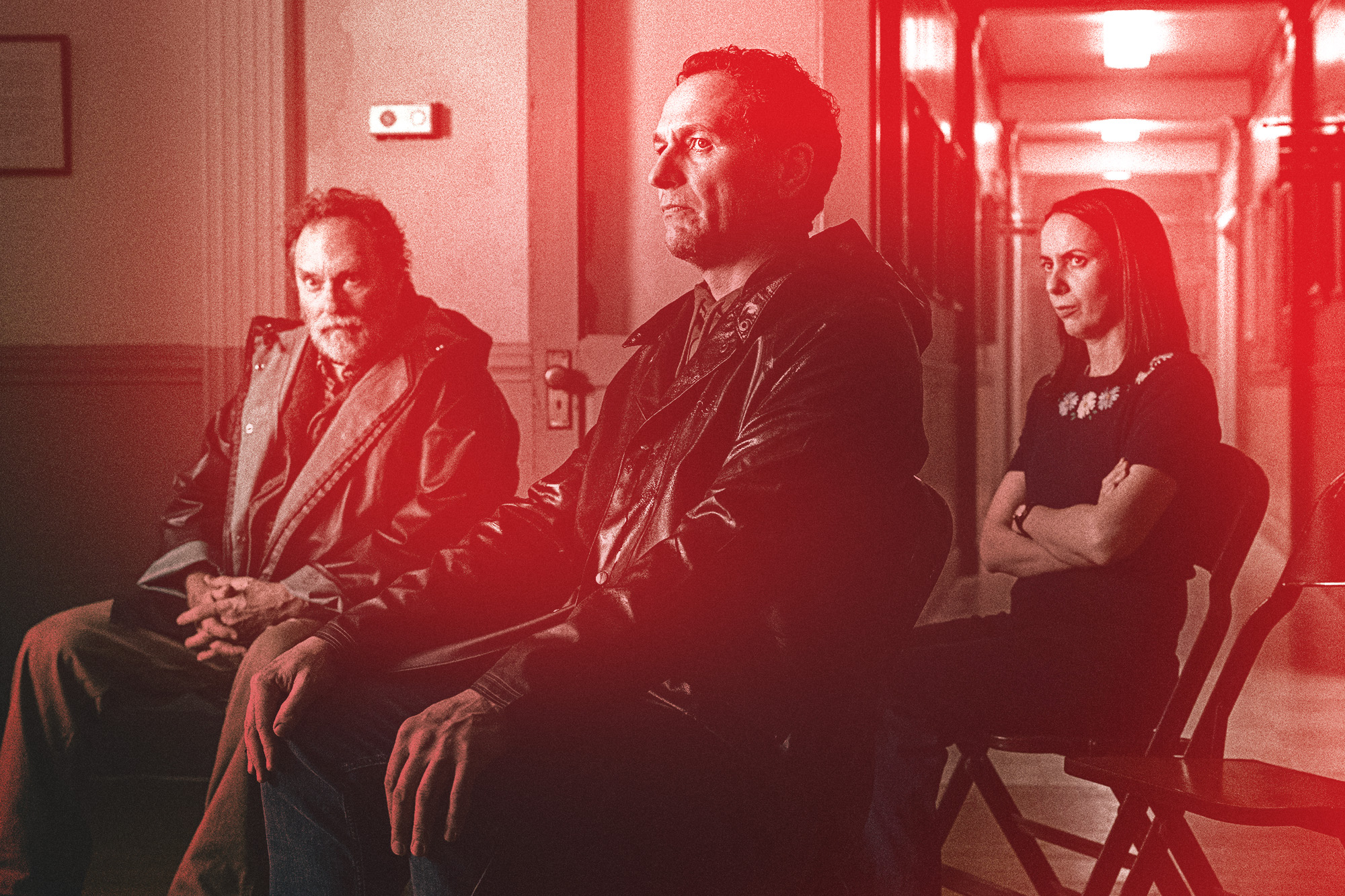
Katie Dippold knows better than anyone that her show Widow’s Bay is “tonally tricky, and it could go off the rails very quickly.” Every single episode of the 10-episode first season, which ended last night on a shocking cliffhanger (good thing the show has already been renewed for a second season), is an example of that tightrope walk of tone. But to me there’s no better way to see it in action than in the third episode, “The Inaugural Swim.”
Matthew Rhys’ Tom Loftis is the mayor of a small, fictional New England island community — which he thinks could be the next Martha’s Vineyard if it weren’t for all the weird happenings and mysterious deaths. By the third episode, Tom has pretty much come to agree with the island’s old-timers (most notably Stephen Root’s Wyck) that Widow’s Bay is cursed, which is why he’s terrified but not surprised when the legendary sea hag comes to his house one night. He’s frozen in fear as she crawls toward him, her stringy hair and black fingernails looking exactly as scary as they would in any horror movie.
Except in Widow’s Bay, Tom’s face of fear is also undeniably funny, even more so when he reclines his chair so the Hag goes crashing into a corner.

The Cardiff, Wales-born Rhys, an Emmy winner for The Americans, swears that in scenes like this one, he’s just following the advice of Hiro Murai, who directed four episodes of Widow’s Bay, including the sea hag one. “There is no tone,” Rhys says Murai told him. “You just play it for real.”
Specifically for the sea hag sequence, Dippold says they really went for it. “I wanted that to be truly scary, because I think the comedy for that should come from Matthew reacting the way he does. But he just can’t help being funny because he’s a naturally funny person. It’s in the human reactions that the comedy comes from.”
The world of Widow’s Bay includes things like sea hags, a slow-walking serial killer called The Boogeyman, a cursed book that leads Kate O’Flynn’s dogged public servant, Patricia, to turn a party into a pagan murder ritual and a blanket of fog that kills. But it also includes some of the funniest jokes on television this year, all of which are born from the specific oddball tone of the show and make almost no sense out of context. Maybe this clip from the second episode, when Tom challenges himself to spend the night in an allegedly haunted hotel suite, can give you an idea:
Dippold, the screenwriter behind Paul Feig comedies The Heat and 2016’s Ghostbusters, has had the idea for Widow’s Bay since she first wrote it as a spec script to get hired as a writer on Parks & Recreation — but it actually goes back even further than that. As a child, she tells me, “we would go to this haunted house on the boardwalk in Long Branch, New Jersey. I love that feeling of being giddy, and that anticipation of getting scared. You’re gonna cover your eyes, and you’re gonna scream, but then you’re gonna laugh. That’s what I wanted the audience to feel going into the show.”
Rhys says Dippold shared that story of the haunted house with him during their early conversations about the show, and he relished the freedom it gave him to play Tom as essentially a haunted-house visitor, along for the ride.
“You are at the behest of something you cannot see or affect or reason with,” Rhys tells me. ”That to me is the ultimate horror story.”
Scary Comedy
Here’s another way to describe the tone of Widow’s Bay, which I have actually used to sell a few people on the show: imagine the absurdly funny town hall meeting scenes on Parks & Recreation, or the huge murals in that show’s city hall office that blithely portray horrifying violence. Now make it all a little bit haunted.
If that sounds too weird to make it on to television, that’s what Dippold, 46, assumed, too. When she decided to pitch the show, “I just wanted to take a big creative swing, and I had heard enough negative things that I wasn’t scared of hearing any more negative things.” Having watched the industry become increasingly fear-based, she was all but certain the show wouldn’t even sell.
But then it did — and with a full series order from Apple. Dippold quickly moved to assemble a writers room and execute the exact risky tone she imagined. “In the writing, it was knowing to be brutal about cutting jokes that would undercut the tension,” she explains. “The risk is that taking out those jokes might make people feel uneasy and not understand what the hell they’re watching. But I believe you’re rewarded by actually being scared and tense — and because that’s what I would want.”
On Widow’s Bay, the comedy and the scares often come from the same place, and no character encapsulates that better than Rhys’ Tom Loftis. As the hapless manager of an office full of oddballs, all played by great character actors like Emmy winner Jeff Hiller and Dale Dickey, Tom has got a bit of Michael Scott’s DNA from The Office, a show Rhys calls “the zenith of what comedy is.” But Tom is also enduring far scarier stuff than most of us could probably handle, and Rhys thinks he deserves more credit for it.
“I’m always telling everyone, ‘He is much braver than you think,’” Rhys, 51, tells me, sounding just a little defensive of this fictional mayor he’s brought to life. “Everyone’s like, ‘Tom’s a coward,’ but he actually goes through a lot.” But because he’s Tom, sometimes what he’s going through — like this moment at sea that went viral — is just a little bit ridiculous, too.
That clip comes from the show’s seventh episode, “Seasickness,” in which Tom and Wyck head out in the ocean to try and dispose of the reanimated corpse of the island’s founder and hopefully end the curse once and for all. (The corpse is played by Hamish Linklater and is also funny, trust me). Many Widow’s Bay episodes riff on specific classic horror stories, from The Shining in the hotel episode to a Halloween riff in which Patricia evades a masked killer. “Seasickness” is the Jaws episode right down to Stephen Root telling a tragic story that sounds a whole lot like the famous U.S.S. Indianapolis scene.
Rhys, a “massive Jaws fan,” says he and Dippold talked about the Spielberg film from the very beginning. He even asked the costume department to make Tom a jacket with anchors on it. (“Too far” was the costume designer’s response.) But “Seasickness” was not exactly his Jaws dream come true.
“It’s frustrating because I don’t get to be Quint!” Rhys tells me. “Stephen Root gets to be Quint. I was like, ‘Am I Brody in this? I don’t want to be Brody.’ And they’re like, ‘Well, you are.’ I don’t look like Roy Scheider! I don’t get to look that cool.”
If Dippold or anyone else working on Widow’s Bay season two is reading, for the record, Tom Loftis would look great in these glasses.
Balancing Acts
To be honest, I’m not sure anything on television is pulling off a tonal balance as impressive as Widow’s Bay, which is both the scariest and funniest thing on television and makes doing both look insanely easy. But we’re living in what might be a golden age of comedies pushing the boundaries of what their tones can be, and Widow’s Bay is at least in very good company.
Earlier this season, I talked with Dan Levy about his new Netflix comedy Big Mistakes, in which two siblings get tangled up with Russian gangsters but also can’t stop squabbling with their boyfriends, their mom and each other. “What if I told you a story that was just as funny as it is thrilling?” was the question Levy asked himself when he started the show, allowing him to craft a family story that is miles from Schitt’s Creek, but just as rewarding.
Also tangled up in criminal mischief, but no less funny for it, is Sterlin Harjo’s FX series The Lowdown, starring Ethan Hawke as a Tulsa-based journalist breaking open a major local conspiracy. The tension ratchets up often on The Lowdown, as it does on the Peacock Cold War spy comedy series Ponies, in which Emilia Clarke and Haley Lu Richardson play two women who form an unbreakable bond even when they’re being tracked by the KGB.
But you still can’t talk about comedies that blur tonal lines without talking about FX’s The Bear, which returns for its fifth and final season in just a few days and is in this year’s Emmy race for its fourth. With Jeremy Allen White’s Carmy continuing to deal with his demons and everyone in the kitchen stressed out all the time, the show frequently makes time for one-off grace notes like the Ayo Edebiri-centric episode “Worms,” or even finding physical comedy in the chaos of running a restaurant. Argue all you want about whether it’s a comedy, but The Bear is still distinct this many years into its run, and will leave an empty spot in television when it’s gone.