
Nicole LaPorte wrote about the pain runaway production inflicts on families, L.A.’s struggling real estate market, the battle over Brentwood Country Club’s barbed-wire fence, the spec script market comeback and how Hollywood DEI is now D-I-E.
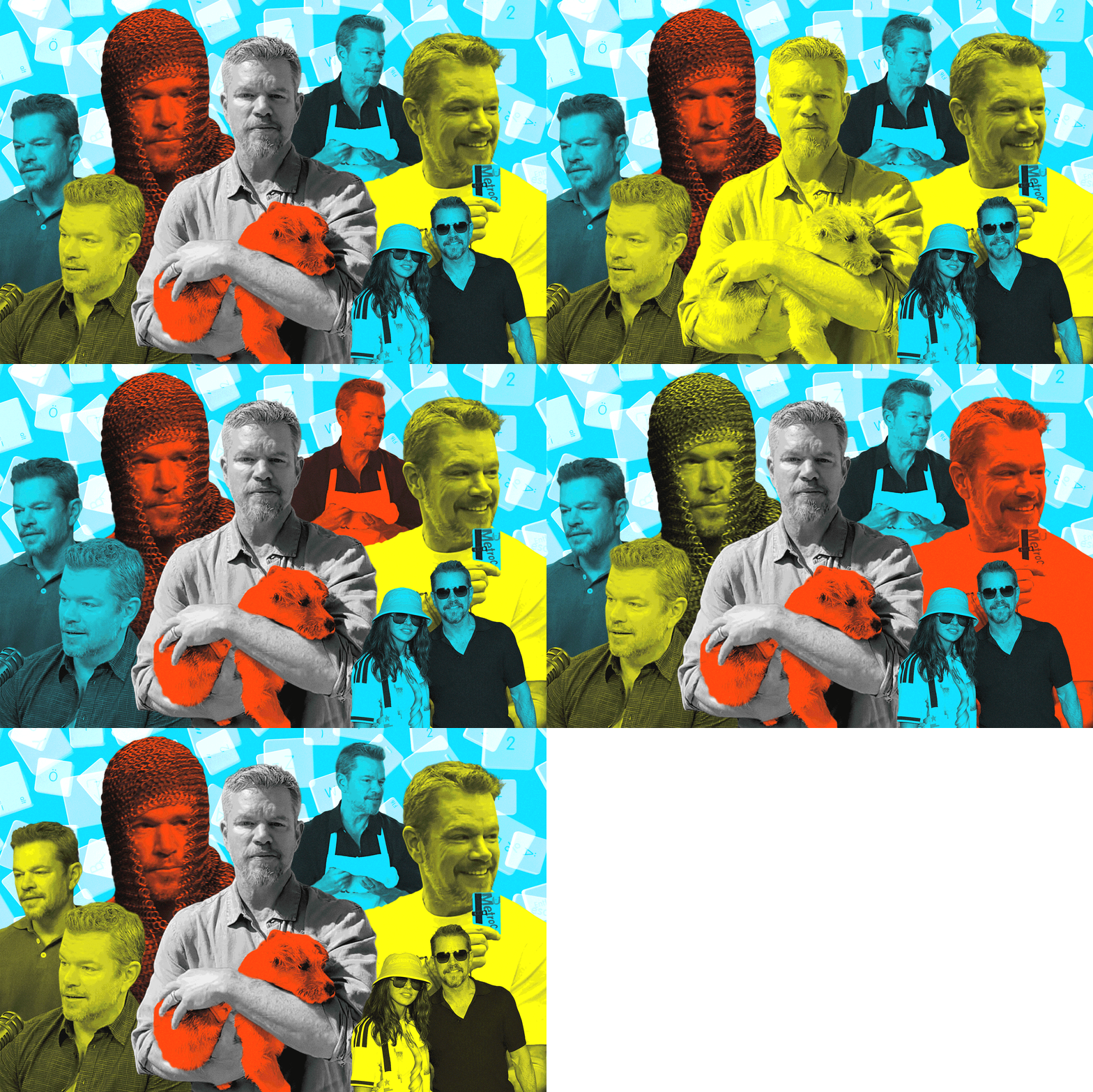
In the weeks leading up to The Odyssey’s mid-July opening, nary an eye was batted as Matt Damon talked about adopting puppies on the TikTok/YouTube channel The Dodo; broke down how he got “jacked” at 55 on the Good Hang with Amy Poehler podcast; dressed up like a knight for Brittany Broski‘s YouTube series, Royal Court; rode around beneath New York City for Subway Takes with Kareem Rahma; and compared notes about journaling with British TikTok star Thomas Duke.
All of this was in addition to the slew of traditional media appearances Damon made (Today, The Tonight Show, ABC News, Entertainment Weekly, etc.) as part of the rollout for Christopher Nolan’s Homeric blockbuster. And all of it, along with media blitzes by fellow stars Anne Hathaway and Tom Holland, plus Nolan himself — who invited TikTok influencer Reece Feldman, a.k.a. @guywithamoviecamera, to set so he could blast out videos during production — helped make the film the biggest cultural event of the summer. After all, despite Nolan’s standing as one of the few directors considered stars, and the A-list wattage of the cast, what share of the TikTok crowd — i.e., the most valuable moviegoing audience — is familiar with, let alone has read, Homer’s epic poem?
The jokey social media appearances brought in viewers who had no idea what they were in for. As one publicist puts it: “Some people don’t know what The Odyssey is, and wouldn’t have gone to see it if they didn’t think it was a weird comedy.”
Cue booking Damon and Hathaway on Royal Court, where Gen Z host Brittany Broski’s 12 million followers tuned in to watch the Oscar winners — outfitted in cheap Arthurian court costumes — gamely answer questions like, “What’s your go-to movie snack?” and “What sound or smell would lure you like a siren’s call?” while sitting attentively on a faux-medieval set.
Fair warning: I started reporting this in June, and the list has already moved. That’s not a caveat; it’s the finding. I wrote for The Ankler a year ago that the traditional press tour had been turned on its head. What nobody realized then was how fast the new order would start eating itself. (Call Her Daddy, anyone? Anyone?) The hierarchy of what matters in Hollywood now resets about every four months, and no one can say why one show curdles and another doesn’t.
When it comes to the gimmicky new stops, studios are “strongly encouraging” talent to make time. “Studios are like, ‘I have an idea, hold these Labubus or whatever’ — which they did for F1,” says the publicist.
The starkest example is who isn’t on this list. Last year the manosphere was the whole conversation — Theo Von, Joe Rogan, the long-form bro sit-down as the way to reach the young male ticket buyer nobody else could find. They remain relevant: Damon and Ben Affleck appeared on The Joe Rogan Experience in January to promote their Netflix film The Rip, and a veteran publicist calls Von’s This Past Weekend “a safe place” with “a broad audience.” Another said: “For the right guest they can have more impact than a bunch of traditional TV appearances because of the depth of the conversation and the loyalty of their audiences.” Nonetheless, their turf is being infringed upon by younger-skewing, red-state media mavens like the Kelce brothers.
As for old-school outlets, which are relied on to complement the more whimsical social media pitstops by adding heft and validation to a project, they’re similarly gaining and losing favor by the nanosecond. The controversies at CBS News since the arrival of anti-woke media impresario Bari Weiss have some publicists steering clear of 60 Minutes, once the go-to platform for in-depth, credential-burnishing interviews ahead of a film’s release. Editorial upheaval at Vanity Fair has further dimmed the magazine’s reputation in an era when being a glossy print publication is already challenging. “Who’s their new editor, again?” asks a former studio publicist. “I don’t even remember.” Nor did the snafu at the VF Oscar bash earlier this year help: Blinding lights on the red carpet made stars look twice their age.

Behind the scenes, drama is escalating. As stars are asked to fill their schedules with back-to-back TikTok and influencer “interviews” involving everything from eating hot wings to belting out tunes in a kitchen, personal publicists and studio marketers are duking it out. The number of influencers, hosts and producers that publicists need to know and build trust with has become both unwieldy and ever-changing — nothing like the days of a relatively stable list of magazine editors, TV news producers and late-night contacts on speed dial. “It’s not like tiny violins,” says the personal publicist. “But a good publicist has serious relationships, and it’s really hard to have relationships in every single sector.”
As for asking their clients to open “blind” boxes of trendy toys, “studios aren’t looking out for someone’s brand or someone’s long-term. Or, to be honest, if someone’s going to look stupid on it. That’s a personal publicist’s job. Sometimes you can push your client outside their comfort zone because you know they can nail it, but sometimes it doesn’t make sense and it’s not going to benefit anyone.”

Studio marketers, meanwhile, can’t understand why not everyone is getting onboard with the new reality of movie marketing. “Some talent are really open to trying something new,” says one. “But the majority are very — I don’t want to call them old-fashioned, but they have reps that want the easiest possible thing for them. And obviously a lot of press in 2026 is not just, ‘Tell me about the movie for five minutes.’”
“We see that even with traditional outlets,” this person went on. “EW or People will come to us now with these new concepts or games or stunts that perform well for them on their platform. But then the talent comes back to us and says, ‘No. It has to be straight three minutes. Straight three minutes.’”
Publicists and studios are also butting heads with influencers who have become stars in their own right with busy schedules and, in some cases, monetary demands in exchange for promoting projects and stars. Brand partnerships with major influencers can cost studios six figures. And even smaller social media players with fewer than a million followers are commanding “fees that are massive,” says the former studio publicist. “That’s where the money is going,” this person adds. “It’s where the talent resources are going and it’s where studios are putting their marketing and PR resources.”
The studio publicist calls the asks “outrageous.” Their argument — one the publicist concedes is a good one — is that with 80 million or 100 million followers, they have a following to rival the talent: “So that’s the other cycle of hell that we’re on.”
So who’s winning in this push-pull? Coming up: the 17 press stops moving the needle right now — and the legacy must-books starting to look wobbly.
Don’t stop here
Get the rest of this story — and the scoops and intelligence Hollywood reads first.
Already a subscriber?