

As you read this, we’re in the midst of our jam-packed final day of interviews here in Toronto, which includes more A-listers stopping by our video and portrait studio as well as my live onstage conversation with La Bola Negra directors Javier Calvo and Javier Ambrossi. (Look out for more of them later this week, too!) Of all the conversations we’re hosting today, I’m most excited to spy on Christopher Rosen talking to Jesse Eisenberg, whose new film, The Debut, brought down the house at its Canadian premiere last night. I’ve seen mid-movie, spontaneous applause breaks at TIFF before, but none as loud and ecstatic as the one for The Debut star Julianne Moore.
Chris and I will talk more about The Debut and the festival’s other recent premieres in our final live festival check-in, happening on YouTube and Substack at 1 p.m. PT. And you’ll hear a lot more from us this evening, when Chris and I will be livestreaming during the entirety of the Primetime Emmy Awards, straight from our couch here in Toronto starting at 4:45 p.m. PT. It’s going to be epic and long — and after several days of non-stop work at a film festival, probably pretty punch-drunk too. Why would you watch the Emmys any other way?
For now, take a look back at some of the fascinating conversations we had in our studio at Soluna Toronto yesterday, along with the gorgeous portraits Austin Hargrave and his team captured. It’s been a joy to watch actors who have been out doing interviews all day really stop and get playful with Austin — I know we’re biased, but he’s photographing the stars of this festival in a way truly no one else is.
Babies: Everything Is Copy
There’s a line in Lauren Miller Rogen’s Babies that will stick with me for a long time: “I guess that’s what being an artist is — making something that sucks, and then making it suck a little less.”
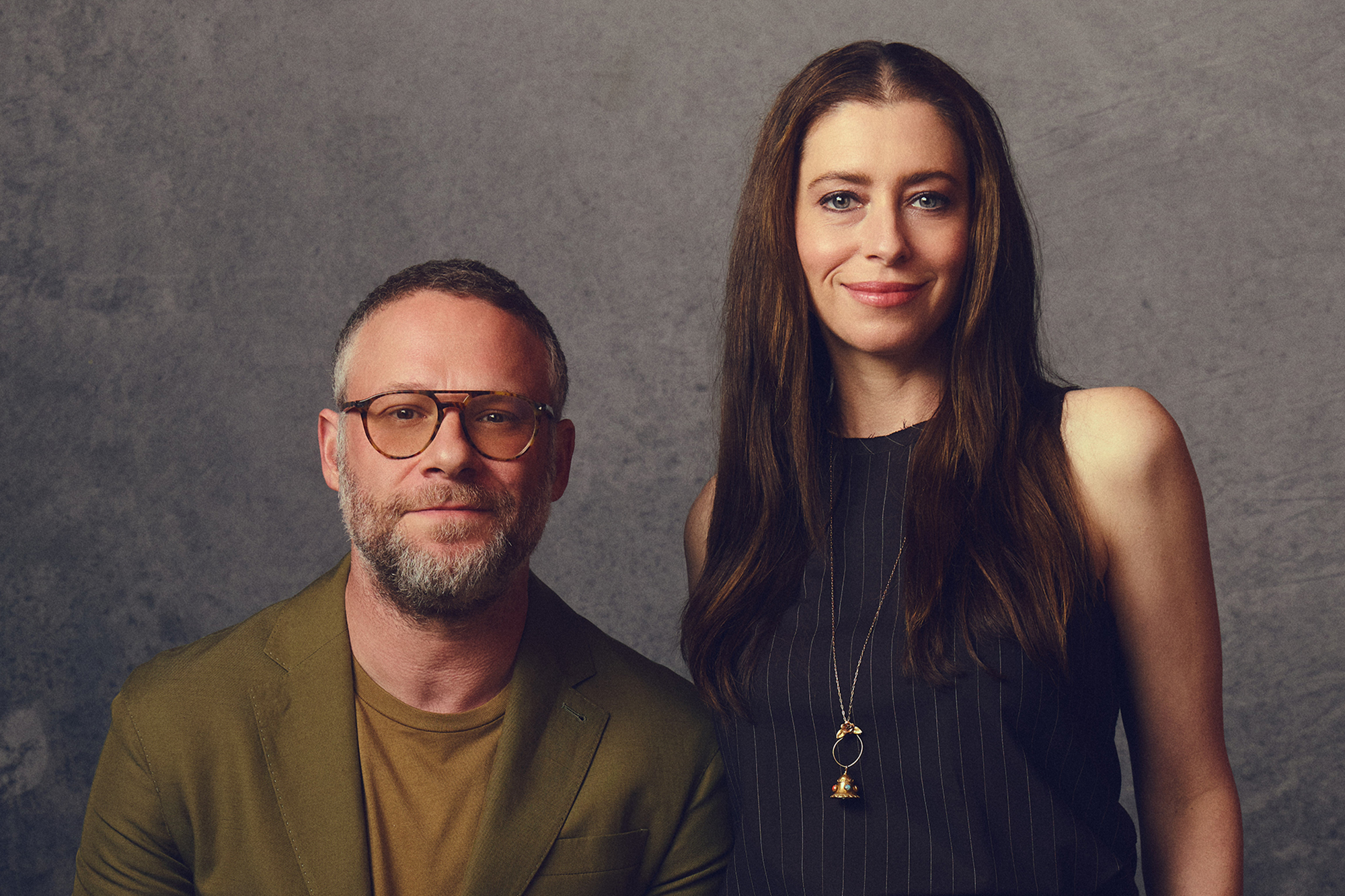
Unsurprisingly, that captures a lot about how she feels about her work as a filmmaker, which this year includes both Babies — starring Anna Kendrick and Miller Rogen’s real-life husband Seth Rogen — and the animated film Tangles, which Miller Rogen produced and will be released by IFC Films later this year.

“I was an art kid, and now I’m an art grownup, and that’s how it goes,” says Miller Rogen, who joined Seth Rogen and Tangles star Abbi Jacobson in our studio. “You just work on something, and usually it’s shit when you start and then you keep working on it, you polish that shit and maybe it gets okay or maybe even good if you get there.”
In both Babies, an autobiographical comedy about a Los Angeles couple pondering the choice to have children, and in the graphic novel adaptation Tangles, a wide range of stars from the comedy world lend their talents to create unforgettable ensembles. “As an actor, this is the exact kind of project that you would long to be a part of,” says Jacobson. “It’s got some of the comedy stuff that I’m known for, and it allows me to stretch into the more dramatic.”
Rogen, meanwhile, says playing an onscreen husband while being directed by his real-life wife is a lot more fun than you might expect. “I really came up on sets that were very familial,” he says, referencing Judd Apatow projects like Knocked Up and The 40-Year-Old Virgin. “I was really brought up in a creative environment where the more personal it is, the more social the set is, the better. It’s so nice that all these years later, I get to keep working with people that I love spending time with.”
Tender Loving Care: A Master’s Final Word
Mike Leigh famously doesn’t make movies like anybody else. He gathers his actors for weeks of conversation, character development and rehearsal, all of them together building from scratch the characters who will then go on to populate his latest screenplay. Leigh makes that process for his new film Tender Loving Care sound easy — “They all are brilliant actors that I know. They are consummate character actors, they’re friends, and I just felt that there are possibilities in the combination that would lead to fruitful results. And that’s all I can tell you, really.”
But the stars of Tender Loving Care — perhaps Leigh’s final movie after 50 years of acclaimed work — make it clear how special Leigh’s process can be.
“There’s a freedom working with Mike,” says Marion Bailey, who stars alongside Alice Bailey Johnson, Paul Jesson and Kate O’Flynn in Tender Loving Care and is also Leigh’s longtime partner. “You always arrive on set knowing so much about your character. You know what they’re thinking. And I’ve not experienced that freedom anywhere else really.”
Darlene Love: Center Stage
The legendary singer Darlene Love says several people tried to make a film about her before she met Barry Avrich, the man behind the new documentary Darlene Love: I Know Where I’ve Been. She was open to telling her incredible life story — background singing on countless hit records, recording hit songs with Phil Spector, even though her name didn’t often appear on the tracks — but the initial problem with Avrich was simple.
“I didn’t know Barry at all, and then I started reading about him and seeing the things that he had done, and I still wasn’t convinced,” Love says of Avrich (Filthy Gorgeous: The Bob Guccione Story and David Foster: Off the Record).
“I had to come to dinner and sing for my supper,” Avrich adds. “And so she would say, ‘This is the audition. What is your vision?’ I said, ‘I’m going to take you back into the recording studio.’ She said, ‘I don’t like that.’ I said, ‘Trust me.’ A couple of bottles of Opus One and we got there.”
Premiering at this year’s TIFF and seeking distribution, Darlene Love: I Know Where I’ve Been is an intimate portrait of a singer who’s routinely cited as one of the best ever — and, yes, Avrich won out: It includes multiple scenes of Love performing at New York’s famed Power Station recording studio alongside a band led by Paul Shaffer. The film tracks Love through her entire life — from her start as a background singer in the 1960s through her struggles in the early 1980s before returning to prominence thanks to the embrace of “Christmas (Baby Please Come Home)” — bringing in family and famous friends like Bruce Springsteen, Dionne Warwick and Nancy Sinatra to discuss her incredible career.

“I know all those songs, but I had no idea that she sang with Elvis Presley. I mean, you name it, she sang with them,” says Taraji P. Henson, an executive producer on the film. “She’s a hidden figure — pun intended. So I’m bringing light to stories that the world needs to know about. Her story is going to inspire the world to never give up because God’s timing is perfect.”
Love featured prominently in the Oscar-winning documentary 20 Feet From Stardom, about the careers of background singers. In fact, she was such an integral part of that film’s success that when it won the best documentary Oscar, Love went up on stage to sing — despite not actually being one of the winning producers.
“Let me tell you something, there’s 20 feet from stardom, and then there’s stardom,” Avrich says. “There’s no 20 feet anymore. This is it.”
The Life and Deaths of Wilson Shedd: Actors’ Director
Actors will often tell you how gratifying it can be to be directed by a fellow actor, but few are as effusive about it as Amanda Seyfried and Scott McNairy, talking about the experience of working with Tim Blake Nelson on his latest directorial effort, The Life and Deaths of Wilson Shedd.
“I have had the privilege of working with really formidable directors, really brilliant people, and Tim Blake Nelson is absolutely number one by a mile,” says Seyfried, who plays a woman teaching creative writing in prison who sparks an unexpected romance with an inmate, played by McNairy. She turned to Nelson and told him, “You’ve helped me find accessibility in my psyche that I didn’t have before I worked with you. It is enlightening. I had three weeks with him, and it just changed so much for me as an actor.”

McNairy, who plays the titular inmate and undergoes some truly harrowing scenes, added that what Nelson gave him was “fucking confidence.” “There’s an unspoken, undeniable trust that’s just there that you can play with. It’s not something I really had with other filmmakers before. He was speaking to me in a little bit different way than other filmmakers.”
Nelson, who has been directing films for 30 years in addition to his acclaimed acting career, spent 12 years trying to get Wilson Shedd off the ground — but as he tells it now, it was worth all the struggle. “I’m so optimistic now,” Nelson says. “Not only for the movie, because I think that we created a better version of the script than I could have imagined, largely thanks to these two actors sitting next to me. But also we are coming out of a period in indie cinema where it was perhaps more difficult to get these movies made than it ever has been. But I think we’re coming out of that now. And I feel like the fact that I finally did get this financed is a harbinger for that.”
The Liberation: Confronting Past Trauma
Oscar-winning filmmaker Guy Nattiv (the short film Skin) didn’t always have the courage to grapple with what happened to his grandmother — a Holocaust survivor living in America who, in the mid-1980s, left her family to join a cult. “Only when I had my two daughters did I feel like I was ready to write it,” he says. Over a decade, with the pandemic in between, he wrote the script for what would become The Liberation, Nattiv’s new drama with Carrie Coon playing his grandmother and Lily James as the cult leader, Rikki, who is much more than meets the eye.
“Guy wrote an extraordinarily beautiful and honest and challenging script, and I was always struck by the lack of judgment and considering this is a personal story, a story about his grandmother,” James says. In conversations with Nattiv, they spoke about Rikki not as a villain, but with understanding and curiosity. “Her core teachings — before they got so extreme — there was something in them that I really responded to, in this question of how do you release trauma? Can you heal?” James adds. “I was so drawn to the extremes to which Rita went, and the bravery she really showed to really follow a path to healing, however that ended up looking.”

Nattiv says no one in his family has watched The Liberation yet (out this year from Bleecker Street), but they will at the right time. “I brought my heart and my soul, and I put it on the table. That’s my family,” he says. “It’s an open wound in my family. So for me, it was also healing.”
A Talent for Murder: Mystery Maker
There’s what you think you know about Patricia Highsmith, the masterful writer of the Tom Ripley novels; there’s what we actually know about her, including that she was “apparently not very nice,” as director Anton Corbijn puts it; and then there’s the mix of fiction and reality that plays out in A Talent for Murder, starring Helen Mirren as Highsmith, Alden Ehrenreich as a book editor trying to get her to write one last Ripley book, and Olivia Cooke as a woman who gets caught up in their stories.

“Part of the joy of it is taking on a big challenge,” says Ehrenreich, who winds up playing Ripley himself in a series of imagined sequences. “That was a big part of the appeal of doing the movie was trying to build two characters simultaneously and figure out the relationship between the two of them.”

As a character who shares scenes with Ehrenreich both in the film’s reality and the new Ripley story, Cooke has her own double act to play, though not quite the same challenge Ehrenreich did. “The deviation between the two characters wasn’t as severe as yours, but it was really fun playing the tonal aspect of the magical realism and exploring the story that Patricia Highsmith and your character are devising,” Cooke says, talking to Ehrenreich. So with less of a heavy lift, was she jealous of her co-star? “No, I was happy,” Cooke answers. “I was chilling.”
All of a Sudden: Real Drama
It’s difficult to wrap your head around Ryusuke Hamaguchi’s All of a Sudden even as you’re watching it. It’s a fairly simple story of a friendship that forms between the leader of a Parisian elder care home (Virginie Efira) and a Japanese playwright (Tao Okamoto), but also a deeply philosophical exploration of caregiving, capitalism, art and life; at one point Okamoto’s character brings out a whiteboard to explain herself, if that gives you an idea of how deep things go.
Efira, a Belgian actress who had to learn Japanese to make the film, says she avoided asking Hamaguchi many of those bigger questions when she first started working on All of a Sudden — “maybe because I was afraid of the answers,” she jokes. Instead she focused, as many actors do, on the script and the answers that could be found within it. “When I read the script, there was so much inside,” she tells me. “There was something mysterious inside it. You have a lot of philosophical things, metaphysical things, theory things, and it produces a physical emotion.”
Okamoto and Efira shared the best actress award at Cannes earlier this year, a tribute to the incredible performances they build together, spanning French, Japanese and English and pages and pages of dialogue. Hamaguchi worked with them to repeat the scripts over and over until they “come in your body,” but also gave them cryptic direction that, Efira says, helped them even if it’s hard to understand.
“He told me, ‘You must ring Tao’s bells,’” Efira explains — and yes, at first she was as confused as you might imagine. She remembers asking, “‘Bells? What’s the bells?’ But he didn’t explain that. So okay, for him, there is a bell. He told us, ‘This bell is two fingers under your belly button near your spine. And you must ring this bell very precisely, very loud.’”
Once you see All of a Sudden, just trust me — you will see them ring that bell.
Gentle Monster: Belief Shaken
In many of these festival interviews, I’ve asked writers and directors about how they learn to trust each other — an essential element of any good filmmaking partnership.
But it seems especially essential for Netflix’s Gentle Monster, a movie that not only requires a powerhouse, deeply vulnerable lead performance from Léa Seydoux, but is about the act of trust. The new movie follows a woman who learns that her husband has been charged with an unthinkable crime.
“It’s such a big part of my job, to work with actors and to learn what they need,” says Gentle Monster writer and director Marie Kreutzer. “What I really need an actor to be is in the moment, and to trust me and trust the camera to see everything. And Léa is so amazing at that.”

Seydoux credits Kreutzer with creating the space she needed to dig deep for her performance — and to close herself off when needed as well. “When I’m doing those scenes, I need to be extremely focused— and I can get embarrassed as well, which is something very personal,” Seydoux admits. “But when I have to express so much emotion in a scene, I need to close myself in a way. But apart from that, with Marie, it all felt very natural.”


Comments
Only Ankler All Access subscribers can comment
Already a subscriber?