

Thanksgiving week is here, which means Hollywood is finally slowing down — and awards voters are running out of excuses not to tackle their screeners. Before everyone disappears into turkey and travel and tryptophan, I have one request: Please don’t let some of the year’s best movies get lost in the shuffle!
The Oscar conversation has a way of narrowing around a handful of favorites. But some of the year’s most rewarding performances and films are still fighting to be seen. Yet there’s reason to hope they won’t be entirely overlooked.
Take the newly announced nominations for AARP’s Movies and TV for Grownups Awards — recently renamed to include TV and still making some of the best choices of any awards show.
To that point: The inclusion of Quincy Tyler Bernstine — the cynical heart of Hulu’s breakout hit Furious — thrilled me, as did the multiple nominations for Mike Leigh’s Tender Loving Care, including star Marion Bailey in the best actress mix alongside more expected contenders like Julianne Moore for The Debut and Sophie Okonedo for Clarissa.
Hopefully, these nominations are just one more nudge as voters in many different groups dig into their screener piles (well, mostly screener apps these days, though shoutout to Neon for continuing to send its gorgeously packaged box of discs every year).

I’ve been writing in this newsletter for weeks about what I think you ought to see. But with the long holiday week, consider this one last round of friendly harassment.
Here are three titles I want to draw your attention to — and why they deserve a place at the top of your queue:
- Mouse (IFC Films): Directors Kelly O’Sullivan and Alex Thompson nail every detail in this coming-of-age drama about a teenage girl (Katherine Mallen Kupferer) who forms an unlikely bond with the mother of her vivacious best friend; the mother is played by Okonedo, who is having one hell of a year.
- All of a Sudden (Neon): Yes, this Ryusuke Hamaguchi film is three hours long and includes an already memed scene in which one main character pulls out a whiteboard to explain capitalism to the other. But the talky drama about unlikely connection and end-of-life care makes the most of that runtime, building cumulative power and linking its stories into one of the best endings of any film I’ve seen all year. There’s a reason Virginie Efira and Tao Okamoto shared a best actress prize at the Cannes Film Festival, and I expect that once the major critics’ groups start handing out prizes, people might take their potential Oscar nominations a bit more seriously.
- Josephine (Sumerian Pictures): With Channing Tatum and Gemma Chan in lead roles, this should be starry enough to cut through the awards-season chaos. But Beth de Araujo’s somber film about a young girl witnessing a horrible rape is not the easiest watch. It’s also canny and emotionally rewarding, anchored by the lead performance from 10-year-old Mason Reeves and de Araujo’s thoughtful depiction of how what we witness as children can linger with us in surprising ways.
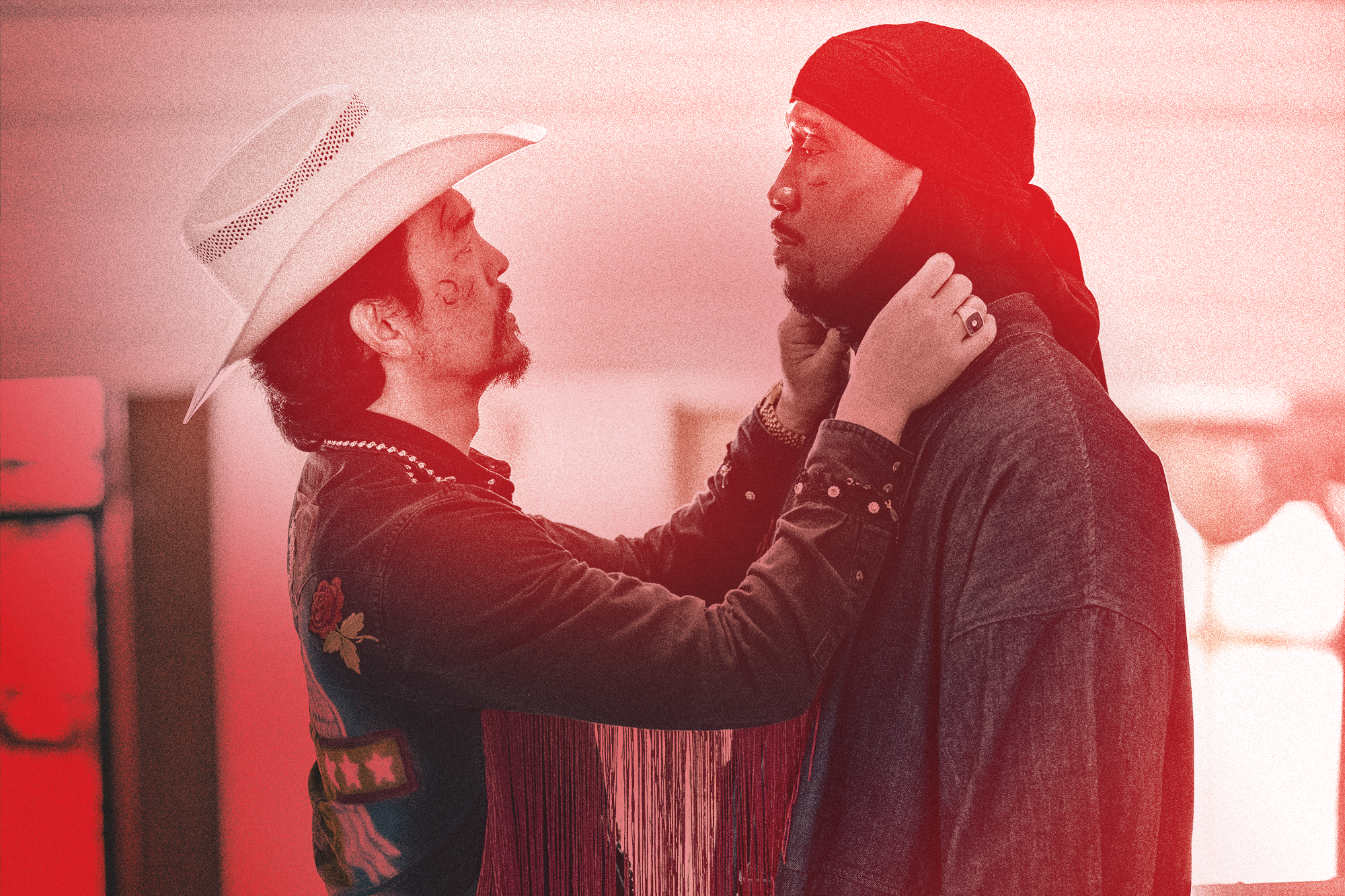
And then there’s No. 4, Your Mother Your Mother Your Mother, a movie that may be the most gloriously under-appreciated awards contender of them all this season: Mahershala Ali as a devout Muslim father, grieving widower and lethal hitman who knows his way around a samurai sword.
Mother of a Movie
Your Mother director Bassam Tariq has heard from a lot of people about his film, which Amazon MGM brought to theaters in late September and has also been making the fall festival rounds.
What stands out to him most, he says, is what people aren’t asking him about.
“People are actually understanding the craft of it, and they’re getting past the representation conversation, because I’m a bit tired of that,” Tariq, 40, told me in Los Angeles last week, just before I joined him for an onstage Q&A following a screening of the film. “They’re first to talk about the way Kate Arizmendi shot the movie. They’re talking about the editing of Cam McLauchlin. So it gets me really excited that’s what we’re talking about, and we’re not just stuck on like, ‘Wow, it’s so great to see Muslims in America.’ It’s like, ‘Okay, yeah, we did that too.’”
Tariq, who spent the first part of his childhood in Queens, New York, and the second part in Houston, set Your Mother Your Mother Your Mother within Houston’s Muslim community because, as he puts it, “this is the world that I come from.” But he also makes phenomenal creative leaps within the city he recreates with immaculate, loving detail. Ali, whose collaboration with Tariq first began on their ill-fated Blade superhero film, plays Latif, who battles through the city to help keep his family together. His foes include underworld figures who could plausibly exist in the real world, as well as a gloriously over-the-top church leader and Army veteran, Pastor Hwon, played by John Cho.
“There’s something very lawless about Houston,” Tariq says, with evident affection. “You can get away with a lot. There’s a very Western quality to it.” That lent itself to huge action sequences — Latif tangles with Pastor Hwon in the former strip club he’s transformed into a church, as well as a McMansion full of parishioners armed to the teeth — and to the sense of different sects establishing their own rules. Though the primary plot tension is between the Muslim Latif and the Christian Hwon, Tariq’s film is less about a millennia-old religious conflict than the turmoil within the characters.
“As American filmmakers, we have this tried and true thing of people contending with faith and then having some element of their hands in crime as well,” Tariq says. “Look at Martin Scorsese films, or Francis Ford Coppola. When you start to see that this is part of that same tradition, then people go, ‘Okay, cool. We get it.’”

A father mourning the recent death of his wife and now struggling to raise three kids, including an infant who has been exclusively breast-fed, Latif is dealing with a different set of challenges than, say, the angry young men of Scorsese’s Mean Streets. That’s one of many things that gives Your Mother Your Mother Your Mother its rich emotional texture: a story Tariq says he initially imagined as about a father and daughter, with Latif slowly allowing his teenage child, Fatiha, to see more of the truth about his life.
“I think Christopher Nolan even talks about this, that the audiences are smarter than we give them credit for,” Tariq says. “I do think audiences are super intelligent, and you can throw them into a world as long as they can understand the very human relationship that’s at the center of it. And it helps to have great actors.”
Tariq credits casting director Susan Shopmaker — “a brilliant, crazy, chaotic person that gets really into the weeds of everything” — for helping him find the mononymous Adia, who earned a Gotham Award nomination for playing Fatiha, and Abubakr Ali as Hatty, the swaggering nephew of Latif’s boss who is making “halal porn” and gets in Pastor Hwon’s pious crosshairs as a result. Ali’s casting is yet another argument for the death of the self-tape audition. “I didn’t like his first performance on his tape,” Tariq says. “Susan was like, ‘You need to really spend time with him,’ so I said, ‘Okay, I’ll bring him back.’ And he stole my heart.”
He also got a self-tape audition from Cho, the actor’s first in 20 years, according to Tariq. With a long career spanning American Pie, Harold & Kumar and the Star Trek franchise — plus appearances in basically every great TV comedy of the century — Cho makes an impression in almost everything he’s in, which is exactly why Tariq wanted him to play a character as wild as Hwon. “John’s fucking stellar, and in anything I’ve watched him in, he gives a damn, and he makes really strong choices,” Tariq says.
Shortly after our conversation, I joined Tariq onstage with many of the people he’d just been praising — Abubakr Ali, Cho, and Mahershala Ali, who all shared stories about the commitment it took to pull off Your Mother Your Mother Your Mother’s intense action sequences as well as the inner bedrock that makes all of these characters work. Given the film’s relatively small theatrical footprint — it topped out under 1,000 theaters and hasn’t yet been released internationally — it was a joy to watch an audience process what they’d seen in real time, hanging on every word from Mahershala Ali (who can blame them?). With three Gotham Award nominations and possibly more critical attention next month, I’m hopeful the distinctive film will get more attention. But it’s on you to actually watch it.



Comments
Only Ankler All Access subscribers can comment
Already a subscriber?