


I wrote about Ari Emanuel’s bulk sales, private equity buying authors’ publishing rights and John Green’s first novel for adult readers. Subscribe to The Optionist, my weekly list of available IP.
A Thanksgiving treat: Today’s feature is free for everyone, and it’s a deliciously revealing look at Hollywood’s new memoir business, where Michael Douglas, Sylvester Stallone and Ari Emanuel are discovering the steep price of selling a bestseller. Consider it a little holiday reading — and perhaps some inspiration for your gift list.
Speaking of gifts, if you’re still not a paid subscriber to The Ankler, now is the time to treat yourself to an upgrade — because through Dec. 1, we’re offering 20 percent off annual subscriptions. Click here or use the code GIFT2026 for full access to all of our great journalism, the no-spin intel Hollywood runs on.
Hollywood spent decades creating stars whose names alone could sell movie tickets — and whose elusiveness was part of their mystique. Now, in an era of diminishing roles and fragmented audiences, those same stars are discovering that selling their own stories requires a completely different kind of performance. The old Hollywood playbook was to preserve the mystery. The new memoir playbook is to give it all away, even if that means borderline humiliating yourself.
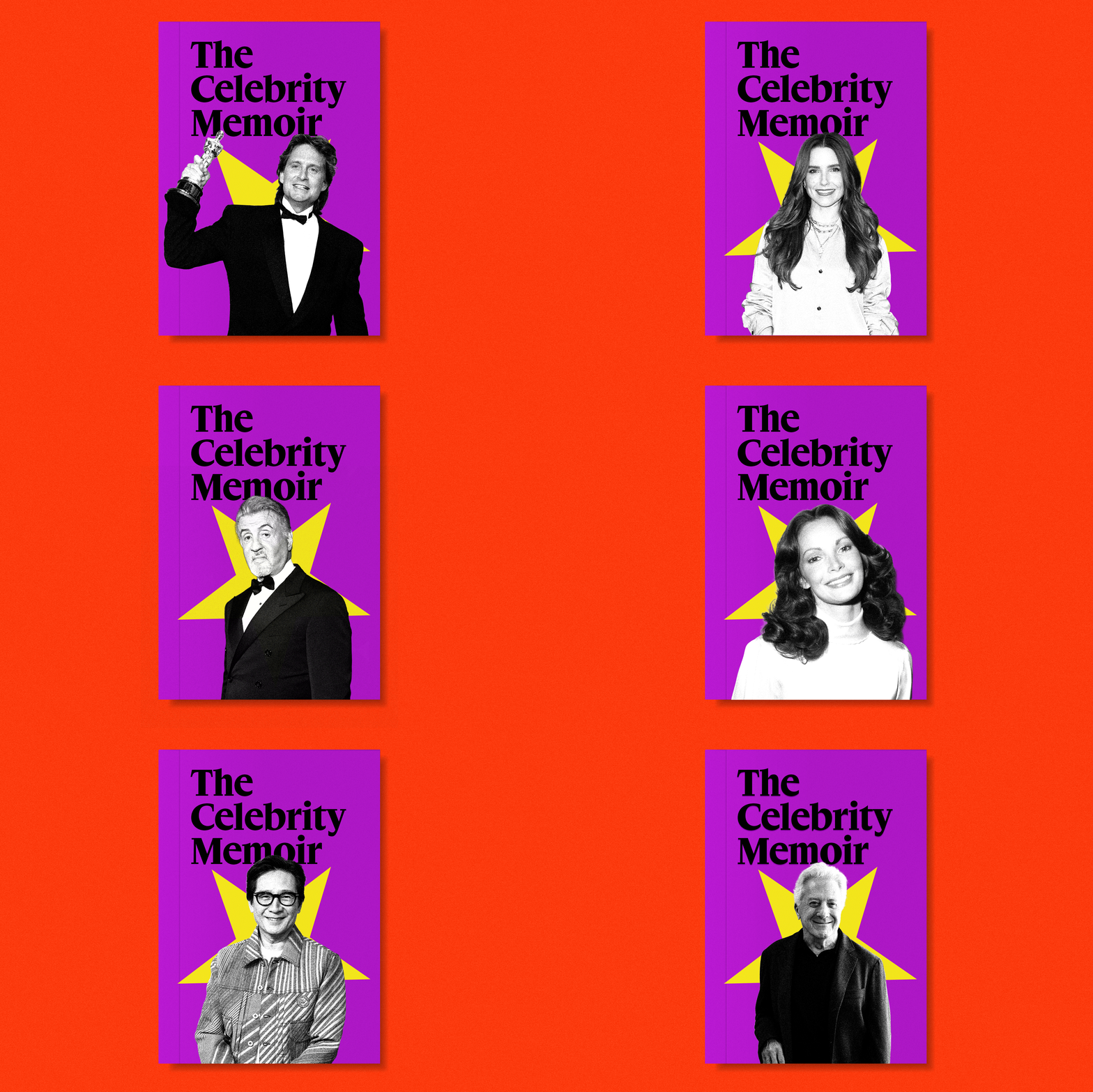
Judging by this fall, plenty of them are willing. No fewer than 18 Hollywood memoirs have hit the shelves so far, including ones by Jaclyn Smith of Charlie’s Angels fame, Oscar winner Ke Huy Quan, super-agent Ari Emanuel and One Tree Hill star Sophia Bush. Dustin Hoffman’s Look at Me and a posthumous memoir from Peter Bogdanovich both arrived earlier this month.

But the biggest winners have been two octogenarian A-listers: Sylvester Stallone, with Steps, and Michael Douglas, with One Helluva Ride. Both debuted at No. 1 on the New York Times hardcover and combined print and e-book nonfiction lists — Stallone’s on Sept. 29, Douglas’ a week later. The Times list isn’t a pure sales ranking, but Circana BookScan, which tracks about 80 percent of hardcover sales, agrees: Each was the bestselling nonfiction book of its debut week, with about 40,000 copies for Stallone and 20,000 for Douglas. Both remained on the Times’ combined list for more than a month.

Their success shows what the new playbook demands. Social media has already stripped celebrity of much of its mystery and flooded feeds with influencers narrating every intimate detail of their lives. To compete, a star’s memoir has to be more revealing and better written — “authentic” is the buzzword agents and ghostwriters use — and the star has to be willing to sell it. Everywhere. That’s what it takes to earn back the seven-figure advance an A-lister can command (more on that below), and to keep a book in the conversation long after launch week.
For Stallone and Douglas, age is what got them talking. Stallone said in a social-media post that turning 80 the same year Rocky turned 50 prompted him to tell the story of those early days, something he called “almost a secret.”
Douglas, 82, told British TV host Graham Norton that he “just thought it was about time” to consider his legacy and the combined eight decades he and his late father, Kirk, had spent in Hollywood. Then he joked that the “real reason” was his fading memory: “I realized the only things that matter are your friends, your family and what you remember. So I’m doing this whole process of going back so I’ve got a whole bunch of new memories to keep in my mind for at least a day.”
Age may be an advantage at the register, too. Full lives have full stories to tell. More important, their fans are the people who still buy hardcovers — and, as one publishing insider notes, younger readers will pick up a book about an older star far more readily than older readers will about a younger one.
The Dirt: How Much Is Enough?

A celebrity memoirist has to deliver — or, as former Knopf executive Paul Bogaards puts it, “bring the pizza.” Shane Salerno, whose agency, The Story Factory, brokered Douglas’ book deal and who co-wrote the book with Douglas and entertainment journalist Mike Fleming, says One Helluva Ride worked because it gave people something “they haven’t read in People magazine for 30 years.”
Douglas figured that out quickly. His first impulse, he told Norton, was to do something actorly, a “workshop” book on craft. “But then the producer in me said, ‘Let’s just go for the dirt — sex, drugs and rock and roll.’” Out came seven decades’ worth of secrets: his own Mrs. Robinson moment with a friend of his mother’s; previously undisclosed on-set affairs with Romancing the Stone co-star Kathleen Turner and Basic Instinct’s Jeanne Tripplehorn, nearly 20 years his junior; drunkenly insulting Julia Roberts when he thought she was hitting on his 13-year-old son, Cameron; and snorting cocaine with O.J. Simpson at Jann Wenner’s apartment.
CAA literary agent Cait Hoyt says the same instinct to tell all drove her client Bush, whose And I Will Tell You Mine debuted atop the Times hardcover nonfiction list last week and was the fourth-bestselling nonfiction book of the week, per BookScan. Bush writes about her marriage to One Tree Hill co-star Chad Michael Murray and his infidelity, a set she describes as toxic at Chicago P.D. and the rumors that she cheated on then-husband Grant Hughes with her now-partner, soccer star Ashlyn Harris. “People thought they knew a version of the story because of social media or gossip,” Hoyt says. “And to hear it firsthand… that’s an intimate experience.”
And if you think Douglas and Bush are oversharing, they’re in very good company. The past decade has accelerated the tell-all industry, with everything from frostbitten royal body parts to Hollywood’s most intimate marital secrets. Apparently, there’s no such thing as TMI when you’re trying to sell a bestseller.
A Decade of OMG Moments
Demi Moore, Inside Out (2019) → Agreed to threesomes to please then-husband Ashton Kutcher, who she says later cheated on her
Matthew McConaughey, Greenlights (2020) → A dream about floating naked down the Amazon sent him on a real-life trip to Peru
Matthew Perry, Friends, Lovers, and the Big Terrible Thing (2022) → His colon burst after years of opioid abuse, leaving him in a coma; at one point he was taking 55 Vicodin a day
Jennette McCurdy, I’m Glad My Mom Died (2022) → Turned down $300,000 in hush money from Nickelodeon to remain quiet about the creepy behavior of a producer she refers to as “The Creator”
Prince Harry, Spare (2023) → His frostbitten penis (treated with Elizabeth Arden cream), losing his virginity behind a pub and a mushroom trip in which a toilet talked to him
Jada Pinkett Smith, Worthy (2023) → She and Will Smith had been separated for years — including the night he slapped Chris Rock
Britney Spears, The Woman in Me (2023) → Had an abortion while dating Justin Timberlake, who she says didn’t want to be a father
Elliot Page, Pageboy (2023) → Before Page transitioned, a well-known actor approached Page at a party and said, “I’m going to fuck you to make you realize you aren’t gay.” Also revealed a secret romance that same year with Kate Mara, who was then dating Max Minghella
Has the ante really been upped, though? Byrd Leavell, co-head of the publishing department at UTA, isn’t so sure, noting that the tell-all has been around for decades — from 1978’s Mommie Dearest, Christina Crawford’s OG tell-all, to 1990s classics such as Julia Phillips’ juicy You’ll Never Eat Lunch in This Town Again and Drew Barrymore’s shocking Little Girl Lost. What’s different, he says, is that “the way media is consumed now is a totally different thing.” On TikTok and Instagram, a revelation gets clipped and recirculated, keeping it — and the book — in the conversation longer.
The Story: Why Dirt Isn’t Enough

Today’s memoirs are also better written. Everyone points to the influence of Andre Agassi’s 2009 memoir Open, ghostwritten by J.R. Moehringer, who went on to write Shoe Dog with Phil Knight, Spare with Prince Harry and this fall’s Roll the Calls with Emanuel. “Andre Agassi’s memoir changed the genre’s intellectual trajectory,” says Bogaards. “Agassi’s book was a revelation in terms of its transparency and candor. It was also exceptionally well-written. Celebrities read that and were like, ‘Man, Andre came down with some hard truths. I want that for me.’” Open sold more than 500,000 copies in its first year.
Better writing also means knowing which stories to tell. Leavell, who represented Stallone on Steps, says a memoir has to be more than an exercise in ego or a recitation of “this happened, this happened, this happened, this happened.” For Stallone, that meant focusing on just a slice of his life, from 1969 to about 1978, when he went from early roles like an unnamed character in Downhill Racer to starring in Rocky. As Leavell says, “He wanted to tell the story of the struggle” and “he wanted to make them feel it.”
Feeling it meant painful stories: his fraught relationship with his parents, stretches of homelessness and being so broke when he got married that he wore the costume from a movie he’d been an extra in because he couldn’t afford a suit. He also leaned into the nerve-racking stretch of turning down life-changing money again and again until United Artists agreed to let him star as Rocky Balboa in his own screenplay about a journeyman fighter whose trajectory mirrored his.
Emanuel’s Roll the Calls shows how much of a difference good writing can make, especially in contrast to this season’s other big book by an executive, former Disney boss Bob Chapek’s Behind the Castle Walls. Emanuel got Moehringer on board as ghostwriter and offered lots of dish. Chapek, on the other hand, spent a lot of time on his Indiana boyhood and left more unsaid than said about his conflicts with Bob Iger and what went wrong during his tenure at the top of Disney.
The care extends to the audiobook. Most celebrities now narrate their own, including Douglas and Bush, but Stallone brought Hollywood production values to his. He got Rocky composer Bill Conti to write an original piano score for it, which also includes a snippet of the movie’s famous theme, the brass-driven “Gonna Fly Now.”
The Dollars: What’s a Hollywood Secret Worth?

Spilling it all can pay, though mostly for the A-list. A few outlier deals — a reported $15 million for Britney Spears, $20 million for Prince Harry — distort the picture. One agent who has represented multiple high-profile memoirs says even $4 million or $5 million deals happen only once or twice a year; the going rate for an A-lister is in the low seven figures. Below that tier, the money falls off fast, with the best of the rest getting low- to mid-six figures.
And the money depends on the candor. Editors will make those big bets, the agent says, only if they believe the star is truly committed — to being revealing and to promoting the book once it’s out.
The reported $2 million Emanuel got for Roll the Calls is about the ceiling for anyone who isn’t on camera, whether an agent or an executive. A good chunk of it likely went to Moehringer, the most sought-after ghost of the moment, who reportedly got $1 million for Spare.
Will these books earn back their advances? Many won’t, and publishers can still do fine. Stallone’s advance for Steps hasn’t been reported, but say, for round numbers, it was $1 million, on a book with a list price of $32.50. At a standard 15 percent hardcover royalty, Stallone earns about $4.80 a copy, so he’d need to sell roughly 210,000 hardcovers to earn out. The publisher, though, keeps about half the list price on each copy — roughly $16 — and after about $6 a copy for printing and warehousing, it has covered that $1 million at around 100,000 copies, a number Steps should reach by Thanksgiving. At that point Stallone is still less than halfway to earning out, and that’s before counting audiobook, e-book and eventual paperback sales.
The Hustle: CBS Sunday Morning to Joe Rogan

That hustle has become ever more important. In today’s fractured media landscape, Leavell says, there’s “no more one big thing” that can sell a book. The perennial stops — CBS Sunday Morning, Fresh Air, the network morning shows — still matter, especially for the first week, but less so than before. To motivate buyers, a book has to cut through the noise on social media and “win the battle against the phone” on a constant basis. That means going everywhere, for weeks.
Matthew McConaughey wrote the playbook with his bestselling 2020 memoir, Greenlights. At the height of the Covid pandemic, he appeared on basically every major podcast, from Joe Rogan to Marc Maron to Tim Ferriss, on the way to selling more than six million books.
Emanuel ran the same play. He was everywhere, from The Wall Street Journal and PBS NewsHour to live appearances with everyone from Kara Swisher to Rachel Maddow, and the book broke through. As I reported, Publishers Weekly declined to rank it because of potential bulk buying; still, in one form or another, it sold 17,397 copies during its launch week, per BookScan. Chapek sold fewer than 2,500. Behind the Castle Walls sits at No. 21,736 on Amazon’s book-sales ranking; Roll the Calls is at No. 2,837. Chapek’s media tour was more modest, heavy on print and mainly in the business press — The Wall Street Journal, Bloomberg – with his highest profile on camera hit an appearance on CNBC.
Douglas took a similar approach. In addition to the usual TV hits — The View, Good Morning America, Jimmy Kimmel — and a magazine cover (People, in this case), Salerno says, “We did Graham Norton. We did Joe Rogan. We did Conan O’Brien. We did SmartLess.” He says the different outlets “sold the book in different ways” that weren’t always predictable. “The things that we were told were going to be tsunamis were not, and the things that some people dismissed were tsunamis.” (He declined to share specifics.)
Stallone did extensive promotion too, including flying to London to sit on Norton’s couch, a booking that, Salerno says, moved books in both the U.K. and the U.S. Leavell points to Stallone’s out-of-the-gate appearance on the New York Times podcast The Interview with Lulu Garcia-Navarro as “setting the tone for the whole launch, because he put himself out there in this unbelievable way.”
A strong start matters — “you’ve got to launch it like a flare across the night sky,” Leavell says — but so does keeping a book from being a one-week wonder. A star’s own social media can help with the launch, he says; after that, it’s podcasts and traditional media that keep the conversation going.
“A dose of this, a dash of that,” Leavell says. “It’s hard to get people to buy a book,” and “even in 2026 the most powerful thing of all is word of mouth.” Which brings things full circle: The same social media that pushes stars to reveal more is what sells the books, turning those reveals into viral clips — the 21st-century version of word of mouth.
With Hoffman’s memoir out earlier this month, the list of big stars nearing the end of their careers who haven’t written one — the last holdouts of the old playbook — is getting short. Now that the holiday shopping season is underway, publishers are hoping the latest crop of Hollywood confessions will find their way under Christmas trees. And there are still a few stars whose secrets remain tantalizingly out of reach. Meryl Streep has yet to write her memoir. Harrison Ford, Leavell says, would be his dream client.
For now, Hollywood’s aging icons are discovering that the mystique they spent decades protecting may be their most valuable remaining asset — provided they’re willing to give it away.

Comments
Only Ankler All Access subscribers can comment
Already a subscriber?