

Brad Ingelsby jokes that he’s stuck living in Pennsylvania’s Delaware County — nicknamed Delco — whether or not he wants to be there. “It’s not leaving me,” the Emmy nominee says.
But it wasn’t a given that Task — Ingelsby’s follow-up series to HBO’s Emmy-winning limited series Mare of Easttown — would also be set in the same southeastern corner of Pennsylvania, where the writer grew up and now lives full time.
“There were definitely some ideas I had post-Mare that were not here in Delco,” he tells me in a recent Zoom call from his Delaware County office, where he’s at work on the second season of his latest HBO hit. Still, when Ingelsby, 46, started thinking of the characters who would become the focus of Task’s first season, he knew he had something. “You have ideas you’re more connected to, and you can just tell right away how deep you’re going with the characters,” he says. “And a lot of it was just talking to my uncle.”
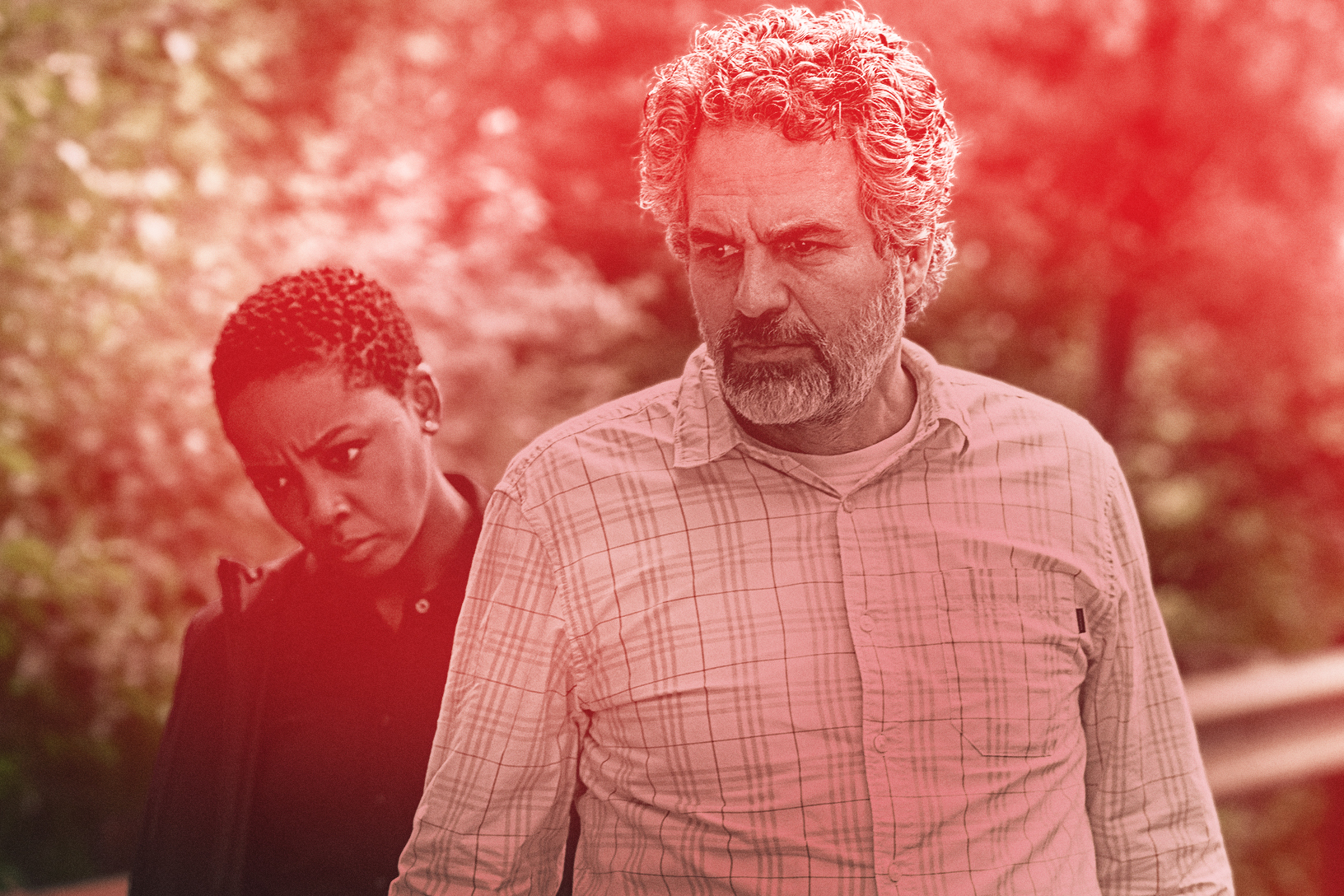
Ingelsby began imagining his uncle, an Augustinian priest who eventually left the church, in conversation with his great-uncle, a priest who was “a very tough, rigid Catholic.” But Ingelsby didn’t make a show that’s precisely about priests; Task, which debuted on HBO in the fall, stars Mark Ruffalo as Tom, a former priest who becomes a leader of an FBI task force, and Tom Pelphrey as Robbie, the sanitation worker who robs drug houses and eventually finds himself in Tom’s crosshairs. Once Ingelsby had created Tom and Robbie with his relatives in mind, the next question was simple: “What is an excuse to tell a story about this character?”
After building Mare of Easttown around a whodunit mystery, with Kate Winslet’s Mare on the tail of a kidnapper, Ingelsby knew he needed a different structure for Task. But he was still happy to embrace the mechanics of genre to tell the bigger story he had in mind for Tom and Robbie.
“I wrap my arms around the genre,” says Ingelsby, whose screenwriting career includes the Liam Neeson crime thriller Run All Night and last year’s 2018 Camp Fire drama The Lost Bus. “It’s always a balancing act of trying to embrace the expectations that an audience brings and looking for areas to subvert them. But I love the set pieces, I love the cliffhangers. I want to make those things really exciting and yet also in between there explore these ideas of faith.”
Both Tom and Robbie spend the first season of Task grappling with recent losses within their families and struggling with how to move forward — Tom throws himself into work with the FBI, while Robbie robs drug stash houses, eventually revealed to be connected to the biker gang responsible for his brother’s death. Though they’re on opposite sides of the story, their journeys are so parallel that the audience is itching to see them finally collide — as they do at the end of the fifth of the season’s seven episodes. What comes next is an unbelievably tense shared car ride, an explosive action sequence and a plot development Ingelsby admits he’s gotten some grief about — “but I think audiences want to be surprised.”
But that element of surprise is crucial, Ingelsby says, not just for unraveling the mystery at the center of Task’s story but the characters who populate it. “You have to be very strategic about the order of information,” he explains. “It’s not just what do we want an audience to know about a character— it’s when do you reveal those things and how do you pace it out so characters are constantly surprising an audience.”
So even though Task is just as driven by genre plotting as Mare of Easttown was, Ingelsby noticed the feedback on season one focused much more on the characters — Tom and Robbie in particular — than on the unfolding story. “Obviously we didn’t have the mystery element as we did in Mare, and I think that’s a super sexy thing that draws a lot of people in,” he says. “But I think the setup that we have latched onto [with Task] is a cops and robbers story, but one where you want the cop to get the robber, and you want the robber to get away.”
That means that, yes, like basically every other filmmaker of his generation, Ingelsby was taking inspiration from Michael Mann’s Heat, which stars Robert De Niro as a thief and Al Pacino as the detective on his tail. If it feels like a familiar concept, Ingelsby sees that as a good thing. “We’re tapping into something that an audience can latch on to,” as he puts it. “They’ve seen these stories before, and then we’re telling it in a slightly different way.”
American Dream
The second season of Task, with Ruffalo returning opposite new stars Mahershala Ali and Harry Melling, was announced last fall after the first season aired. Call it a surprise. Many viewers, myself included, had assumed Task would be a limited series like Mare of Easttown — especially given how it ended. But as he did with season one, Ingelsby figured out the second season by starting with the characters.
“I think my worry with the second season, especially one that was built as a miniseries, is what’s left emotionally?” he says. “I know there’s some procedural thing we could drag in. There are so many stories — and we have so many tech advisors we talk to — that if I got in a room with those guys, we could come up with a plot that was interesting. I hate to say this, but I’m not that interested in the plot engine of things as much as I am in the emotional lives of the characters.”
Emotionally rich characters, fascinating plots and a Delaware County setting — sounds about like what we’d expect from a Brad Ingelsby show at this point. Though Ingelsby is currently the only showrunner laser-focused on this precise corner of America, Task is one of many dramas in this year’s Emmy race that benefits enormously from having a very defined sense of place, whether the well-trod sidewalks of Hollywood or the wide open plains of the West.
Though Euphoria dramatically expanded its world in its third season, leaving high school behind and finding Zendaya’s Rue caught in a war between two rival drug gangs, it continued to be firmly set in sun-baked Southern California, making Los Angeles look more alluring and more terrifying than ever. Studio lots, Calabasas mansions, poolside apartments in Hollywood, strip mall strip clubs, barren deserts — all of it came under Sam Levinson’s camera lens, and all came away a little roughed up but unbelievably memorable for having been there.
TV production in Los Angeles still isn’t what it used to be, but Euphoria didn’t get the city’s locations to itself this year. High Maintenance continues to set itself apart from the standard network procedural by trotting all over L.A.’s many neighborhoods to unravel its mysteries, while over on the comedy side of things, Wonder Man brought Marvel to Hollywood with its superhero-inflected spin on the business — it even features a dinky apartment complex very similar to the one where Lexi and Cassie live on Euphoria!
Taylor Sheridan has built an entire universe of TV shows exploring the West, and added a new one to the collection this year with The Madison, which uproots New Yorker Stacy (Michelle Pfeiffer) to a gorgeous ranch in Montana that eventually starts to feel more like home. Further south, the oilfields of West Texas become the setting for major drama on another Sheridan show, Landman, where the central role of the land is right there in the title.
I’m leaving out period and fantasy pieces, no matter how accurately they conjure places as fantastical as Westeros or turn-of-the-century New York, but a special shoutout anyway to Pluribus, which brings Vince Gilligan back to the New Mexico deserts of Breaking Bad but in a very different context. Rhea Seehorn’s Carol could have conceivably lived anywhere in the world while going to battle with the Hive mind on the post-apocalyptic show, but the specificity of her New Mexico cul-de-sac — and Gilligan’s clear love of shooting those mountain vistas — makes Pluribus distinctly itself. Learn from Brad Ingelsby and Vince Gilligan, everyone: If you find a place you love to tell stories, why leave it?