
To say it takes a village to create a television show is a bit of a undersell — a cliché lacking the proper specificity.
What it takes is a crew of artisans working together at the top of their fields.
“These guys are just so impressive, they’re actually underselling what they’re doing,” Jury Duty Presents: Company Retreat director and executive producer Jake Szymanski says of production designer Joe Warson and cinematographer Chris Darnell. In the Prime Video comedy series, a real person is unknowingly cast in a television show, surrounded by actors who don’t reveal the subterfuge until the final episodes — after the show’s star, or “hero,” has completed a predetermined journey.
“A lot of people see the show, and they go, ‘I don’t know. I think he had to know. When crazy stuff like that is happening, and there are cameras on you, you just know,’” Szymanski says. “And that’s a testament to how good these guys are — because the hero has only ever seen three camera people at any time. We have 46 cameras on our show, and most scenes don’t feel like hidden camera because of how well the cameras are placed and hidden within the environment.”
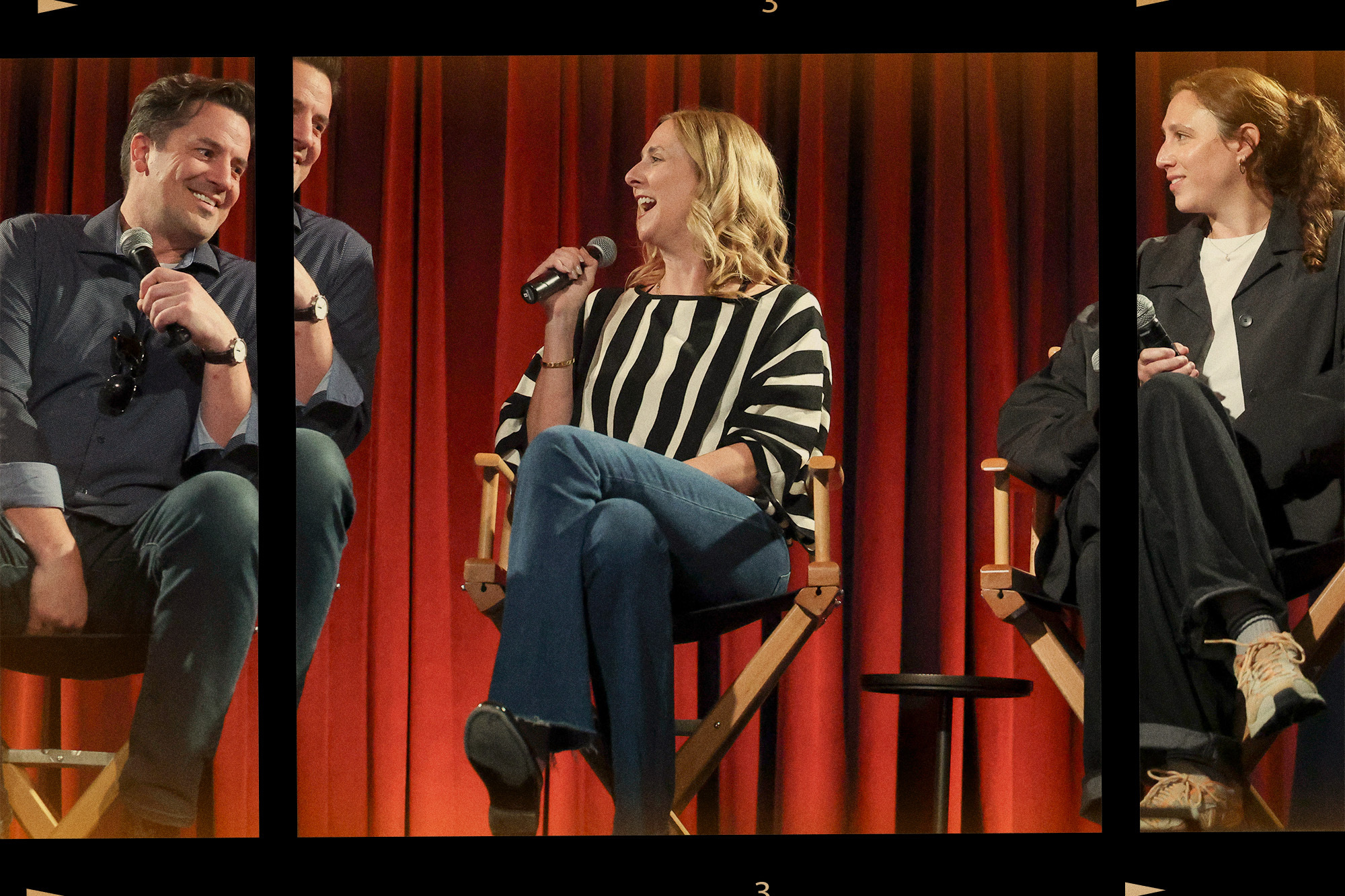
The craft team behind Jury Duty Presents: Company Retreat was one of four groups celebrated at The Ankler’s recent Art & Crafts Live event, hosted by deputy editor Christopher Rosen, at the American Society of Cinematographers Clubhouse in Los Angeles on May 7.
An Emmy nominee for best comedy series in its first season, Jury Duty Presents: Company Retreat greatly expanded its scope for the sophomore season’s episodes, focusing on a fictional hot sauce company (Rockin’ Grandma’s) and the temp employee (the hero), Anthony Norman, who helps save its employees from consolidation and ruin.
“Every day, the pressure ratchets up,” Darnell says, “because there’s no guarantee that we would come out with a show. It’s all on Anthony. He has to do it for himself.”
In the end, thanks to the bonds he’s formed with the company’s employees, Norman succeeds in stopping the sale of Rockin’ Grandma’s. “That’s the kind of person he is,” Darnell adds of the moment when Norman completed his journey. “The entire control room just cried hard when that happened. It was very emotional.”
Fostering that level of passion was also paramount to the team behind Disney and Marvel Television’s Wonder Man, a superhero comedy unlike any other. The first-year series tells the story of a struggling actor with superpowers, Simon Williams (Yahya Abdul-Mateen II), who dreams of playing the superhero Wonder Man on the big screen, despite a law that prevents enhanced individuals from working in the industry.
“I was actually struck by some of these other shows that have had such a big influence on our culture and on me, like The Bear,” co-creator Andrew Guest says. “And I thought, could we do what The Bear did for restaurants with actors, where you’re in their shoes when it feels like a life or death moment when they’re up for a role?”
That depiction and embrace of Hollywood itself, Guest adds — not to mention that Wonder Man was shot in Los Angeles — is why the show was able to assemble such an all-star team of department heads and creatives, including production designer Cindy Chao, cinematographer Armando Salas and editor Nena Erb.
“It was such a different kind of Marvel show,” says Chao, a native of Los Angeles who prioritized finding locations and neighborhoods not typically shown onscreen. “Everyone here who watches it can relate to it, because we keep it grounded in tone — the sets are grounded, the camera work, the editing, it’s beautiful. You feel like you’re experiencing Simon’s journey, his passion and his desire to be successful in his career — but he’s limited because he has this superpower. You could relate that to yourself, like having something that you’re hiding in life.”
Music from the Heart
Wednesday creators Alfred Gough and Miles Millar and the series’ primary director, Tim Burton, all really appreciate thematic music, the show’s composer Chris Bacon says, “which is a blast for me, because I love kind of being unabashedly melodic.”
Starring Emmy nominee Jenna Ortega, Netflix’s modern spin on Charles Addams’ Addams Family characters uses a great deal of music to tell its coming-of-age story about an outcast with burgeoning psychic ability making her way through school — not just Bacon’s score, but several soundtrack songs chosen by music supervisors Jen Malone and Nicole Weisberg.
“We have a nice opportunity on this show because there are also a lot of reimagined orchestral covers,” Weisberg said, noting the second season included string adaptations of “Don’t Fear the Reaper” by Blue Öyster Cult and “Zombie” by The Cranberries. (Ortega’s Wednesday plays the cello.) “That’s kind of a cheat code on this show. The songs are big songs that we tend to cover, but the interpretations are so original, in my opinion, that they have a whole new flavor than what you might imagine.”
Wednesday season two also made room for an original piece on its soundtrack — “The Dead Dance,” a new song by Lady Gaga, whose music, despite not appearing in the show, became intertwined with Wednesday season one thanks to TikTok edits.
“We joke that it was a lot easier than it was supposed to be,” Malone says of what it was like to land the track.
As with her Little Monsters, Lady Gaga was also a big fan of Wednesday, and her label reached out before season two to explore a potential collaboration.
“It really was kind of that easy,” Malone says. “The hardest part, I think, was keeping it quiet — not only from a press standpoint, but also when they were shooting it, because there were so many extras on set.” The solution was a drum track that kept the beat of “The Death Dance” without revealing its sound.
“We couldn’t take that chance of somebody leaking that we have a Lady Gaga song,” Malone says.
That kind of close collaboration between departments is vital to the success of all shows, but the bond between Paradise composer Siddhartha Khosla and editor Julia Grove goes back to before the Hulu hit even premiered.
“We started with Dan Fogelman on This Is Us, and so we’re like family working together,” Khosla says. Any conversations about the show’s music, he adds, are intertwined with Grove’s editing.
“Julia’s seeing dailies or even as she’s talking about the script, knowing that she’s going to need maybe a redacted version of our main theme or a broken version of it later on, I’ll be able to try something,” he adds.
For season two of the Emmy-nominated drama, Paradise flipped its script — expanding beyond the post-apocalyptic bunker where the first season was set and showing what happened to the outside world after an extinction-level event left few survivors, including a new character, Annie, played by Shailene Woodley. A former tour guide at Elvis Presley’s Graceland (created for the show through production design and also visual effects from fellow panelist John Stewart), Annie rides out the early stages of the end-of-days alone as depicted in the season two premiere, “Graceland.”
“I’ve been a passive fan of hers just watching her work over the years,” Grove says of Woodley. “But when I saw her up close in the dailies, she was basically truly by herself playing house — just like throwing herself into these emotional moments, like a lot of physical stuff, too. Just like the grace and professionalism that she carried herself with, I was very impressed.”
Annie eventually meets fellow survivors in the episode, including Link (Thomas Doherty), who will later become the father of her child. The two characters engage in several powerful scenes in the episode, including a sequence in which Woodley’s emotion was so strong that Grove decided to leave it in, uncut.
“A lot of people are like, ‘Oh, I didn’t realize that was a oner,’ because you always felt like you were seeing what you needed to see between them,” Grove says. “I’ve been doing this a while… sometimes you don’t need to cut, and sometimes you do, and there’s really power in both.”