

I’m deputy editor at The Ankler and co-host of the Prestige Junkie podcast. My special Art & Crafts series this week celebrates the talented, Emmy-nominated artisans behind this year’s top shows.
When cinematographer Darran Tiernan found out early on that Prime Video wanted two versions of Spider-Noir — one in black-and-white and another in color — he realized quickly that there was no time to play favorites.
“Our co-showrunner, Oren Uziel, said, ‘If we’re gonna do a color version, we have to be excited about it as much as we are the black-and-white version,” Tiernan says. “That had to be our starting point.”
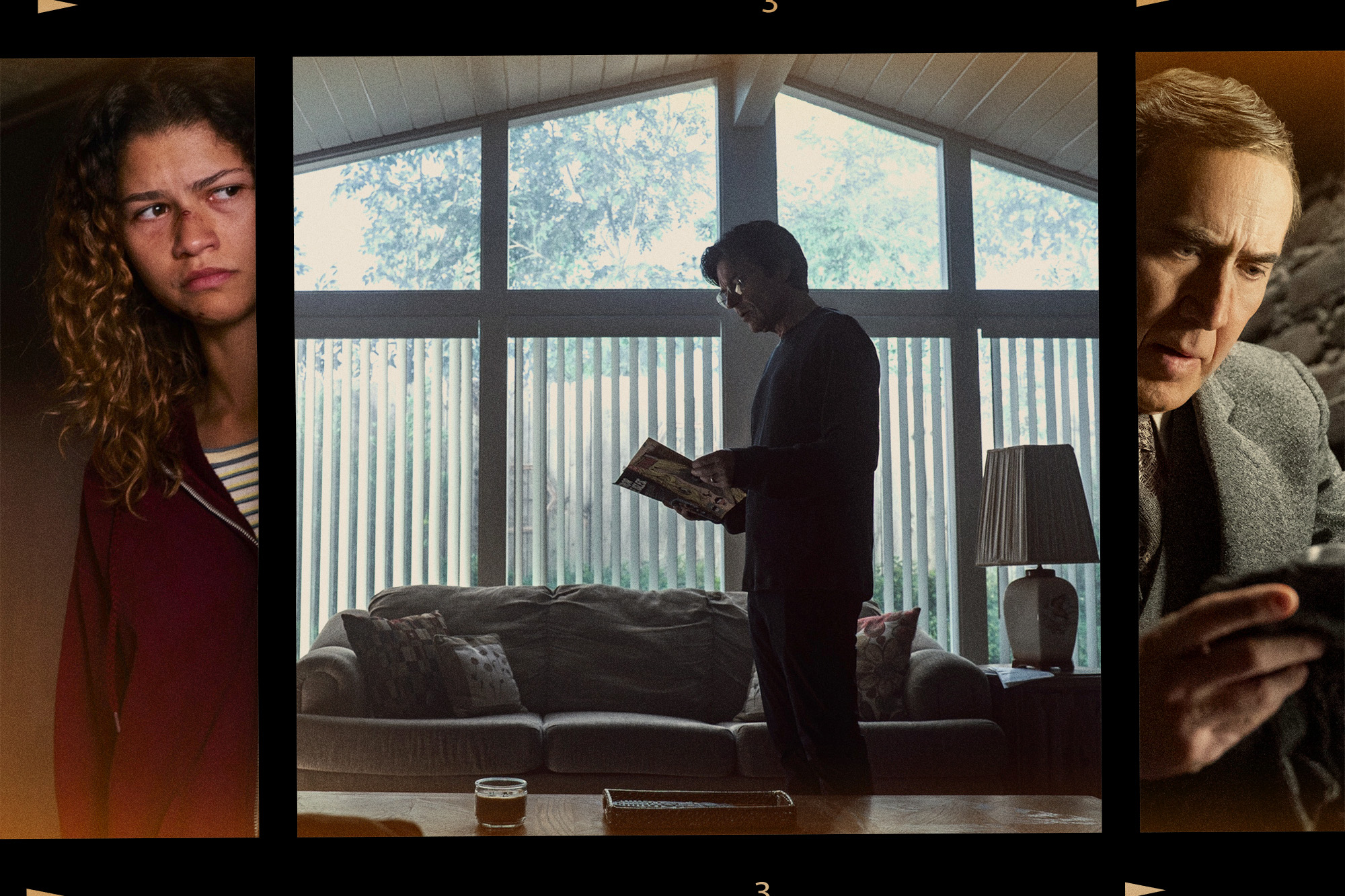
Based on the Marvel comic of the same name and starring Nicolas Cage as the title character — a 1930s detective named Ben Reilly who moonlights as Spider-Man — Spider-Noir is one of this year’s most ambitious projects. There’s the black-and-white version of the Spider-Man story filtered through the lens of film noir that allowed the show’s artisans, including Tiernan, to reference the genre’s best films; and then there’s the brightly colored take, presented in what Prime Video calls “true-hue color,” that replicates the feeling of reading a comic book. The two different presentations — shot as one on set — required great collaboration from the project’s below-the-line crew, many of whom, including Tiernan, received Emmy nominations for their work. (Spider-Noir led all Prime Video shows this year with 11 total nominations.)
“We all learned together,” Tiernan says, of the juggling required to make it work. “We all kind of creatively together created the color look of the show through our choices and the collaboration.”
To help the process along, Tiernan says he provided each department head — including Emmy-nominated production designer Warren Alan Young and costume designer Trayce Gigi Field — with a basic lighting system and camera that were similar to what he was using for the show. That way, they could test color options on the fly to see how it would appear in both black-and-white and color.
“I really wanted to keep everybody on the same page,” Tiernan says. “We could have discussions about what worked in color but didn’t tend to work in black and white. You’d have to address all these challenges at the time.”
Tiernan, who has also worked on shows like The Penguin and Perry Mason, adds that the unique requirements of Spider-Noir shifted the way the entire crew worked together.
“Maybe we would not have been as collaborative if it had been only a color, or only a black-and-white version,” he says. “We were forced to be more collaborative than normal, which was brilliant because we were all up for it.”
Rue’s Last Look on Euphoria
Few shows in recent years have hit the zeitgeist like Euphoria. Sam Levinson’s hit HBO series about the struggles of Gen Z — filtered through influences as wide-ranging as Quentin Tarantino, Paul Thomas Anderson and John Ford — launched countless think pieces, debates and memes.
“I think the subject matter is very much in the culture now,” says cinematographer Marcell Rév, the man behind the visuals that powered all those viral social posts about the show. “I’m just trying to match it. It’s not like I’m pushing to say something to the younger audience. I’m just doing my job.”
Rév did that extremely well on Euphoria, landing three nominations for his cinematography during the show’s run, with a win in 2022. His nomination this year is for the series finale, a 93-minute epic that left several characters dead, including the show’s lead, Rue (played by two-time Emmy winner and current nominee Zendaya). Her death from an accidental drug overdose happens partway through the final episode, a shocking turn of events that shifts the narrative perspective to Colman Domingo’s Ali, Rue’s addiction sponsor and longtime confidant.
“It’s a very special sequence,” Rév says of Rue’s death, which plays out as a dream sequence that reunites her with good friend Fezco (Angus Cloud, who died of an accidental drug overdose in 2023; the character returns through unused footage from season one). “It was very emotional for us. We knew it was the end of something important in our lives. It was a very emotional goodbye to a very important part of our lives.”

Euphoria ends with Ali visiting a farmhouse in Texas near the U.S.-Mexico border that Rue stumbled upon in the season three premiere, as she made a drug run back into the country. There, he meets the religious family who showed Rue hospitality and sits at the same table where she sat earlier. After saying grace, Ali imagines his friend looking back to him, finally at peace.
“It’s her show — she’s the glue,” Rév says of ending with Rue.
The last image of Rue is almost the same as the one from the premiere, he adds, and was shot the same day — just with one tweak:
“We just waited for the sunset.”
Lonely Boys of DTF St. Louis
Cinematographer James Whitaker and writer-director Steve Conrad always felt like they had the goods to break through to a larger audience. But it wasn’t until HBO’s DTF St. Louis that Conrad’s work crossed over to the mainstream. The limited series — a hit for the streamer in the spring — received 13 Emmy nominations this year, including three for Conrad alone (an executive producer of the limited series, plus its writer and director) and Whitaker in the cinematography category.
“I knew that Steve’s writing deserved a real audience — I was excited about that,” Whitaker says. When he heard the show would be on HBO Max, he remembers thinking, “Okay, we’ve got a chance. Now all we have to do is not fuck it up.”
Created by Conrad, who wrote and directed all the episodes, DTF St. Louis is a complex mix of tones and themes — including loneliness, friendship and intimacy among male friends. The show focuses on Clark (Jason Bateman), a local weather man in the St. Louis area; Floyd (David Harbour), Clark’s ASL interpreter; and Carol (Linda Cardellini), Floyd’s wife who starts an affair with Clark. When Floyd turns up dead and Clark is accused of his murder, the investigation leads to surprising revelations about the trio’s relationship.
“At times, we wanted this to feel like we were street photographers who were invading this neighborhood world to capture slice of life moments with not a lot of planning,” Whitaker says, of the show’s visual style. “Steve’s idea that he wanted to get out there was that men should be more comfortable with their male relationships and not be afraid to be intimate. So we talked a lot about how that might develop into the photography.”
To achieve that, Whitaker says he focused on finding cameras, including the Alexa 265, that had a shallow depth of field to help isolate people within the center of a frame. “I think it worked,” he says.

Whitaker and Conrad also focused on the framing of their images. For instance, when Clark is questioned by police in the lobby of the sheriff’s office, the light falls across him like bars in a jail cell; an early shot of Clark’s home features a similar motif, replacing the beams of light with trees.
“The trees made it feel like he’s kind of trapped in the house,” Whitaker says. “You could feel like maybe he needs to get out of there. I had this idea that I always wanted it to feel a little unsettling — that strange things do happen in these places. So we’re gonna give you some strange compositions that you know that are off. It’s like the quote in the show: ‘No one’s normal. Just looks that way from across the street.’”