
“The paint was never dry on this movie.”
Production designer Dennis Gassner has credits on several classics — including Field of Dreams, multiple all-time greats from Joel and Ethan Coen (Miller’s Crossing, O Brother Where Art Thou?) and the James Bond films Skyfall and Spectre. But his work with co-designer and supervising art director Richard Johnson (Once Upon a Time in Hollywood, The Hateful Eight) on Digger was like nothing either veteran had experienced before.
“It was hard as hell, but it was still wonderful because it was taking the world of the theater and putting it into cinema,” Johnson says of the risks they took in making the Alejandro González Iñárritu satire. Ostensibly about an oil tycoon (Tom Cruise) whose carelessness causes an environmental catastrophe, Digger reveals itself to be something more complex and thorny — an examination of the power and limits of how society uses art to understand its failures.
“Every piece of the puzzle was a masterpiece of art,” says Johnson.
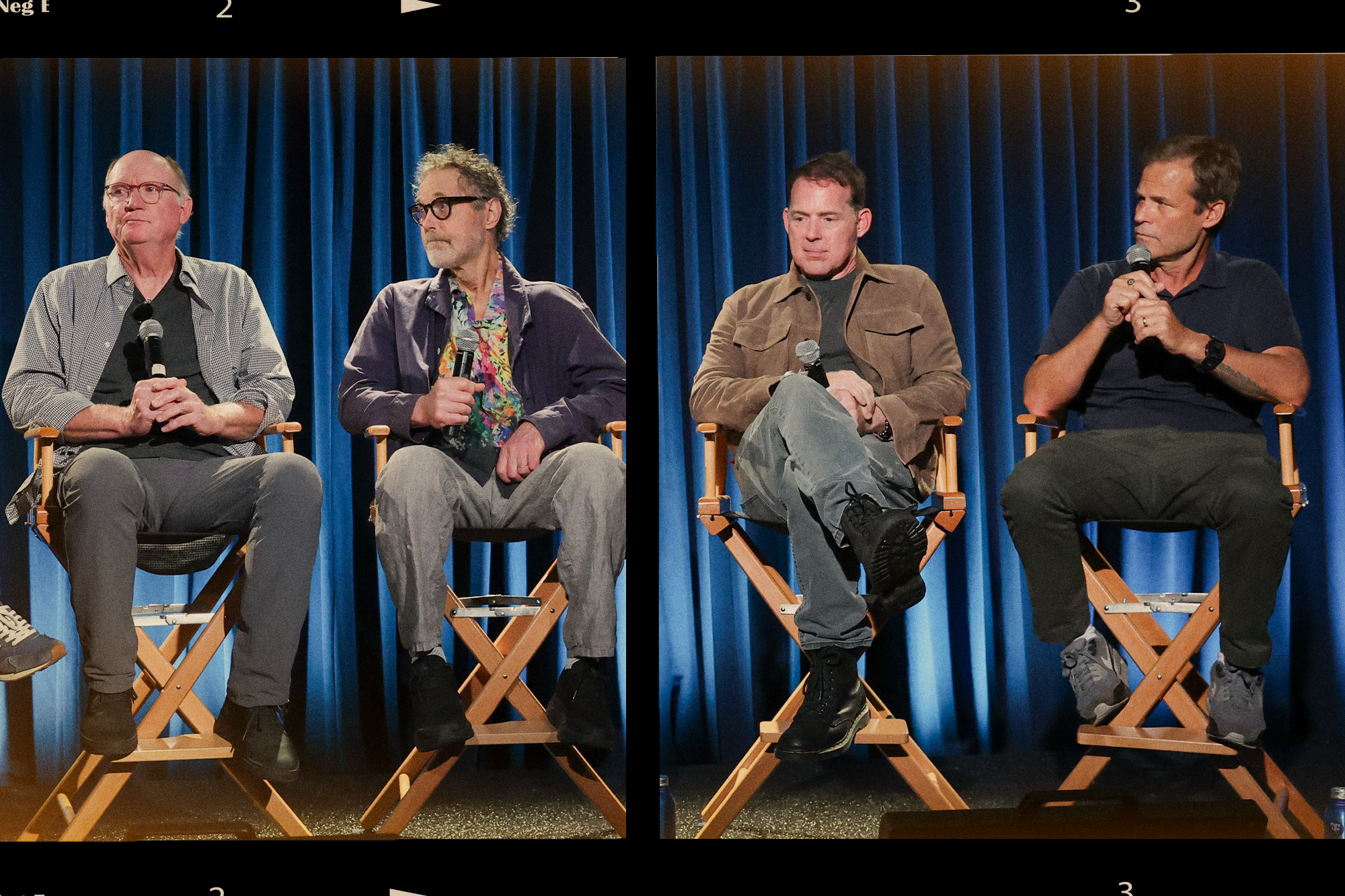
Shot on 35mm film using VistaVision by Oscar-winning cinematographer Emmanuel Lubezki, Digger brought together several top artisans — including Gassner, Johnson, editor Conor O’Neill, and supervising sound editor and re-recording mixer Johnnie Burn — all of whom were among the craftspeople celebrated at The Ankler’s recent Art & Crafts Live event. Hosted by managing editor Christopher Rosen at the American Society of Cinematographers Clubhouse in Los Angeles on Nov. 13, the annual confab featured insightful conversations with the Digger crew, as well as production designers, editors, costume designers and casting directors from Artificial, Wicker and Wildwood.
“It’s not a straightforward tone. It’s pretty unique, and it needed to be discovered during the course of editing — both during the shoot, and then after the cameras wrapped,” O’Neill says of Digger, which counts numerous high-profile celebrities as major fans despite a divisive response from critics.
Credit to the film’s creative success goes to the entire team — Burn, for instance, had to do substantial work to remove the loud noise from the VistaVision cameras. “Every single phrase had to have a little bit of work done,” he says. “It was painstaking.” But it’s Cruise who shouldered much of the burden in the dialogue-heavy movie.
“I don’t want to speak for Alejandro, but he would come to me and go, ‘This guy’s incredible,’” O’Neill says of Cruise. The filmmaker, O’Neill adds, was especially impressed with Cruise’s ability to take notes and process them immediately — sometimes 10 different notes across 10 takes.
“That’s sort of the level of Tom’s artistry,” O’Neill says. “Alejandro was like, ‘I think it has to do with the fact that he does films like Top Gun where you have to fly planes and jump off cliffs. You have to be precise, or you’re dead.’”
A different type of precision was required for Artificial, the new film from Luca Guadagnino that focuses on Sam Altman and the rise of OpenAI.
“The main challenge here was to find the balance between the different tones, because the movie can be very funny, but sometimes it can be very, very dark,” says editor Marco Costa. Often comedic thanks to a diabolical performance from Andrew Garfield as Altman, Artificial also plays like a horror movie about what happens when a monster breaks free from its master’s control.
“Sometimes even a small change in timing could completely alter the way a scene was perceived,” adds Costa, who has edited five consecutive Guadagnino films starting with 2022’s Bones and All. “But at the end of the story, the movie leaves the audience with a lot of bitterness in the mouth. It was a great challenge because it’s maybe the first movie where Luca mixes different tones.”
Nowhere is that more apparent than in Elon Musk, played by The Studio star Ike Barinholtz. “That character was a real puzzle and we were playing with ideas for Elon for quite a long time,” says casting director Jessica Ronane, who joined Costa and production designer Stefano Baisi for the panel discussion.
Barinholtz was a late addition to the cast. “I did feel like this could be quite spectacular, but I didn’t know him in Luca’s world,” says Ronane, who also cast Queer and After the Hunt for Guadagnino. Luckily, the filmmaker and star warmed up to each other quickly. Ronane says she heard Guadagnino and Barinholtz had something of a “bromance” on set, and their camaraderie led to a collaboration she calls “fruitful.”
“With casting, there’s a lot of risk,” she says. “You try to ensure you’re making this wonderful company and they’re all gonna do what it says on the tin.”
Unfortunately for Barinholtz, he’s so good as Musk, he might have ruined it for anyone else who wants to try. “Once you see him, you’re like, ‘Who else would play Elon Musk?’” Ronane says.
Handmade With Care
When stop-motion animation studio Laika promoted Wildwood as coming from the “hands that made Coraline,” the company’s 2009 breakthrough, it wasn’t an exaggeration. Several of the people behind Wildwood have been with Laika from the beginning, including editor Christopher Murrie-Green and costume designer Deborah Cook.
“I’ve worked on all of the movies, and each one has changed considerably,” says Cook. “We’ve learned things along the way.”
That growth across five previous films — all nominated for best animated feature at the Oscars — came in handy for Wildwood, an epic adventure based on the fantasy novel by Colin Meloy that includes battle sequences that rival what audiences might expect from Avatar or The Lord of the Rings.
“One of the great things about working on something that’s of this scale is that you have this much more dynamic range to play with,” says Murrie-Green. “We can go to those places where we have these gigantic battles, huge scale, cast of thousands. But as a result, that gives us that much more dynamic range on the bottom end where when we go intimate and we go quiet, we have that much more of a swing to make.”
Murrie-Green says editing the climax of Wildwood afforded him the chance to allow his “inner 10-year-old on the screen and bash my action figures together.” But it also gave him the chance to really surprise the audience. “I was building tension, trying to turn the screws and escalate so that by the time we got to this final confrontation between just two people, the audience is so pressed into their seats.”
Set in Portland, Oregon, where Laika’s studios are based, Wildwood follows a teenage girl named Pru as she heads into the Impassable Wilderness just outside the city to rescue her brother from a mystical land after a murder of crows kidnaps him.
“It was almost like designing for several individual movies,” says Cook of the multiple factions within Wildwood, including anthropomorphic coyotes and a group of bandits. “They’re very, very different from each other, but then there’s also contemporary Portland. What you can actually buy there, clothing-wise, is really outdoor wear, very substantial clothing and a lot of vintage. But designing for the differences between those few communities and contemporary Portland was really interesting.”
Cook, like Murrie-Green and production designer Nelson Lowry, lives in the Portland area. “I’ve never designed a film that’s in the place that I live, so that was a huge leg up,” says Lowry, who has made four films with Laika. “But just the idea of a stop-motion epic movie, that’s such a strange concept because there’s so many things that work against you when you’re building a world in miniature.”
Fortunately, Lowry says, being led by filmmaker and Laika studio co-founder Travis Knight has its benefits. “He loves the art of stop-motion and so do we, but he wants to raise the bar every time,” Lowry adds. “So as terrifying as Wildwood was, I was incredibly engaged because there was every challenge imaginable.”
The challenge faced by Wicker makeup artist Joe Dunckley probably seemed unimaginable: turn Alexander Skarsgård into the Wicker Husband for the romantasy film Wicker.
Or maybe not.
“It’s just Alexander Skarsgård plus basket. You’re done,” jokes Dunckley.
Based on The Wicker Husband by Ursula Wills, Wicker is about a solitary fisherwoman (Olivia Colman) who commissions a local basket maker (Peter Dinklage) to make her a husband out of wicker.
“It’s definitely my first rom-com, unless you count King Kong,” says Dunckley, a Wētā Workshop veteran who has worked on multiple major projects for the special effects house, including Avatar: The Way of Water and District 9.
“We’re known for fantasy films and sci-fi and monsters, but this character needed to hit entirely different cues, and we were excited about that challenge,” Dunckley adds. “He needed to be desirable. We needed to deliver a more dramatic performance. For us, getting the chance to do something original was invigorating. It creates a really nice culture around that job on the workshop floor, just a lot of excitement.”
It helps, too, when an actor like Skarsgård is playing the role. Dunckley and the Wētā workshop had 18 months to create the prosthetics worn by the Big Little Lies star in the movie — enough time to devise a design that kept the star’s recognizable handsomeness intact. “We were sculpting forms that were beautiful, and that supported Alexander’s looks,” he says.
But an equally important concern was making prosthetics that didn’t create a barrier between Skarsgård and Colman for their intimate scenes together.
“In those scenes, Olivia, she has her arms around the wicker husband. She has her hand on his back, and then she slips a finger through the weave of his shoulder blades, and it’s like you wouldn’t write that in a script,” says Dunckley. “You only come across that because you’ve got him physically in the set and so the performers can actually explore the intimacy of the characters, which is pretty special.”
Response to Wicker, especially among its core audience of women, has been ecstatic — and the film has enjoyed viral success because of its strange and enticing premise.
“The attention it’s getting, I don’t think I’ve ever experienced,” says Dunckley. “I’m loving seeing so many cosplayers creating their own costumes already, and there are some great ones out there. Some of the worst ones are my favorites, but there are some extremely skilled ones as well.”


Comments
Only Ankler All Access subscribers can comment
Already a subscriber?