
For obvious reasons, you don’t hear much about the communal viewing experience during Emmy season. But listening to a crowd roar on Friday night while watching Woody Harrelson on Subway Takes and gasp when a clip from Cleo Abram‘s Huge If True ended on a cliffhanger, I started to wonder if that might be something we should talk about more.
Building a sense of community is a major but rarely discussed aspect of the Emmy FYC season, and one that’s in overdrive right now — with studios and strategists going hard on in-person events before Emmy ballots finally go out on Thursday. Voters could skip the line at Max & Helen’s on Saturday on behalf of The Traitors and then attend a live table read with the cast of Shrinking, and coming up later this week is a live taping of Jimmy Kimmel Live! plus a BBQ “mix and mingle.” Emmy voters attend these events to see the stars, of course, but also connect with each other, trading war stories about the industry’s challenging past few years or maybe even indulging in some of the tentative hope that seems to be in the air these days.
All of that was happening at YouTube’s official FYC event held at the Television Academy’s Saban Media Center in North Hollywood, where I was onstage moderating conversations with four creators whose shows are incredibly different, but still undeniably television: Abram’s science-focused Huge If True, Kareem Rahma’s casual but deceptively rigorous interview show Subway Takes, Julian Shapiro-Barnum’s high-energy Celebrity Substitute and Brittany Broski’s hangout interview series, Royal Court. All four creators came ready to explain why their work is just as extensively produced and high-quality as anything on traditional TV, and based on my conversations with voters at the reception afterward, the message came through loud and clear. As one veteran Television Academy member told me, “My eyes have been opened!”
“I think this is the biggest remaining misconception about shows that happen to distribute on YouTube — that they are any less difficult to make or reflect any less creative effort and vision than anything else on TV,” Abram told me, going deep into the team of animators, editors and researchers (among others) who make it possible for her to make episodes about things like black holes and how astronomers discover new asteroids. “The freedom that we have creatively allows us to do this. I get a lot of questions like, ‘Oh, how do you do that given that you’re on YouTube?’ And I say, ‘No, it’s because I’m on YouTube that I have the opportunity to do that.’”
Even the most seemingly relaxed of YouTube shows can require an enormous amount of work. Before celebrities put on goofy medieval gear and answer ridiculous questions on Broski’s Royal Court, there has been an enormous amount of prep work. “I have a team of writers who are watching every interview these people have done, because I don’t want to repeat a question that they’ve been asked,” Broski said. When it comes time to shoot, she added, “I have three camera operators, a DP. I have a director and editor, assistant editor, producers, writers, bookers. I mean, it is a complete production studio that I’m running.”
Royal Court, Subway Takes and Celebrity Substitute all rely on booking famous people who agree to do something very different from the usual press tour stop — which is generally where the magic comes in.
“The best guests are the ones that embrace that chaos and embrace that uncertainty,” said Rahma, whose Emmy submission for Subway Takes has Harrelson mixing it up with middle schoolers and an unhoused man during the episode. For Shapiro-Barnum, who brings celebrities like Kehlani and Ed Sheeran in to teach real New York City public school students for two hours, he’s offering a challenge that’s hugely different from regular celebrity duty.
“What I think is fun about my show, and working with kids in general, is it’s not about [the stars],” he told me. “So much of what they do, especially when they’re on these big press tours, it’s all about them and whatever they’re promoting. [My show] is very much about just coming in and building something together.”
Awaiting Their Breakthrough

Of course, we’ve been here before. Last year, I attended YouTube’s first-ever FYC event on behalf of three other shows, none of which earned Emmy nominations. This felt especially galling in the short-form categories, where many YouTube shows compete, with nominations instead going to supplementary material from existing shows or late-night bonus segments. With all due respect to last year’s short-form winners Adolescence: The Making of Adolescence and The Daily Show: Desi Lydic Foxsplains, they are not at all representative of the kind of short-form videos that are driving culture right now — all on TikTok, Instagram and YouTube.
There’s an understandable learning curve here for Emmy voters, who may still think of YouTube as the place for unboxing videos or something their kids (or grandkids) spend too much time watching after school. Plenty of the voters I spoke with on Friday night weren’t familiar with any of the creators, but left the event impressed by the work that goes into their shows — two voters, in particular, highlighted how the creators went into detail about their crews and production processes. Every Emmy campaign is about getting people to actually watch your show and, ideally, have a positive association with it — whether from talking to the stars at the reception or simply from how good the food was. (The food at the YouTube reception was indeed excellent.) But YouTube creators have an extra step to travel: First convince them to consider your show at all, and then get them to love it.
YouTubers also have an Emmy rule change working in their favor this year, requiring that the short-form categories include at least one original series, not just shows based on or derived from other programming. That won’t help Broski’s Royal Court or Sean Evans’ Hot Ones, both of which are competing in the variety category that recently merged with the talk series category and has its own convoluted rules that make it very hard to predict even the traditional shows, like Late Night with Seth Meyers, that might make it through.

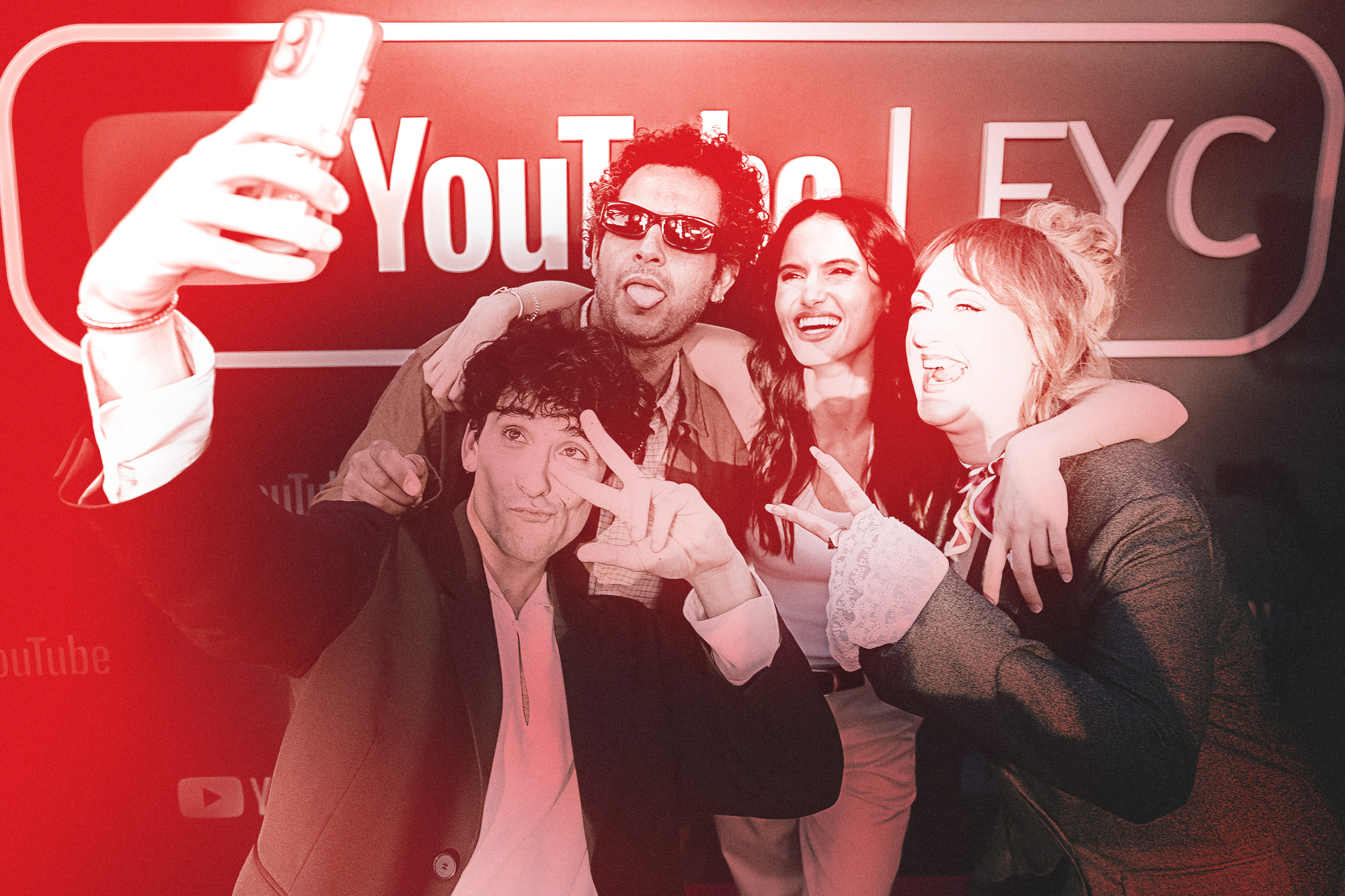
But for Abram, Rahma and Shapiro-Barnum, the door may now be more open for their entirely original short-form shows to make Emmy history. My colleague Natalie Jarvey, who joined me at Friday night’s event (check out what’s become our annual photo op tradition above!), wrote last year that “YouTube stormed TV. Now they want its Emmys, too.” But listening to the audience applaud Broski as she described the Burbank studio where she shoots Royal Court with a crew of dozens, it was incredibly obvious to me that YouTube is TV — whether the awards catch up or not.
True Stories
A few days before our onstage conversation, I caught up with Abram on Zoom — both because of her perspective as a former journalist (she was on Vox’s video team) and, frankly, my kids love her videos. When she decided to leave Vox and launch Huge If True in 2022, she could have pitched it to a more traditional media outlet. But Abram says the factors that drew her to YouTube in the first place are what have allowed her show to thrive.
“I think the most exciting things about making a show on YouTube are the opportunity to make it exactly the way that you want to make it,” she tells me. “Huge If True is this really optimistic, incredibly highly produced show. The investment per episode is really high, and I have a mission to help people see these optimistic futures. I don’t think I could have made that at a media company, and I think that remains true.”
Abram makes deep-dive, 15-minute episodes explaining things like nuclear fusion and AI, but Huge If True also embraces the wild world of YouTube shorts to explain smaller concepts (I greatly appreciated this explainer of the “I am not a robot” click box) as well as long-form Huge Conversations with people like Mark Zuckerberg and Sam Altman. That variety of formats is another YouTube superpower, says Abram.
“I’m really proud of all of those creative options,” she says. “Respecting the audience’s attention mode is a big deal. There’s no human being in the world who only watches shorts. There’s no human being in the world who only watches long-form podcasting. I think you can make things that are incredibly high quality for all of those moments for people — I don’t think it’s an either-or at all.”
There’s very little about Huge If True that feels casual or like the outdated, low-fi stereotype of YouTube — the many hours of research and production that go into it really show. But when Abram addresses the audience, she’s often sitting at her desk, turned toward a camera set up to the side. It feels intimate but also highly choreographed — and as with everything else that goes into Huge If True, it’s very intentional.
“I’m at my desk actually researching things, and I put the camera next to me and turn to it as I would turn to a friend,” Abram says. “Obviously, I’ve spent many, many days working on a script, but I am talking them through the story that I’m excited about. The whole idea of the show is to help people feel like they can participate in the future. So if I turn to them and I talk to them like a friend, it feels honest. I’m welcoming them into a conversation that I’m lucky to be a part of.”