

Believe it or not, Matt Damon has never won an acting Oscar. In fact, it’s been 28 years since he took home his one and only statuette, for writing Good Will Hunting in 1998. Heck, even Odysseus made it home in 20 years! But if Christopher Nolan and Universal have anything to say about it, Damon’s long journey to an acting Oscar may finally be coming to an end.
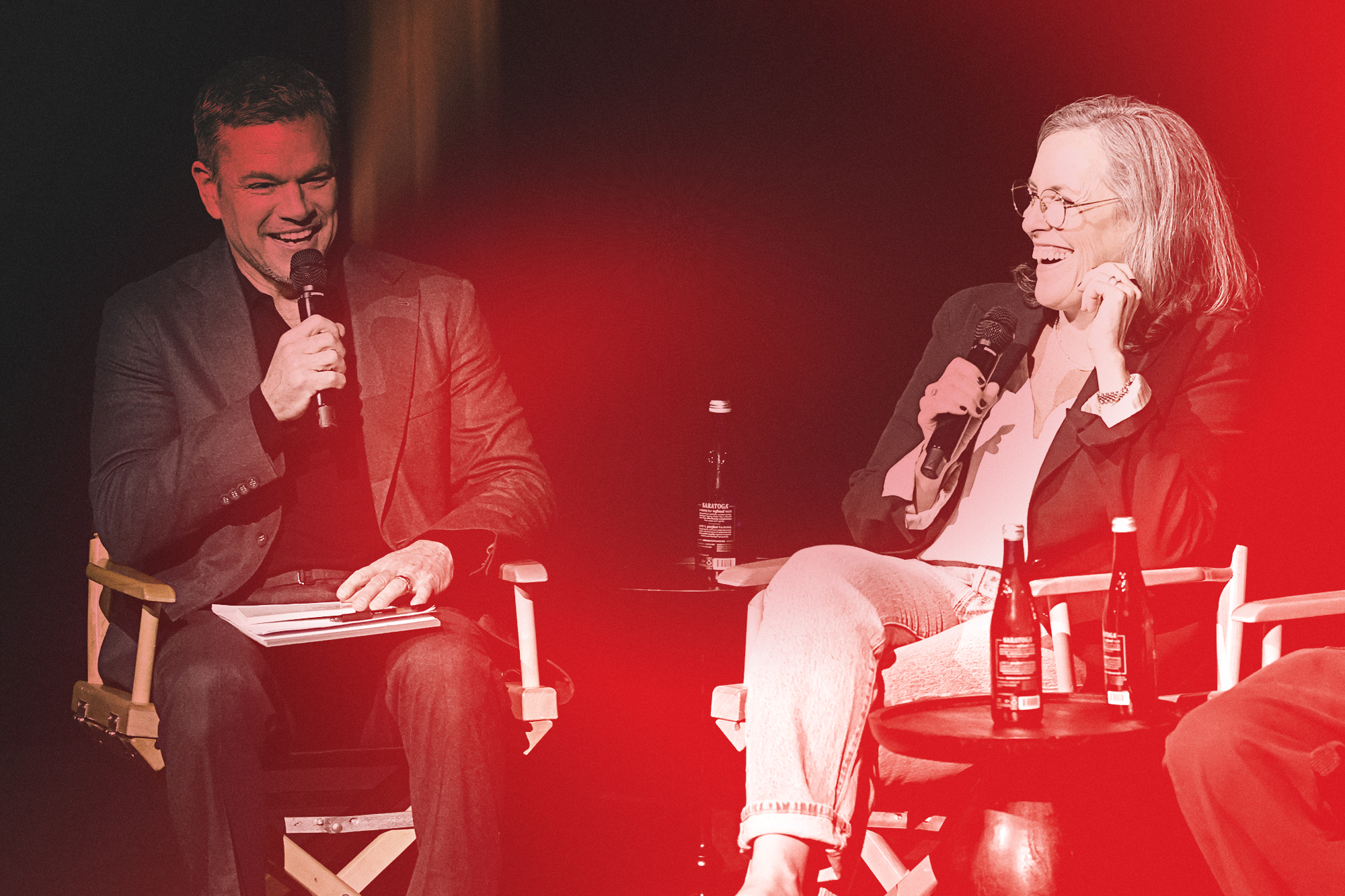
On Tuesday night in Los Angeles, I watched Nolan kick off a lavish The Odyssey awards event by declaring that his leading man had delivered “the performance of a lifetime.” Damon then spent the evening moderating a Q&A with 12 — yes, 12! — of the film’s craftspeople, dispensing personal anecdotes, plenty of charm and a reminder of why he’s been one of Hollywood’s most likable stars for three decades.
Forget Odysseus’ journey. The Matt Damon Oscar charm offensive is just beginning.
Here in Los Angeles, the sun is shining — and if the tray of passed appetizers hasn’t gotten to you yet, please stay in line! There are more than enough buffets, cocktail receptions, Q&As and intimate dinners (always “intimate”) to go around this week — the frenzied period surrounding Sunday’s Governors Awards, when everyone is a contender and doing their best to prove it.
I’ll be in the thick of the madness for the next few days, including today’s Ankler Art & Crafts event (where my colleague Christopher Rosen talked to some of the most brilliant behind-the-scenes artists of the season; look for a recap next week) and Sunday’s Governors Awards, which I’ll cover in Monday’s newsletter.
But Universal has already set a high bar. Tuesday’s Odyssey extravaganza wasn’t even centered on the film itself, but on a 75-minute behind-the-scenes documentary that will be available on the film’s home video release next week. (Chris tells me he’s already pre-ordered the 4K.)
And if this was just the opening salvo of Universal’s Oscar campaign, the competition should be paying attention.

Moderating the event, Damon had personal anecdotes for nearly every participant, which included frequent Nolan collaborators like producer Emma Thomas (also Nolan’s wife), production designer Ruth De Jong, editor Jennifer Lame, composer Ludwig Göransson and costume designer Ellen Mirojnick, all of whom reunited with Nolan following Oppenheimer for a remarkably brisk but insanely massive production.
But the behind-the-scenes footage made all of their accomplishments feel genuinely mind-boggling, from De Jong recreating the city of Troy at a UNESCO World Heritage site to Göransson incorporating actual ancient Greek instruments into the score. During the Q&A, production sound mixer Willie D. Burton — whose first Oscar nomination was in 1979 for The Buddy Holly Story! — went into hilarious detail about crouching down in the hull of Odysseus’ ship to capture the sound of oars creaking. Everyone from Damon onward couldn’t stop talking about how physically challenging the production was, with the kind of good humor you probably only have when all that hard work paid off.

The evening did an excellent job of showcasing the film’s many crafts, including a post-screening exhibit featuring costumes, set models and more. But it was also a tremendous showcase for Damon, starting when Nolan took the stage with an introduction that included extensive praise for his star: “He was there inspiring everybody with his example. A really genuine leader.” The documentary followed up that praise with ample evidence of Damon hard at work, from stunt training to boat-rowing to laughing with Himesh Patel after particularly soggy, difficult takes. Damon’s smile, a known superpower for decades, doesn’t get much time in The Odyssey, but seeing it pop out from beneath that Odysseus beard has a real impact.
I remain bullish on Damon as a strong best actor contender and the raft of Odyssey Q&As coming this week ought to only help him more. (During an event last night, he sat on the other side of the process with Nolan and Thomas as Robert Downey Jr. handled moderating duties.) All that said, thank goodness he doesn’t seem to be doing any more moderating this week — leave some work for the rest of us, Matt!
Now, here’s Chris — not with a review of The Odyssey Blu-ray, but with a chat with I Play Rocky screenwriter Peter Gamble, who waited decades for his big break, much like the subject of his new movie.
Going the Distance

If they make an I Play Rocky version of I Play Rocky in 50 years, whoever gets cast as Peter Gamble will have a hell of a part.
“I felt very unseen,” Gamble, who wrote the new movie about the making of the Sylvester Stallone classic, told me last month during a live conversation at the Denver Film Festival after I Play Rocky played on opening night.
Based on the making of Rocky — which won best picture in 1977 and launched the career of Stallone, who battled homelessness and even starred in a soft-core porn movie before writing the boxing hit — the new Amazon MGM movie from Peter Farrelly has been defying the odds for years. Gamble’s script circulated for almost a decade before it landed with Farrelly — and the Green Book Oscar winner only looked at it because his daughter’s ex-boyfriend read it on a whim and thought it was “one of the best scripts” ever. That praise was enough to pique Farrelly’s interest. (“I told [the ex] afterward, ‘Dude, you could read a thousand scripts before you come across one this good,’” Farrelly relayed to Richard Rushfield in a recent chat.)
Kismet was at work in the casting, too. Young actor Anthony Ippolito, who had a small part as Al Pacino on the Paramount+ series The Offer, heard about the movie and put himself on tape to play Stallone — and he does an almost uncanny impersonation of the star, right down to his voice and mannerisms. “People say to me, ‘Don’t you wish the movie got made sooner?’ And I say, ‘Well, the movie universe knew better than I did,’” Gamble said. “Anthony Ippolito didn’t exist in the way he needed to be in this part. He existed, but he wasn’t old enough. His audition tape gave me chills.”
Rocky is an underdog story about a guy no one believed could succeed. Gamble’s used to that, too. Born in Florida and diagnosed with dyslexia as a child, Gamble left for L.A. at 18 to attend USC (where he’d later return as an adjunct associate professor). After graduating in the mid-’90s, he worked as an assistant and ghostwriter for “one of those people in the industry that you hear about,” he said during our conversation at Denver’s Tattered Cover bookstore. Gamble didn’t name names — neither the writer nor the project — but said that after crashing a rewrite for a high-profile awards hopeful in a week, the older screenwriter took credit for his work. “It was a really tough experience,” Gamble said of the time, noting the writer claimed he’d have his back on the next one. “I knew his character. I had very low hopes for that.”
Gamble eventually rebuilt his confidence with Men in Black writer Ed Solomon. “He said, ‘When I saw you, you looked like a kicked dog,’” Gamble said, getting emotional. “He was rehab for my soul.” Gamble and Solomon worked together for almost 15 years, and Gamble helped in the writers room on major projects like Now You See Me and its sequel. “I got to watch how this guy — who’s at the top of this career — worked,” Gamble said, noting how Solomon always led by brainstorming from theme, not plot. “This was an apprenticeship, and we should have more of those, right?”
Still, Gamble strove to tell his own stories — to be seen. During a meeting with his manager, the pair brainstormed ideas for biopics — a popular genre in Hollywood and a good way to get a spot on the Black List for best unproduced screenplays, they reasoned. When the idea came to tell Stallone’s story — how he wrote Rocky as his ticket to stardom and stood his ground to play the title character when he was constantly told no (the studio wanted Ryan O’Neal among other stars at the time) — it sparked something familiar.
“I was attracted to him because he felt unseen. He’s this actor with a speech impediment and a partially paralyzed face — and everyone sees him as a thug or a cop,” Gamble said. Like Stallone at the time, Gamble felt he had more to offer.
While Stallone wrote Rocky in three days, Gamble took significantly longer — researching everything about the movie, watching countless interviews with Stallone and speaking to those around him during the time Rocky was made. Still, one person he didn’t interview was Stallone himself; before the movie was made, Gamble never even met him — but he did pitch the project to Stallone’s production company.
“We met with one of his producing partners. He said, ‘Look, Stallone likes this, but he feels that it would be weird if he made something about himself. It’d be kind of pretentious,’” Gamble said. Crucially, however, Stallone didn’t have a problem with the movie itself.

Now, I Play Rocky is in its final rounds. After premiering at the Toronto International Film Festival to raves from its crowd — I was there; people treated the screening like a rock concert, breaking into spontaneous applause throughout — the movie played several regional film festivals, like the one in Denver, where it won the audience award. I Play Rocky was released in select theaters last week, with a wider run scheduled for later this month.
In the immediate future, Gamble will be on the awards trail for the movie — which is a dark horse in several categories, including for his screenplay, where some doubt remains about whether it will be eligible as original or adapted. (My POV: If Maestro, about Leonard Bernstein, Milk, about Harvey Milk and Mank, about the writing of Citizen Kane, were all considered original screenplays, then why not I Play Rocky?) Still, befitting the movie and its subject, several Prestige Junkie Pundits may be underestimating its awards potential — perhaps because of residual issues with Farrelly’s best picture winner Green Book. (Not me, I’ve got it all over my predictions!)
But no matter what happens in the future, it’s clear the experience is one Gamble won’t soon forget. Toward the end of our chat in Denver, Gamble recalled how, when he was on set, people kept coming up to him to tell them how excited they were to be making the movie. At one point, the boom mic operator pulled Gamble aside.
“He said, ‘The first film I ever worked on was a great movie, and that’s what got me into this.’ And he goes, ‘I’ve been doing 20 years of this, and this is the second great movie that I’ve worked on,’” Gamble recalled, crediting Farrelly for fostering that kind of environment. “This is why I believe that this movie is great — because people wanted to make sure that their link was not going to be the one that broke.”



Comments
Only Ankler All Access subscribers can comment
Already a subscriber?