

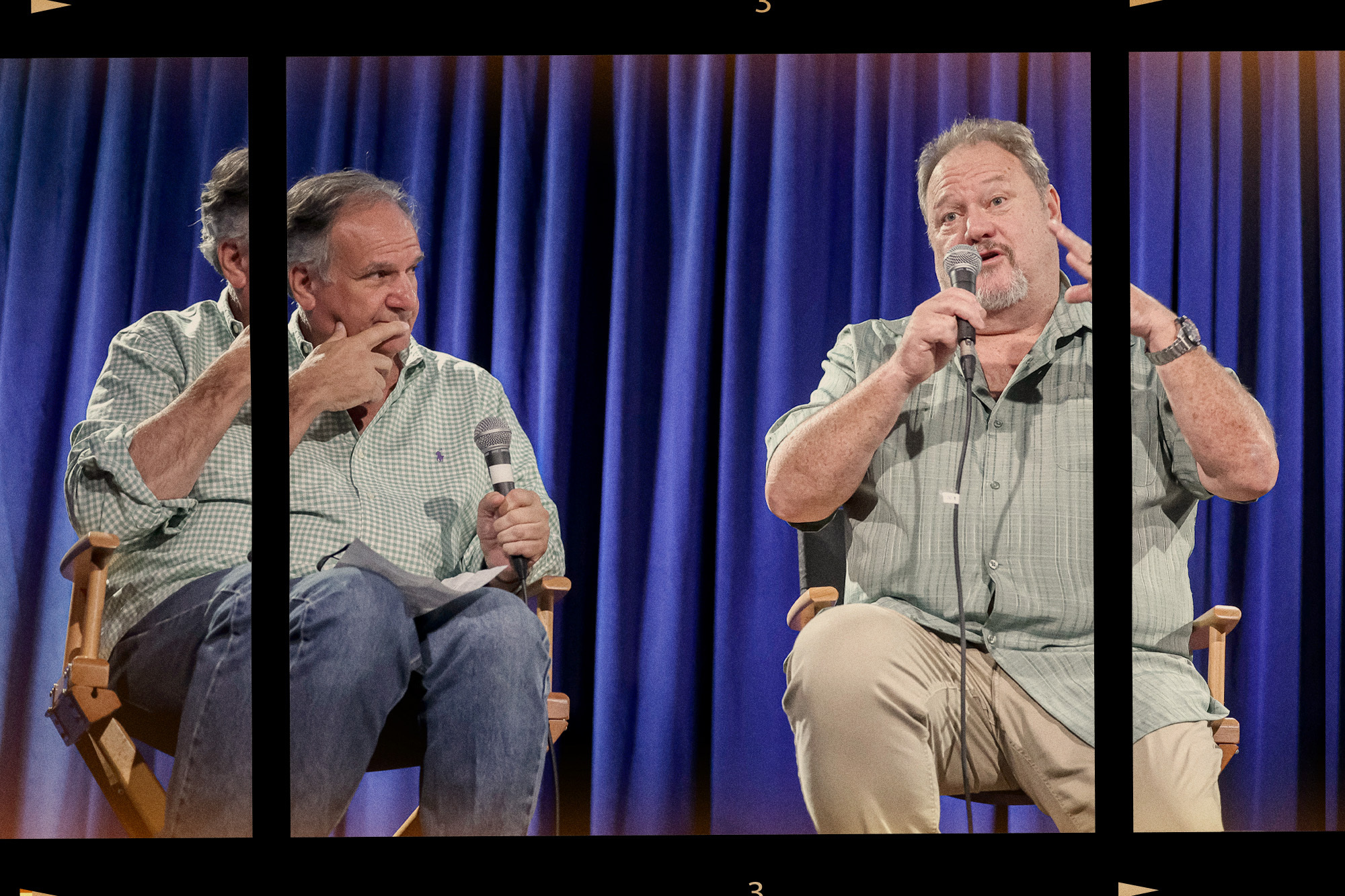

Welcome to the new Emmy season of Art & Crafts, our podcast series that brings audiences behind the scenes with the artisans who create the film and TV we love. This conversation is sponsored by Netflix. Subscribe on Apple Podcasts.

When visual effects supervisor Everett Burrell was a kid growing up in Orange County, he would go into his grandmother’s bedroom to watch her old black-and-white television. It was during that time that three movies struck his fancy: 1933’s King Kong, 1959’s The Killer Shrews and 1962’s The Brain That Wouldn’t Die.
“I was off to the races,” Burrell says of seeing the creature features as a young boy.
But the inspiration for the Emmy-winning Burrell (Babylon 5), a nominee again this year for Netflix’s The Umbrella Academy, didn’t stop there. As Burrell tells moderator Rob Legato, ASC, VES, and an Oscar and Emmy winner, during the Art & Crafts podcast recorded live at the American Society of Cinematographers’ Clubhouse in Los Angeles on Aug. 7, the idea that he could conjure the Hollywood magic he fell in love with as a child didn’t connect until a little later.
“There was a magazine called Famous Monsters of Filmland that they used to sell at a 7-Eleven near my family’s house. And one day, I looked in the back of it, and there was a photo of them putting a man into the Godzilla suit. And I went, ‘Oh, wow, it’s a suit. Somebody makes this stuff,’” Burrell says. “And that was totally the rocket ship in my brain to want to do this.”
Based on the comic book series of the same name, The Umbrella Academy is about a dysfunctional family of superheroes who, in the show’s final season, must reckon with a looming threat called the Cleanse, a massive creature that threatens to destroy the world.

To create the massive creature, Burrell used a variety of tools, including an “AI generative tool.”
The program helped “generate textures and looks on our initial 3-D model. And that blew my mind as a tool,” Burrell says. “I think it’s absolutely fantastic, and it made me think in ways I don’t think I would ever have thought.”
Related:

Says Legato, a legend in the field of visual effects and three-time Oscar winner (for Titanic, Hugo and The Jungle Book), “AI is usually a little more demonized when people speak of it. And I remember this one quote that Ted Sarandos said, which I sort of agree with: ‘AI is not going to take your job, but somebody who knows how to use it will.’”
On The Umbrella Academy, Burrell says AI became a “fantastic tool” for helping expand upon the visual effects team’s original model and work.
“It would create such a weird variety of things that to me was eye-opening. It was still our model, our design, but the textures and the vibe and the just things going on inside the creature were things I would have never thought of,” Burrell says.
Burrell is a seven-time Emmy nominee for his work as a visual effects artist, so he’s come a long way from watching that old TV in his grandmother’s room.
“My parents really didn’t understand what I wanted to do. No one thought I could make a living. I still don’t know if I can make a living,” he says. “But I remember we had a family friend who worked at MGM Studios way back in the early ’80s, and I was able to go with them one day to the set of Buckaroo Banzai, which is one of the first sets I ever worked on. They were an apprentice sign painter heading towards the studio. They made a left into a bar called the Cozy Inn, sat there and drank for two hours before going to work. So I was like, ‘This must be Hollywood, huh?’”
Listen to earlier conversations from our live Art & Crafts event focused on cinematography, editing and production design.

Comments
Only Ankler All Access subscribers can comment
Already a subscriber?