
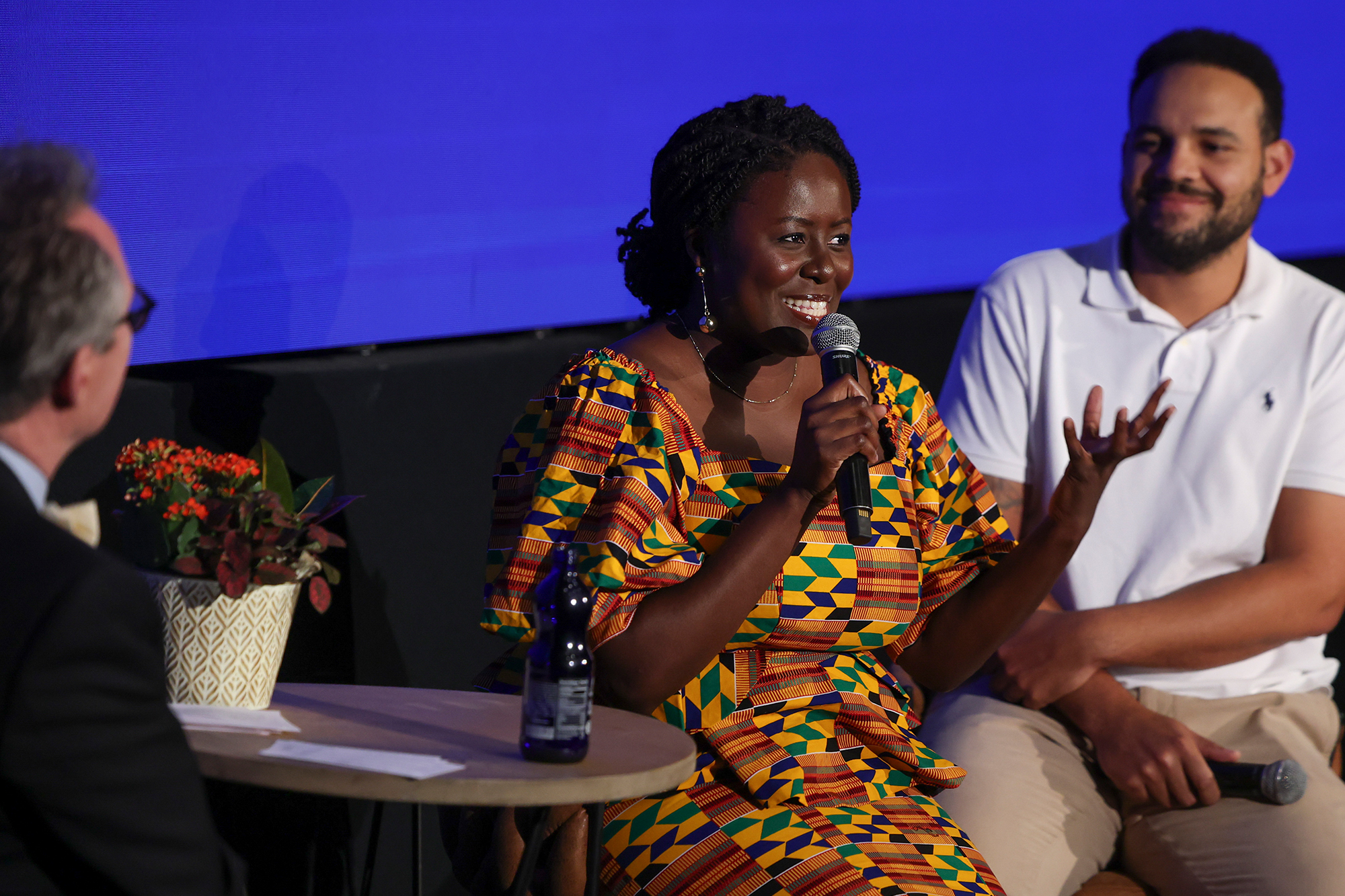
Hosted by Thom Powers, Documentary Spotlight is a partnership between Pure Nonfiction and The Ankler highlighting the best in nonfiction film and television. This edition, held in Los Angeles on Oct. 15, was presented by Nat Geo, Sony Pictures Classics, Watermelon Pictures, HBO Documentary Films, Higher Ground, Breakwater Studios, 4th Row Films and Guest House Productions. You can also listen to audio of these filmmakers in conversation with Powers on the Pure Nonfiction podcast.
Leonard Bernstein believed so strongly in the power of art that he felt it could spur people to “wake up and be active” and drive societal change.
“He believed in people,” Bernstein’s Wall director Douglas Tirola tells Pure Nonfiction host Thom Powers during this month’s Documentary Spotlight event at the Culver Theater in Los Angeles. “That message is really what everything is about — because we’re all looking for change. All these films here today, there are some common themes — including a hopefulness about people.”
For the latest collab between The Ankler and Pure Nonfiction, Powers spoke to Tirola and several other documentary filmmakers — including the directors and producers behind Rehearsals for a Revolution, A Fox Under a Pink Moon, Time and Water, Seized, Just Look Up, The Eyes of Ghana and American Doctor — about their projects and how each reconciles a question Bernstein asks about his own work: “Can art make a difference?”
Humanity Fights Back
American Doctor, Rehearsals for a Revolution, A Fox Under a Pink Moon
Director Poh Si Teng chose the title American Doctor for her documentary about three physicians working at Nasser Hospital in Gaza for a simple reason.
“I just didn’t want people to be biased against the film before they even saw it,” she says. “I thought, ‘Well, let’s choose the most noncontroversial title. That’s the Trojan horse: American Doctor.’”
A former journalist who worked for the New York Times, Teng was so outraged about the human cost of Israel’s war against Hamas — which has left at least 74,000 Palestinians dead, including thousands of children, and been classified as a genocide by many scholars and organizations — that she quit her job at ABC and spent $150,000 of her own money to make the film. The project premiered at this year’s Sundance Film Festival and follows Dr. Mark Perlmutter (a Jewish American orthopedic surgeon from North Carolina), Dr. Thaer Ahmad (a Palestinian American emergency physician from Chicago) and Dr. Feroze Sidhwa (a trauma surgeon from California of Pakistani Parsi heritage) as they seek to provide care to Palestinians injured in Israeli military attacks.
“I had so many fears going into this,” Teng says. “I have never directed before, and I chose the topic that everybody has a strong opinion on. I had to find an angle that was undeniable. If, as a viewer, you may have a bias against this person or that person, can you deny all three? Can you deny what you’re seeing? And so there was a real fear in the question of, How do we craft this?”
Teng says she intentionally avoided wallowing in “depravity” in the movie, opting instead to find a common humanity. “We wanted to make sure that if we see Palestinians as we see ourselves, then we will be willing to fight for them as we would fight for our own.”
When the physicians featured in American Doctor, released by Watermelon Pictures, returned from Gaza, they made several media appearances and even received death threats. But Ahmad says he’s seen a change in awareness ever since the New York Times published a story on its front page earlier this year about Gazans dying from starvation.
“I think there was a click in this country, especially where people were like, ‘No matter what, you don’t do that.’ You don’t watch kids starve to death. There can be no justification,” he says. “And there was this natural conversation that was evolving, and it was happening really at the grassroots level, and that started to materialize upwards. I would never have guessed this. I never would have predicted this is what was going to happen.”
Iranian actress-turned-filmmaker Pegah Ahangarani has storytelling in her blood. Both her parents were filmmakers, and they pushed her to experience the power of movies, even at great personal risk. “I remember I was 6 or 7 years old and my dad came home with something in his hands — he had wrapped it in sheets because he wanted to hide it.” It was a VCR, a machine the Iranian government had forbidden. “But he started to connect the wires, and magic happened for the first time,” she says. They watched Doctor Zhivago first. “Cinema has always been part of my life.”
Now years later, Ahangarani has combined her love of films with her parents’ willingness to push back against Iran’s authoritarianism. After appearing in 40 movies and being arrested twice for participating in anti-government protests (and serving 18 months in prison for supporting the Green Movement), Ahangarani shifted to directing. In 2022, after her short I Am Trying to Remember won multiple awards, she left Iran and emigrated to the United Kingdom. That’s when she began working on her new film, Rehearsals for a Revolution, a Sony Pictures Classics documentary that traces Iranian history from the 1979 revolution to the present day through Ahangarani’s memories.
“I have lived in Iran for many years, and I know very well that the dictators don’t only censor people; they also try to erase our past, erase our memories and erase our victims — especially our victims,” she says. Rehearsals for a Revolution — which won the L’Œil d’Or (Golden Eye) prize for best documentary at this year’s Cannes Film Festival and is also the United Kingdom’s submission to the international feature Oscar race — uses five portraits of Ahangarani’s family members and mentors, and tracks their lives and activism through personal archives, home movies, recordings of street protests, newspaper reports and oral testimonies.
“I think this resistance and this struggle is ongoing in Iran,” she says. “I think continuing to fight, continuing to resist, is a form of hope. These are very dark days for all of us as Iranians. But I know that as soon as people find a space, they will stand up again, fight again and continue to struggle. And this is hope. Hope is continuing even when you are in the darkness.”
The harrowing story of Mehrdad Oskouei and Soraya Akhlaghi’s A Fox Under a Pink Moon, about Akhlaghi’s attempts to flee Iran — where she lived as an Afghan refugee — and reunite with her mother in Austria, began with a conversation.
“I used to sit in the corner in the workshop, just passing time by myself,” says Akhlaghi, who started sculpting as a teen. When she was 15, Oskouei came into her life. “I didn’t like to go and have conversations with all these people that kept coming to the workshop. But when Uncle Mehrdad came in, he was immediately curious to see what I did.”
Oskouei, an acclaimed Iranian filmmaker, was planning to make a documentary about Akhlaghi’s mentor; instead, he turned his attention to Akhlaghi and her efforts to leave Iran and her abusive husband. Using footage Akhlaghi recorded on her phone over five years, the ensuing film tracks her journey.
“To be honest, I hated to film myself because I was a teenager, and all the photos and videos that I took of myself were with filters, and they weren’t really me,” says Akhlaghi, who speaks through a translator for the interview. “So this process started when I hated myself and my image, and step by step, as we went further and further, I started to make a connection with the camera — and I understood that the camera was becoming my friend; a friend I didn’t have.”
Akhlaghi, who currently lives in Berlin, and Oskouei, based in Iran, couldn’t travel with A Fox Under a Pink Moon this year (Kino Lorber is handling distribution), but “our dreams and our film can fly everywhere,” Oskouei says.
“Soraya is my role model,” he adds. “I believe that she can change something in the near future. And she can, like the butterfly effect, she can change little things for Afghanistani girls, for women, and for all women and girls around the world with her film.”
Environmental Matters
Time and Water, Just Look Up
Filmmaker Sara Dosa was fascinated by Iceland even before she made The Seer and the Unseen, 2019’s magical realist doc about an Icelandic woman who speaks on behalf of nature under threat. “Once I arrived in Iceland, it felt like a transcendent experience,” she says. “I’ve always loved nature, but I really felt like I could see kind of a map of geologic time in the landscape itself. It made me feel so small in my own kind of fleeting human life.”
Dosa confronted those feelings directly in her latest film, Time and Water, which explores the life and work of Icelandic writer Andri Snær Magnason and his eulogy for the country’s melting glaciers. The film uses archival footage of Magnason’s family mixed with his words about the climate catastrophe unfolding in real time.
“His grandparents were some of the first to photograph and film Iceland’s glaciers,” Dosa says. “It was so important for us to communicate the idea that glaciers are still alive. They’re still with us. They have an intelligence, a sentience, a life cycle, even though they’re technically abiotic.”
The goal of Time and Water — which premiered at the Sundance Film Festival and was released in May by Nat Geo (it’s now streaming on Disney+) — was to create an intimate, deeply personal film, the director adds, while acknowledging that the loss of home is a universal feeling.
“We were really hoping that this emphasis on home and this intimacy could invite audiences to feel what it might be like for their own homes to be lost — how their grandparents’ sense of landscape, their relationship to nature, might be so different from their own,” she says. “Many people, tragically, are already experiencing that loss of home.”
Of course, dealing with the climate crisis doesn’t just require empathy — it requires confrontation.
“The other tactics aren’t working,” says Michael Greenberg, the founder of the youth activist group Climate Defiance and the subject of Just Look Up. The film, directed by Betsy Hershey and Emma Wall and executive produced by Adam McKay and Joshua Oppenheimer, follows Greenberg’s group as they confront multiple Democratic officials — including former Biden administration officials like Pete Buttigieg and John Podesta — to spur action on climate change reform.
“We shut down cabinet secretaries, advisers to the president. We confronted Podesta,” says Greenberg. “And let me tell you what happened after that. I ran into him a few days later. He called me a pain in the ass, but he said, ‘We need to talk.’”
That meeting at the White House between Climate Defiance and Podesta eventually led the White House to announce a moratorium on new liquefied natural gas exports.
“In the press release that the White House put out, they even quoted Climate Defiance as one of the groups that was involved,” says Greenberg. “Literally billions of dollars are spent each year on petitions, on coalition letters, on fucking bus stop ads — and people tune it out. There’s overload. But when you see people directly confronting, directly disrupting, that actually breaks through, that reaches people in a way that’s real.”
“It was about nonviolent civil disobedience and how this is the tool that we have as humans to make change,” adds Hershey. “And it’s the only tool that we have when all the other tools have kind of run out of hope.”
Speaking about the power of nonviolent, confrontational protest like the kind that Climate Defiance specializes in, Wall cites Erica Chenoweth’s 3.5 percent rule, which stipulates “those engaging a threshold of 3.5 percent of the population have never failed to bring about change.”
“All those things, when you hear about them in the history books, sound appealing and popular,” Wall says of protest movements throughout time. “In fact, they were all very unpopular at the times that they existed. They made people uncomfortable and angry. And so that was kind of part of it. This is the least that we can do, and we need to do it. There’s no alternative.”
Recontextualizing History
Seized, The Eyes of Ghana, Bernstein’s Wall
Director Sharon Liese first heard about the 2023 police raid on a local newspaper in Marion, Kansas, while listening to the radio. “I happened to live in Kansas, and I’d never heard of Marion before,” says Liese, who lived about two hours away. “I drove to Marion, Kansas, and talked to the editor and just really knew when I got to the town that this is the story I really need to tell.”
Liese’s new documentary, Seized, focuses on the raid on the Marion County Record — which occurred after police suspected a reporter had committed identity theft and unlawfully accessed the driving records of a local restaurant owner. But the story took an even more tragic turn a day after the incident, when co-owner Joan Meyer — who ran the paper with her son, Eric — died.
“Eric wanted to talk,” says Liese. “He wanted to get the story out. But the rest of the town was really hesitant. It took at least a year for us to get other people on board to talk to us, because the media came in and left — and they did tell a story, but only part of it.”
Overcoming the townspeople’s distrust is only part of Seized, a documentary about the assault on First Amendment rights and the actions that have eroded the idea of a free press in America.
“I think everybody wants a free press,” says Liese. “Everyone says they believe in the First Amendment. But when something unflattering is written about you, everyone has second thoughts. And I think that’s what we wanted to explore.”
The other aspect of Seized is its location: the small town of Marion, and its eccentric community. “There’s a plethora of points of view that people feel that don’t often get shown in a film,” says producer Sasha Alpert. “These are people who have very strong opinions about their community and about their newspaper. The film also has a lot of gossip that I think is typical of what you think of as a small town. Sometimes it can feel a little bit like a Real Housewives for a minute because it’s people really giving an unvarnished view of how they feel about their neighbors and the newspaper and their friends.”
Documenting a time and place is foundational to The Eyes of Ghana. Director Ben Proudfoot’s film focuses on Chris Tsui Hesse, the now 94-year-old personal cinematographer to Dr. Kwame Nkrumah, Ghana’s first president.
Proudfoot met Hesse while visiting Ghana on a UNICEF mission in 2021 and heard firsthand about his background: how he saved more than 1,000 rolls of footage of Ghana’s history and its first president after the 1966 military coup.
“That history was sort of buried away. And so this film, working on this film, certainly was an opportunity to excavate that history,” says producer Nana Adwoa Frimpong, whose family emigrated from Ghana to Canada, where she was raised. Eyes of Ghana, she adds, allowed her to “get curious about where my parents are from, what that legacy means, what it means in present day when it comes to thinking about leadership, about the power of archive, about the necessity of our elders.”
Proudfoot, a two-time Oscar winner, partnered with Barack and Michelle Obama’s Higher Ground on The Eyes of Ghana, his second feature since 2016’s Rwanda & Juliet.
“I will never look at a map and see Africa on it in the same way,” says Ethan Lewis, head of non-fiction and sports at Higher Ground. “It’s an incredible story that reframes the story of a continent in a way that is a complete revelation. And that really blew us away; we knew we had to be a part of it.”
But the Obamas aren’t the only big name attached to The Eyes of Ghana. Streamer IShowSpeed (real name Darren Jason Watkins Jr.), whose mother is from Ghana, joined the project as an executive producer and is helping bring the film to theaters for one night only on Oct. 28.
“It’s not just for the 94-year-olds of the world,” says Frimpong, about what the partnership can bring to the movie. “It’s for generations way behind him to see what has happened so that we can learn from it.”
Douglas Tirola premiered Bernstein’s Wall at the Tribeca Film Festival in 2021, earning strong reviews for his archival documentary about Leonard Bernstein.
Then, with a major biopic about Bernstein from Bradley Cooper in the offing, and Steven Spielberg’s West Side Story remake coming later that same year, he waited.
“I do think the film aged in our advantage, which I think we were not expecting, because it’s an archival film about someone who’s passed away,” says Tirola of the five-year delay between the festival premiere and the theatrical release earlier this year. “When we were pitching it, part of what we learned in researching it that made us want to tell this story was that he’s talking about so many things that are still with us now, the same problems. We found this footage early on where he says, ‘People ask me, can art make change, can make a difference?’ And that’s what the movie became about and why I wanted to make it.”
Using Bernstein’s own words and set against the backdrop of his historic 1989 Berlin Christmas Day concert, Bernstein’s Wall touches on the late legend’s history of activism — including the Civil Rights movement and protests against the Vietnam War — as well as his personal life. (Bernstein was gay, although he was married to Felicia Montealegre until her death.) The movie includes multiple letters shared between Bernstein and Aaron Copland. “I had great teachers of conducting, but I never had a composition teacher,” Bernstein says in the film. “The closest I ever came to that was with Aaron Copland. I revere and worship Aaron Copland for what he taught me about composition.”
“What we realized in going through all this footage — he talks a lot about walls, tearing walls down, walls between us, and then the complexities of his own character and personality,” Tirola says. “There was a wall in himself, and he was also trying to tear down walls because he believed everyone should be able to get along together.”


Comments
Only Ankler All Access subscribers can comment
Already a subscriber?