

Degen Pener is the editor of Four Seasons magazine, a contributing writer for C Magazine and has written for the New York Times, Out, InStyle, The Hollywood Reporter, Entertainment Weekly, Elle, Details, Los Angeles magazine, Wallpaper, Veranda and New York.
All around Los Angeles — from industry parties to trendy clubs — cigarettes appear to be making their Hollywood comeback, despite decades of public health campaigns aimed at snubbing them out.
On March 23, the cast and creators of Love Story — chock full of scenes showing Carolyn Bessette (and less frequently, JFK Jr.) smoking back in the ’90s — celebrated the show’s success at the Chateau Marmont penthouse, where executive producer Ryan Murphy sat smiling next to Kaia Gerber, clad in a low-cut black dress with a cigarette held in her perfectly manicured hand.
A week earlier, the night before the Oscars, a writer who had just come from the Chanel and Charles Finch party at the Beverly Hills Hotel exclaimed, “Everyone was smoking there!”
And on a recent evening at private club The Living Room in Hollywood, cigarette smokers were scattered around the garden-like outdoor bar. No one appeared to bat an eye as they lit up.
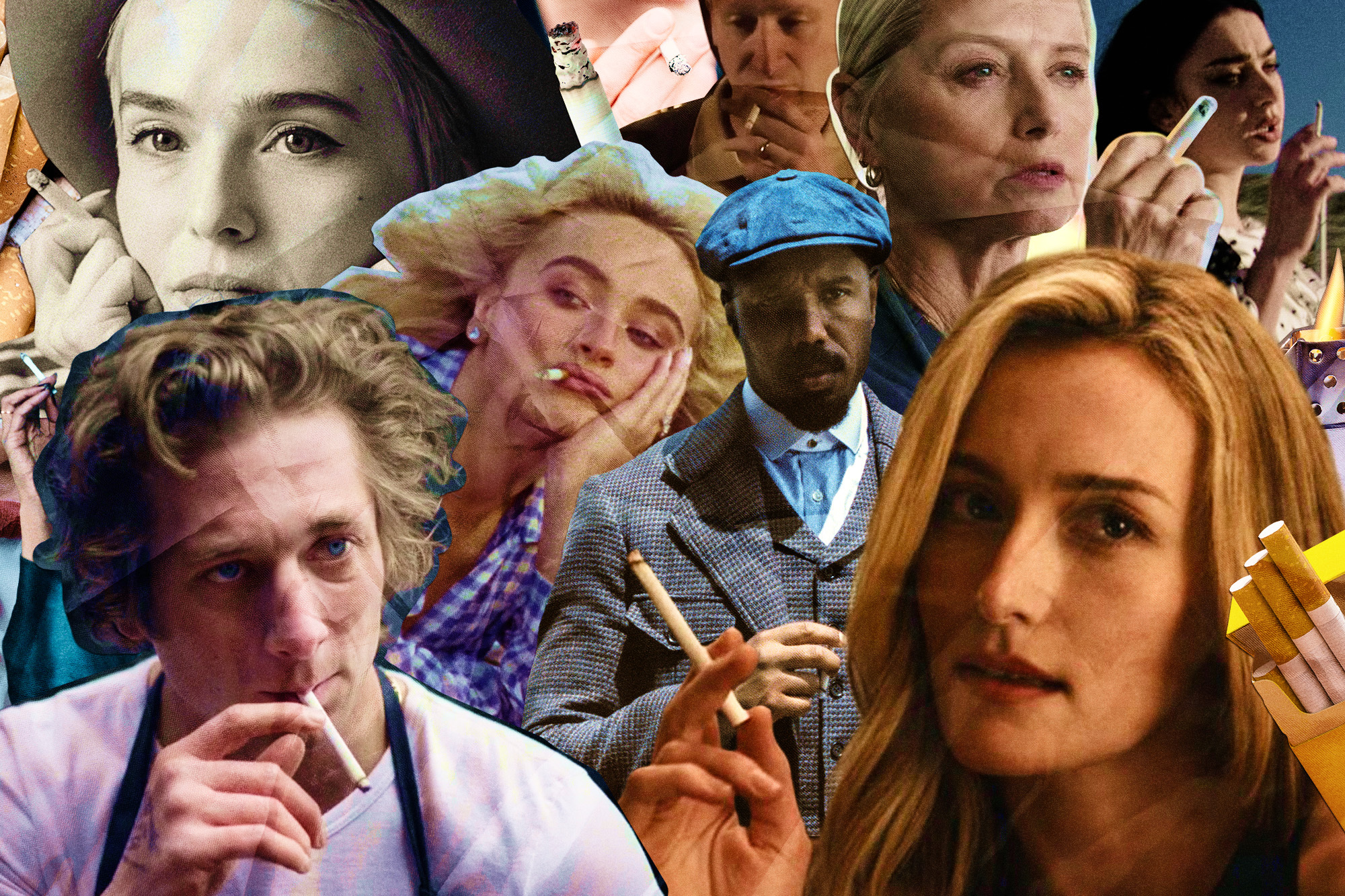
Where there’s smoke, there’s smoking. A growing cohort of young celebs — from Heated Rivalry stars Hudson Williams and Connor Storrie to Addison Rae and I Love LA star-creator Rachel Sennott — have been photographed puffing at or holding old-school tobacco cigarettes, providing plenty of fodder for the Instagram account Cigfluencers, which chronicles famous contemporary smokers.
Fashion brands too are drawing on the history of cigarettes as a signifier of cool, at times even handing out smokes at events. At the launch party for Gwyneth Paltrow’s Gwyn last fall, ultra-skinny cigarettes were set out on little silver trays; a Khaite party at Dan Tana’s last November incorporated branded cigarette boxes aping classic Marlboros, and a Dôen benefit for Planned Parenthood (a health organization natch) at Mother Wolf in December featured cigs on tiered trays decorated with red bows.
Onscreen the habit is everywhere: One Battle After Another and Sinners both featured cigarettes (and cigars), as did several other Oscar best picture nominees. The nurses of The Pitt blow off steam with smoke breaks. Prime Video’s Scarpetta is set in two timelines — present day and the late ’90s — and characters puff like dragons in both of them. Last year, the anti-smoking group Truth Initiative found that on-screen depiction of tobacco increased for the first time since 2002, with smoking shown in 80 percent of the 2025 Oscar best picture nominees, including Anora and The Substance.
Magazines also promote butts as glamorous props, from Kylie Jenner on the cover of the latest Vanity Fair to Love Story star Paul Anthony Kelly and Sabrina Carpenter in Interview and Marty Supreme’s Odessa A’Zion in W. Last November, the fashion research firm Style Analytics reported a 70 percent year-over-year increase in U.S. searches for the term “smoking pose” among people aged 18 to 24 — a demographic that, until recently, had been defined by its move away from traditional cigarettes.

All of this comes at a time when smoking in the United States, at least according to official surveys, has plummeted to an historic low. Just 9.8 percent of Americans smoked in 2024, according to a report from the U.S. Centers for Disease Control and Prevention, down from 10.8 percent the year before. By comparison, 24 percent of Americans smoked cigarettes in 1998.
What hasn’t changed: smoking’s lethality. According to the CDC, cigarette smoking causes about one of every five deaths in the United States each year — more than 480,000 deaths annually (including deaths from secondhand smoke).
Nonetheless, there’ve been a few hot takes lately on the apparent resurgence of cigarettes (see here, here and here), mostly musing on whether imagery of stars smoking will lead to rising rates among the gen pop. The conversation often circles a familiar question: Is culture driving behavior, or simply reflecting it? Of course, among those who work in and around the entertainment industry, celebrity rituals — from cosmetic procedures to juice cleanses — rub off even more readily. So it’s no surprise that as stars light up onscreen and IRL, Hollywood nightlife is starting to look a little hazier.
What’s largely been missing from the discourse is the perspective of smokers themselves. So I spent several nights out on the town talking to young smokers who work in the industry to hear how — and why — they’re picking up the habit.
Their reasons range from a desire to look cool and a love of the smoking aesthetic to the social aspect. Stress relief and rebellion, along with a growing distaste for vapes, are factors too.
‘It’s an Aesthetic Thing’

On a recent Friday night outside of Echo Park’s Taix restaurant (which closed on March 29 after 99 years in business), a trio of twentysomethings are puffing outside on the sidewalk. They’re happy to share their thoughts — but not their real names — for my article (all psuedonyms are asterisked). No one, it seems, wants to be the poster child of this reboot.
Cole* is a script coordinator. “I feel like I know more people who smoke cigarettes my age than who smoke weed, which is, like, crazy,” he tells me. Growing up in the South, he thought of smoking as “an older person thing,” and even back in college, around 2020, he recalls that seeing young people smoking was “very rare.”
But now, “young people are smoking more out here in L.A. It’s much more of a hipster young person thing.” Cole pauses, then adds, “When I’m out, I will always take out cigarettes, especially while you’re drinking with friends. I’m a lot more inclined when I’m around other people.”
One of his friends, 28-year-old Mia*, works as an assistant to a screenwriter. Between puffs, she details that while a few years back “smoking had gone from mainstream to so isolated,” it’s now returned in her social circles. “When I was in high school, vaping had really taken off. I feel like around the end of my college tenure, around 2020, people seemed to agree vaping was kind of cringe and went back to the real thing. For young people who consider themselves more alternative or more rebellious, it became sort of like, ‘Oh, it’s cool again.’”
She doesn’t know anyone smoking “like half a pack a day,” Mia adds. “It’s sort of an aesthetic thing when I’m drinking, when I’m out on the town, you know?”
Another trio of smokers outside Taix, all in their 30s, includes a producer and a comedian.
“When I was younger, we were like D.A.R.E.-programmed out of [smoking]. For a while when I would see someone smoking in L.A., it would be jarring,” says Jake*, the comedian. “Now it’s a little more accepted.” He adds that he also likes smoking cigarettes because “it’s a social activity. It brings people together and it fosters a conversation.”
Jake goes so far as to compare smoking to another trend: vinyl records. “In my head, I’ve connected it to this thing where people are going analog,” he explains. “Like we’re going away from vaping and back to cigarettes, to physical media. Vaping is just not sexy. [Vapes] never were, never will be,” he says. Kate, the producer, agrees. “Vapes are like smoking a machine,” she adds.
Before they walk off into the night, their third friend, who works at a club, pipes up. “[Smoking] is undeniably cool. It looks good. I see someone light one up and I’m like, ‘Damn, I want one now.’”
‘Don’t Tell My Kids’
The next week, a film producer tells me she’s been smoking again out and about on the Hollywood party circuit. “I don’t know why but smoking is everywhere,” she says. “I was at [San Vicente] Bungalows the other night, and I was smoking with this actor friend who was in town, and three men came up and said, ‘Can we bum?’ Maybe we’re not yet at the point of people buying packs, but they are definitely bumming at events and parties I go to. I feel like actors are always gonna smoke, but now I’m seeing other people — it’s not everybody, but there’s definitely a comeback.” Before signing off, she adds, “Don’t tell my kids.”
Just this past Saturday night, a group of seven or so twentysomethings were standing outside the cafe and nightclub Galerie on Sunset, a few of them puffing. (While smoking in outdoor seating areas was banned by both Los Angeles and West Hollywood in 2011, Galerie has a rare exemption permit allowing legal smoking on its outdoor patio.)
Paul* just got his first job in the industry, working in animation at a studio. He doesn’t consider himself a smoker. “I don’t like cigarettes really,” he says. “But when we’re out, depending on how drunk I am, I will sometimes smoke a cigarette. And it’s not for the nicotine. It’s because I think I look cool, and I want to blow smoke out of my mouth.”
Paul’s friend Clark* chimes in that he’s seeing a resurgence of smoking among young colleagues at the talent agency where he works. “Yeah, definitely when they’re out and about, they smoke.”
It may be unrealistic, however, for many of these young smokers to think they can limit cigarettes to an occasional, out-on-the-town habit. Years of research have shown that nicotine is highly addictive — and the health risks are of course well known.
“The harmful effects of smoking have not changed,” notes Nisha Chellam, M.D., an internist with medical practice Parsley Health (which offers virtual care and has physical locations in West Hollywood and New York City). “It still is heart disease, lung cancer, oral cancers.” Smoking a single cigarette takes an average of about 20 minutes off a person’s lifespan, per a recent study from University College London. Vapes, aka e-cigarettes, also come with risks including an increased chance of developing chronic obstructive pulmonary disease; a new report from the University of South Wales also suggests that vaping can cause oral cancer. While vapes do contain nicotine, they’ve long been considered safer than cigarettes because they don’t burn tobacco (which creates tar, a prime cause of lung cancer).
While Chellam says Parsley’s L.A. practice hasn’t seen an increase in cigarette smoking among patients, she does note that one challenge in today’s media landscape is reaching young people with anti-smoking PSAs. “The medical system is really behind on talking about these things constantly on TikTok and other platforms,” she says.
The Social Smoking Network

Sara Wilson, founder of digital strategy consultancy SW Projects, sees a number of factors at play in cigarettes’ appeal with millennials and Gen Z. “First off, people have a short memory; a big part of it is nobody actually has a memory of what cigarettes do. You know, my mom smoked in our home and I remember that viscerally. But if you’re Gen Z and you’re 25 years old, chances are that was not the case.”
Wilson adds that “there are these aesthetic codes that people are obsessed with, and there’s a real desire right now for personal agency too. We’re in a moment of ‘Don’t tell me what to do.’ Any way that you can exert agency I think is very compelling — no matter how unhealthy it might be. And then the other big piece of this is that there’s a huge collective craving for connection. It’s part of the same impetus for club culture and dance parties coming back. People want to be [out] in the world right now.”
Wilson’s comments about personal agency, of course, connect to the overall regressive impulses of the Trump era. According to Chellam, who’s also board-certified in holistic and integrative medicine, if some people in Gen Z are embracing smoking, it could be “a statement against millennial wellness culture.”
There’s also a hedonistic nihilism at work — a feeling of everything being in flames right now, so why not enjoy the moment?
“Look at the state of the world, the state of the country, the state of the industry,” one TV producer tells me. “I think people are stressed out of their fucking minds.” A twentysomething who works in PR told me, amid puffs on a cig on the Galerie patio, that she took up the habit a year ago. “I started because of stress. I have a really hard job.”
As Jake, the comedian, puts it, “L.A. specifically is primed for this because we’re coming off of Covid and the strikes and the fires and like, the contraction of the business.”
Still, Gen Z smokers who spoke with The Ankler reject the idea that their present mindset is nihilistic. “I don’t think it comes out of a place of nothing matters anymore,” says Austin*, another Galerie puffer, who works as a producer’s assistant. “Today, everyone knows what the consequences of smoking are, obviously. It’s no mystery. We’re constantly making decisions, whether it’s deliberately ignoring it because we’re only thinking about the short term or just accepting that one cigarette a week is not going to affect our health as severely as we’re told.”
Austin, who’s 23, didn’t smoke or vape in high school and only started smoking cigarettes in college during a study-abroad program. He tends to indulge just once a week when going out, though occasionally he’ll smoke on his commute home after a particularly stressful day. But smoking for him is, most saliently, a social activity. “It’s an excuse to go up to a stranger at a bar and say, ‘Hey, do you have a cigarette?’ It’s the easiest thing,” he says. It’s even helped him make industry connections. “I’ve met other assistants and coordinators in the industry while sharing a cigarette. I’ve shared cigarettes with mid-level execs and chatted with them outside [a bar]. How can you ask me to give it up when there’s been direct benefits on my career as a result?”
Seeing cigarettes onscreen affects Austin’s impulses. Watching Sentimental Value a couple months ago, he says, he felt moved by scenes in the film showing the characters smoking during reflective moments. “It reminds you that, ‘Oh, my life is a movie too,’” he tells me. “I feel like I’m a character in my own story.”