

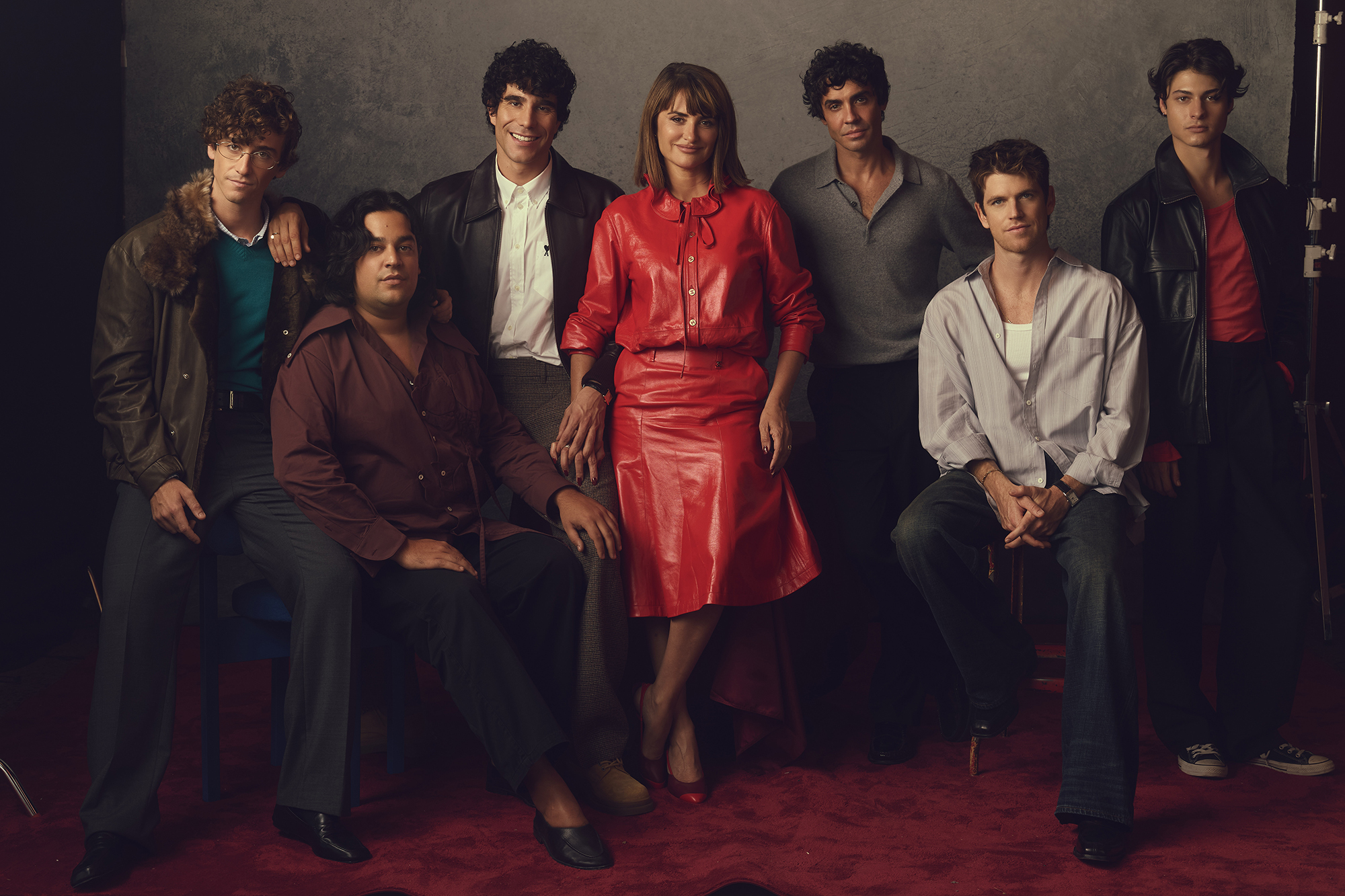
With the Emmys now out of the way — you caught our livestream and podcast recap, right? — we are now free to fully focus on film awards season, and what a great time to do it. As Christopher Rosen and I discussed in our final video TIFF dispatch yesterday, the festival premieres of films like The Debut and Elsinore have supercharged what was already a lot of Oscar buzz. And we haven’t even gotten to the TIFF premiere of Cannes hit La Bola Negra yet!
We’ve bid farewell to our video and portrait studio at Soluna, and today we’re sharing our final batch of video conversations and portraits from the great Austin Hargrave. We’ve got director Jesse Eisenberg fresh off the raucous reception for The Debut, the team behind Tenzing trying to explain exactly why anyone would climb Mount Everest and the wonderful cast of La Bola Negra alongside their fabulous directors, Javier Calvo and Javier Ambrossi (and don’t worry — I’ll have so much more from them next week on the podcast). Let’s dive in, one last time!
La Bola Negra: Cinema Unmatched
With stunning war sequences and a story spanning decades, no version of La Bola Negra could be small.
Based on the plays La bola negra by Federico García Lorca and La piedra oscura by Alberto Conejero, the Netflix film is set across three timelines — in 1932 during the Second Spanish Republic, in 1937 during the Spanish Civil War and in 2017 in contemporary Spain — and focuses on the interconnected stories of several gay men in the various eras.
“When we were writing, at some point we knew that it was an opportunity to make a political statement about LGBTQ+ movies not being niche — that they can be mainstream and be for everyone,” says Javier Ambrossi, who co-wrote and co-directed La Bola Negra with his longtime collaborator and former romantic partner, Javier Calvo. “It’s such a universal message in that intimacy that suddenly in my mind I understood that it has to be big. So we went for us. We went for epic gay drama.”
“But we needed the intimacy,” adds Calvo. “As queer creators, we don’t see creation as a binary thing. It’s like you’re making either a war movie or an intimate movie. No, we like everything. I love Come and See, but I also love Portrait of a Lady on Fire. So it was trying to make a complex, rich movie that could get into your guts, get into your soul, but also see the hardness of war and make a harsh and raw anti-war movie, which is important these days.”

Featuring several breakout Spanish actors — including the trio of young stars who anchor the sections (Milo Quifes in 1932, Guitarricadelafuente in 1937 and Carlos González in 2017) — La Bola Negra also bridges the generations of great Spanish filmmaking, with Penélope Cruz playing a key role as a cupletista — a kind of cabaret singer — who connects with Guitarricadelafuente’s character, Sebastian. Cruz says Los Javis were initially reticent to approach her for the small part, but she’s glad they did. “When I read it, I was blown away by a perfect script, which is so hard to find — perfection from beginning to end,” she says.
In her stunning scenes, Cruz has to sing and dance in ways she’s never done on film before. But what really stuck with her was what the character represents.
“She’s that little window to a possibility of there being a place and a time where you can be yourself. She represents that, and she fights for that,” Cruz says. “For me, that was very moving, and I had zero doubts that I wanted to be part of this. I am just very grateful and honored to be a part of something so special and so important — because once in a while a movie can move consciousness and heart so much that it becomes so much more than entertainment. I think this movie has that.”
Ink: Media Madness
To play Rupert Murdoch in Danny Boyle’s latest movie Ink — about the rise of The Sun tabloid in 1969 — Guy Pearce wanted to avoid conventional wisdom as much as possible.
“Every friend of mine or anyone I spoke to about doing the film — everybody said to me, ‘Oh, what’s it like playing the most awful person who’s ever existed in the universe?’” Pearce says. “I understand why, but I’m not looking at that when we are making a movie. I’m looking at his personality, his psychology, his behavior — just what kind of person he is sitting down at the dinner table with his family and who he was with his mom.”
Based on the play by James Graham, who also wrote the film adaptation, one subversive aspect of Ink is how it makes Murdoch a man foolish enough to think he could ever control his media empire once it got out of the cage. Boyle’s lively drama centers on Larry Lamb (Jack O’Connell), the Yorkshire-born editor whom Murdoch hired to remake The Sun into a populist tabloid by feeding its readers salacious content — like nude models (he’s the brain behind Britain’s Page 3 girls) and what we’d now consider clickbait headlines.
“It was times of plenty,” says O’Connell, who plays Lamb with an amoral, outsider vigor that recalls Leonardo DiCaprio in The Wolf of Wall Street. “There was so much money circulating in this industry at this particular time. There was a lavishness, and there was a feeling of rolling in it, a rock-and-roll type feeling — and that was a massive guide.”

As depicted in the film, Lamb pushed the envelope of The Sun’s coverage — earning more and more readers by the day, financial success he took as an endorsement of his unconventional and reckless approach to journalism.
“There’s a reason why Murdoch chose Larry,” Pearce says, suggesting Murdoch’s initial goal was to take on an establishment media that looked down on the Australian native as lower class. “He knew he would get that in Larry,” Pearce adds, “but he probably knew that it might actually get bigger and more challenging than he perhaps thought as well.”
Tenzing: To the Mountaintop
George Mallory, a minor figure in the film Tenzing, famously said that his reason for climbing Mount Everest was “because it’s there.” There’s a similar story behind Tenzing, which retells the famous 1953 Everest ascent, focusing on Tenzing Norgay, the Nepalese-Indian mountaineer who joined Sir Edmund Hillary to become the first two people to summit the mountain. Norgay’s story has been public knowledge for decades but often overshadowed in the Western world; director Jennifer Peedom wanted to tell it, in a way, because it’s there.
“He grew up in the shadow of Everest herding his father’s yaks as a boy, and had this spiritual connection to this landscape and to this particular mountain,” says Peedom, who joined the film’s star, Genden Phuntsok, and producer, Liz Watts, in our studio. “It was about trying to understand that and what it meant to him and what this journey meant to him, which is very different to what it meant to the British climbers that came to climb the mountain.”
For Phuntsok, who had to learn the Sherpa language as well as mountaineering to play Tenzing, filming on actual mountains — including a real New Zealand mountaintop that stood in for the Everest summit — helped him feel some of the draw of the mountain that the real Tenzing did. “I just stood there for a moment and thought, I’m standing on top of the world.”
A Long Winter: Coming of Age
Andrew Haigh has been thinking about A Long Winter for a long time. He first read the 2006 Colm Tóibín short story it’s based on 16 years ago and “fell in love.”
“I really identified with the kid in the story,” Haigh says of his initial response to the material, which is about a young man named Mike (Fred Hechinger), who lives with his family on a Colorado mountain during the 1950s and grapples with understanding his sexuality as he comes of age.
But returning to the material years later, Haigh says his perspective shifted. “I’ve sort of grown up with this story, and now what I loved about it was this sense of resilience that this character can build and this sense of hope out of pain and loss and struggle that can emerge out of these kinds of difficult places.”

The latest contemplative drama from Haigh, the acclaimed filmmaker behind All of Us Strangers and Weekend, Mubi’s A Long Winter is also his biggest swing — a lavish period piece shot on location in Colorado during a snowy winter.
“Some productions would try to do this on a soundstage, and it’s unimaginable with the movie that Andrew made that it would ever have been on a soundstage,” Hechinger says. For Mike’s home, which he eventually shares with only his father, played by Ebon Moss-Bachrach, Haigh and his team built the dwelling from scratch. Hechinger remembers the wind from the mountain whipping through the ground floor — something Haigh even wrote into the script.
“Every day we were going to very real places,” Hechinger says of the production, “and it forces everybody to step up to the reality of the story and make it real by nature of it being there.”
Ben’Imana: A Country First
For Rwandan filmmaker Marie Clémentine Dusabejambo, making Ben’Imana was about uplifting an entire nation.
“Previously, we were all working on international films as assistants of assistants. So this was a very exciting project for us where everyone was the chief of a department,” she says of her debut feature, which was shot in Rwanda. “And because it was also a shared story about Rwanda, everyone felt the responsibility. The film doesn’t have a million-dollar budget, but its quality and beauty come from the desire to do work that can reach the big platform. The film is everyone’s baby.”
Set years after the 1994 Rwandan genocide left more than 650,000 Tutsi dead and featuring an almost entirely female cast, Ben’Imana dramatizes the nation’s gacaca courts — the tribunals based in Rwandan tradition that were convened to promote reconciliation after the ethnic cleansing — and attempts to show how forgiveness in the face of unspeakable tragedy is possible.
“I knew it was going to take me a lot of time,” Dusabejambo says of the film, which took more than a decade to complete. “It’s a film that I had to make.”
Ben’Imana made history earlier this year as the first movie from a Rwandan director selected for the Cannes Film Festival — an honor made even more special when it won the Caméra d’Or, Cannes’ prize for best first feature.
“There was another film that was shot in Rwanda after Ben’Imana, and every time the crew was saying, ‘Okay, we know what to do. We won the Caméra d’Or, so you don’t have to ask too many questions,’” Dusabejambo says of what the film world’s embrace of Ben’Imana has meant to Rwandan filmmaking culture. “So it was like a passport, like a veil that was pulled out to see that there are local skills, and we can be trusted to make a good film and make it to the big screen.”
The Only Living Pickpocket in New York: Sleight of Hand
John Turturro gets sent a lot of bad scripts. “You read so many that you just go, ‘Wow, I don’t want to do that. I’m not going to do that.’ And all you can do is say no.”
But when he read the screenplay for The Only Living Pickpocket in New York, it gave him pause because it was so good. Taken aback, Turturro talked to his agent, Christina Bazdekis, and wondered if it was as special as he thought. “We read it again, and we both agreed it was great. I was very moved by the world, the character, his relationships, him trying to redeem himself for the life that he’s led.”
By that point, at least on paper, Turturro was in on the project — but one last hurdle remained: meeting the writer and director, Noah Segan.
“I learned from Albert Finney many years ago that the best way to interview a director is over a meal,” Turturro says. “He said, ‘If you don’t like the person after you’ve eaten, don’t work with him.’ And Albert knew what he was talking about.”
Fortunately for Segan, breaking bread with the New York acting legend went about as well as could be expected. “I hope it doesn’t seem too narcissistic to say, but it felt like I was home,” Segan says.

Written and directed by Segan — an actor and filmmaker who has appeared in every project directed by his friend and executive producer Rian Johnson — Sony Pictures Classics’ The Only Living Pickpocket in New York is about a day in the life of Harry Lehman (Turturro), the title small-time crook who encounters friends and foes old and new.
“I love movie movies,” Segan says of his feature, which also stars Giancarlo Esposito as an NYPD detective and Will Price as a young, dangerous criminal nepo baby. “I’m one of those guys who thinks every movie is a genre movie, or at least that’s what I’m looking for. But a movie isn’t anything if it doesn’t have characters — if it’s not about a person or people.”
The Debut: Musical Theater
A funny thing has happened halfway through festival screenings of Jesse Eisenberg’s The Debut in Telluride and Toronto this month — rapturous applause for star Julianne Moore after a particularly incredible scene where her character, a New Jersey housewife who becomes an actress at a local theater, finally understands what it takes to be an actor.
“I expected it only because we’ve done some test screenings and that’s the reaction,” Eisenberg says of how viewers have embraced Moore’s performance in the scene and overall. “It’s great. But it was not intended that way. I didn’t think of it as a comic set piece or anything like that.”
In fact, Eisenberg — who also wrote the film (his third as a writer-director and first since landing an Oscar nomination for writing A Real Pain) — based the scene on his own experience with an acting teacher, who pushed him to an emotional breakdown. “I guess it didn’t occur to me that it would be so triumphant,” he says of the sequence. “I think it also speaks to just Julianne; you feel so much for her by that point that you want her to win.”

Starring Moore and Paul Giamatti as her onscreen theater director, A24’s The Debut was written for the two actors; Eisenberg has called them his favorites, and said if Moore didn’t want to do the role, he wouldn’t have even made the movie.
“It’s a weird thing when you write something, and you sit with it for a while in your head, and the people do it — it feels, at least for me, like a gift, like they’re doing this great thing for me,” Eisenberg says. “I know it sounds like so egomaniacal to put it in those terms that it’s for me, but it just feels like, ‘Oh, I was thinking about this, and they’re doing the thing.’”
As part of the movie, Eisenberg wrote several songs for a fictional musical called Nosy Neighbors — the kind of optimistic, wide-eyed Broadway production that could have run during the 1980s. Better yet, he even gets to perform one himself; the actor-director took a supporting part in the movie, one he initially thought Wicked star Ethan Slater might play.
“I told Ethan, ‘I wrote a part that I would like you to do unless I work up the courage to do it myself. And I’m so sorry, but that’s kind of what’s happening in my mind,’” Eisenberg remembers. “He was like, ‘Oh, that sounds great.’ And so it was very sweet, but I thought it gave me kind of an opportunity to sing and dance myself, which I like doing, but don’t get hired for.”


Comments
Only Ankler All Access subscribers can comment
Already a subscriber?