

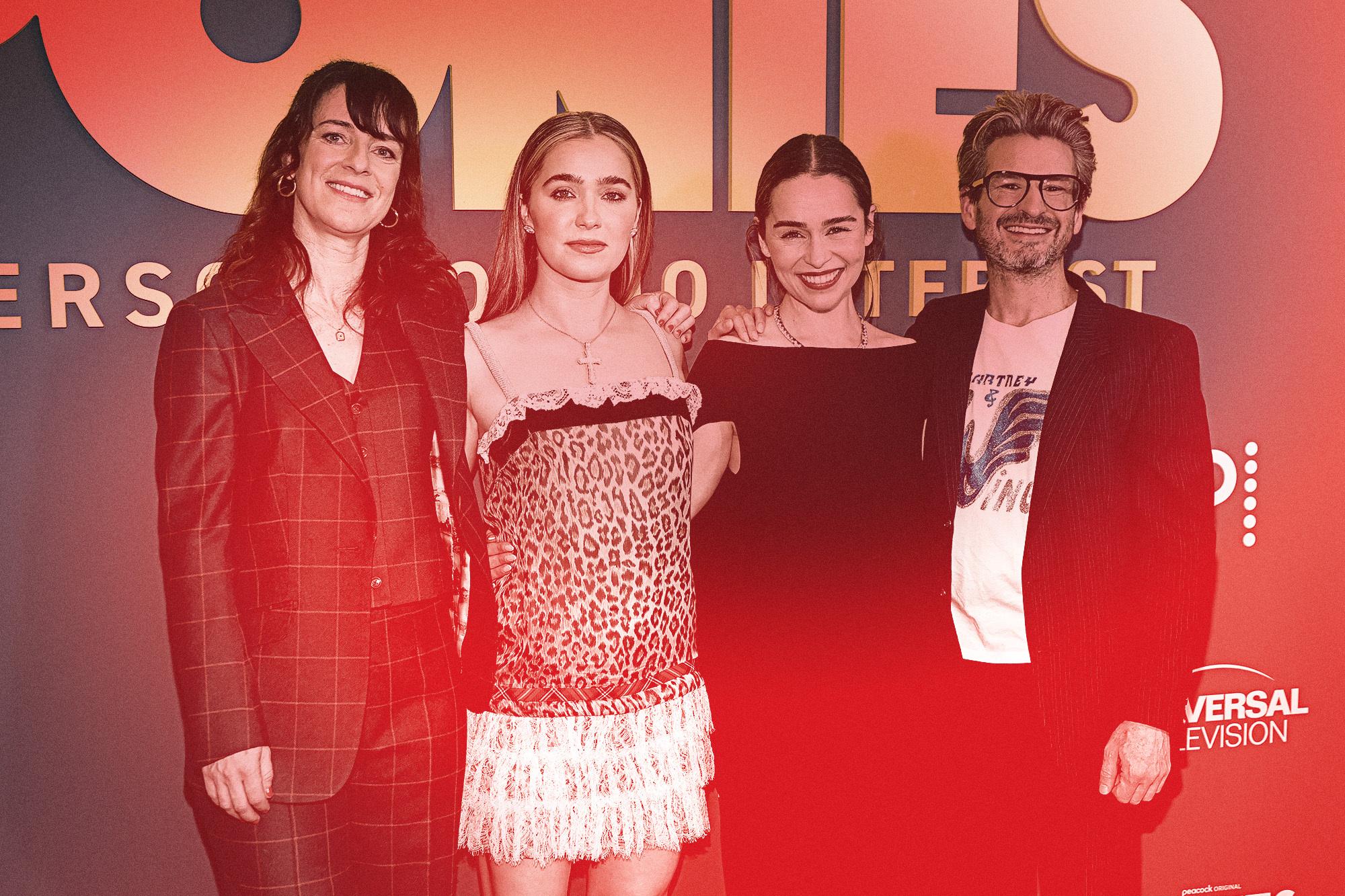
Every writer has been to a dinner party full of fellow writers complaining about their work. Fewer have followed that dinner party conversation to a writing partnership that led to a feature film and a funny, thrilling, constantly surprising TV show.
That’s the very, very short version of what happened when David Iserson and Susanna Fogel decided to join forces over a decade ago, after a series of meetups where “we would inevitably end up having lunch and swapping stories,” as Fogel, 45, remembers it now. “You develop a shared language and shared taste, and then you’re reading each other’s work, and then finally we’re like, ‘Let’s write something.’”
Their latest “something” is Ponies, the Peacock series that premiered in January, starring Haley Lu Richardson and Emilia Clarke as American embassy wives in 1970s Moscow who become an unlikely pair of CIA assets. Full of irresistible period detail — the analog spy devices and Fleetwood Mac-worthy clothes! — and a spiky sense of humor, even in its most action-packed sequences, Ponies treats American-Soviet tensions as both high-stakes and a fantastic way to make a best friend. And if the people who initially heard Fogel and Iserson’s pitch had their way, we never would have seen any of that.
“We pitched this show to HBO, and they were willing to make an offer to buy the idea for a half-hour contemporary set version,” says Iserson, 48. I asked him and Fogel the obvious follow-up question — what in the world does a modern version of Ponies look like when the Soviet Union no longer even exists? Fogel answers drily: “A lot of closeups on phones and Google searches.”
Iserson and Fogel were committed to keeping their spies in the 1970s, dealing with things like bugged telephones and secret codes hidden in paperback books, but the spy story was in many ways secondary to the real story they wanted to tell. “I’ve come to understand the utility of a spy story to tell a female identity story,” says Fogel, a co-writer of Booksmart and director of multiple fantastic, female-driven TV series, including HBO Max’s The Flight Attendant and NatGeo’s A Small Light. “You could tell a story about these women searching for their identities without spies, and it would be a small indie movie no one would see. But you can also do it with spies, and you still get that depth if you put it in there.”
“Being good spies is about relationships,” adds Iserson. “You can explore love and friendship and trust and all of the things that you would explore in your romantic and in your friend relationships, and then add the layer of high stakes.”
Iserson and Fogel have spent a lot of time thinking about spies, but probably even more than you’re imagining. The first project they wrote together that got produced was the 2017 action caper The Spy Who Dumped Me, starring Mila Kunis and Kate McKinnon as another pair of friends who get caught up with spies and the CIA. It was even filmed in Budapest, just like Ponies, with some of the same crew.
But Ponies isn’t just more of a drama than The Spy Who Dumped Me; it’s an example of what happens when two writers take a crack at a genre, learn what works and what doesn’t — and then get a chance to try again.
“They’re so totally different,” says Iserson, a TV veteran who has been a writer and producer for shows as wide-ranging as New Girl and Mad Men. “One of the things that we talked about with The Spy Who Dumped Me is just trying to market it a little bit differently. In retrospect, we found the title of that movie a little bit frivolous. We thought we were hitting some themes that were a little harder for the title to convey. It also felt like we were just older, wiser people when we made this show, and we were just going at it from a different way.”
The title of Ponies is technically a joke, cracked in the first episode when the lead characters are informed that in CIA terms they are considered “PONI,” or “person of no interest.” It’s also a title that’s meaningless unless you’ve seen the show, an invitation to hit play and find out why Richardson and Clarke are being called horses. After talking to Iserson and Fogel, that bit of provocation and mystery feels very deliberate.
“We didn’t have the biggest budget in the world, so instead we were just like, ‘All right, what decisions can we make at every turn that feel like we are trying to be confident and stand out?’” Iserson says. That goes all the way up to the season finale, depicting a very real fire that happened at the American embassy in Moscow, with our heroines facing off against KGB agents with no clear plan of escape. Ponies hasn’t been renewed for a second season, but that didn’t stop Iserson and Fogel from embracing a classic TV cliffhanger. “I think if we had written this season and just tied a little bow on it, that would be a rejection of our ethos going through making the show.”
Just as they were at that dinner party where they met, Iserson and Fogel are frank about what’s not really working in the industry, where writers are constantly told they can make their heartfelt emotional dramedy… but only if it’s attached to existing IP, of course. They’re both now working on other projects with other partners — it’s an “open, polyamorous writing partner relationship,” Iserson jokes — while waiting to find out if a second season is in the cards. But even if it isn’t, Ponies is proof that something smart, spiky and surprising can still get made — and that in a time of great industry uncertainty, sticking to your guns might actually be the only way forward.
“I took two pitches out somewhat recently, and it’s just a different landscape,” Fogel says. “These are the kinds of things my agents are always telling me to do more of, because it’s going to sell, unlike what I usually do.”
You can probably guess how those pitches turned out. But in response to the challenging climate, Fogel has gone in the other direction, taking bigger risks with her own writing.
“I’m returning to the version of myself I was when I was first starting out, maybe not knowing to make preemptive compromises or to sand the edges off what I was doing to try to fit into a box,” she says. “I’m really writing for myself in a different way, because the rules seem to be changing and things are contracting. I don’t know if that’s going to pay off, but I’m prouder of Ponies than a lot of the things I’ve done in the intervening years between being 21 and now. So I mean, who knows?”

I wasn’t among the many, many people who drove Michael to $217 million in global grosses over the weekend — although, despite the bad reviews, I do feel like at some point I need to see Jaafar Jackson’s performance for myself. The negative reviews (38 percent on Rotten Tomatoes) make me think it’s pretty unlikely that Michael will linger through the fall as a major Oscar contender — though, then again, I probably would have said the same of 2018’s Freddie Mercury biopic, Bohemian Rhapsody (60 percent on Rotten Tomatoes), which won four Oscars, including best actor for Rami Malek.
But the real comp I’m thinking of is another early-year hit that overcame tough critical reviews to become a genuine sensation. Back in 2004, the February release of The Passion of the Christ drew a similar mix of negative reviews and roiling controversy, along with ample praise for its lead star, Jim Caviezel. All that hubbub resulted in three Oscar nominations — for score, makeup and cinematography — and what’s now the expected outrage about snubs from the film’s diehard fans. Would snubbing the Michael Jackson movie cause as much hubbub as snubbing a movie about literal Jesus? I mean, you’ve seen the discourse around Michael so far; you know the answer.
The fourth season of The White Lotus is probably still at least a year away, which gives us a whole lot of time to speculate about what in the world happened with Helena Bonham Carter. Production on the HBO series started just last week in the French Riviera, with reports that at least part of the season will take place around the upcoming Cannes Film Festival. As usual, all we know about the season is the setting and the starry cast, which was to have included Carter alongside Heather Graham, Rosie Perez, Chris Messina, Vincent Cassel, Steve Coogan and many more. But late Friday, Carter abruptly exited the Emmy-winning show, with HBO offering the official explanation that “it had become apparent that the character which Mike White created for Helena Bonham Carter did not align once on set.” Is there a more truthful explanation that might wind up being even juicier than what gets depicted onscreen? If you know, tell me! katey@theankler.com.