

Paramount Playbook: Risky, Murky — and Likely to Work. Here’s Why
Still undervalued, PSKY is the Ellison slingshot aimed at Netflix, with WBD as the next big stone

I offer analysis for paid subscribers every other Thursday. I wrote about 7 sleeper hits of the Streaming Wars; why animation continues to make bank and IP dominates the box office; and the audience chart every exec should obsess over.
A few weeks back, Richard Rushfield published an excellent list of book recommendations to read to understand Hollywood. I’d add a few titles to his syllabus, mostly non-entertainment-industry-focused books to help this town run better. (I stand by my recommendation for A World Without Email, even more so in a time of AI slop.)
One critical book I’d recommend is The Goal by Eliyahu M. Goldratt. While it seems like it’s about manufacturing, it’s actually about operations management in general. In it, the all-knowing mentor asks a seemingly simple question I’ve seen bedevil business school students:
What is the purpose of a business?
Usually, students respond with some stammering about products and customers and matching and whatnot, but the point is that the goal of a firm — see the book’s title — is to make money. And how do you measure that? Eventually, Goldratt gets to three-ish items: the amount of money you bring in (cash flow), the profit you make from it , and the return on your investment (ROI).
I bring this up because, when it comes to evaluating companies in the Streaming Wars, we usually toss all that out for another metric entirely: stock price. Or “market capitalization,” the stock price multiplied by shares outstanding. In our current times, Netflix owns this metric absolutely. It’s currently valued at over $500 billion while Disney sits at a lowly $200 billion, and Warner Bros. Discovery is $45 billion. Not even the same ballpark!
But sometimes, these metrics get out of whack. See, stock price should roughly be the market price of a firm’s future cash flows, but when we start predicting the future — which is what current valuations do (to not go full technical, they’re the sum of future discounted cash flows) — well, we’re guessing at the future. Sometimes we’re right, and sometimes we’re wrong. Right now, the market looks particularly bubbly, with stock price valuations matching past peaks, like in 1929 and 1999. While markets are still efficient, the wisdom of the crowds this is not.
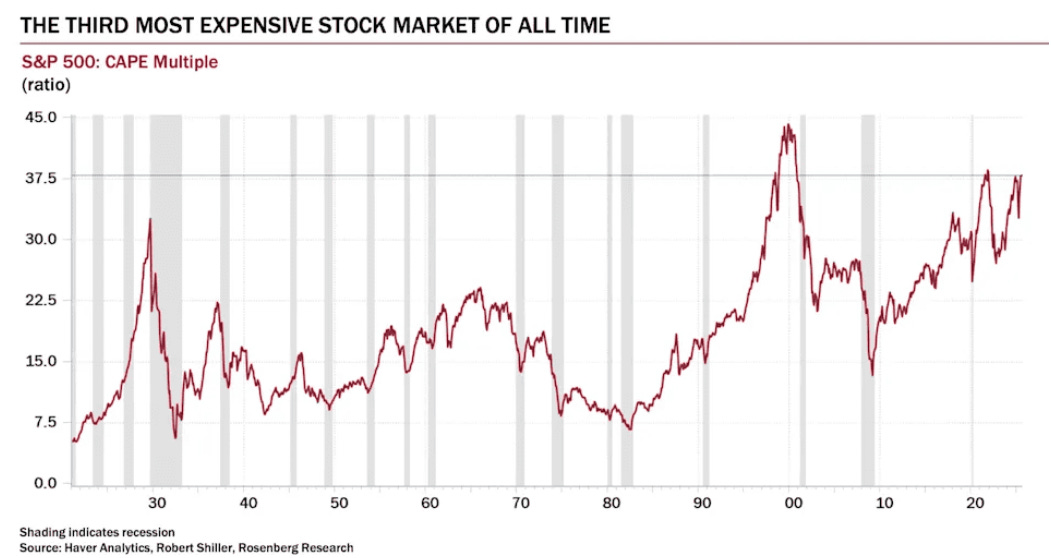
I’d add, the quest for “winner take all” firms has hit a frenzy, and everyone wants a part of the next firm that will monopolize1 its industry, like Apple with phones, Google with search, Facebook with social media, Nvidia with chips, and Amazon with e-commerce. The market has bet that Netflix will take that prize with TV. Indeed, the value of top firms as a share of the S&P 500 has also hit all-time highs.
It’s with that context that I still think Paramount (formerly Paramount Pictures, formerly Paramount Global, and now Paramount Skydance)2 is still the most undervalued asset in Hollywood. (Its market capitalization is only $10 billion; its total enterprise value, including debt, is around $30 billion.) When we focus on winners — meaning Netflix and YouTube in 2025 — we can’t forget that other companies are making money too. And now that Paramount Skydance is doubling down to win the Streaming Wars with its potential acquisition of Warner Bros. Discovery, I could see big things in its future.
In today’s article, I’ll lay out:
How dominant CBS is in broadcast, and why that matters even as cord cutting grows
Paramount+’s sneaky streaming success and recent hit-to-flop ratio
The company’s theatrical wins, compelling projects in the pipeline and library strength — and they key genre where its movies aren’t winning
Why I’m dubious about the industry consensus on Paramount’s planned cable sell-off
Why its recent moves show a company ready to buy, not sell
The chances of a WBD acquisition moving forward, and the major scale opportunity it represents
What else Paramount Skydance should buy now
Undervalued Assets of Paramount Global

To really explain what I mean about the valuation mismatch in Hollywood, it’s worth considering some very buzzy recent deals: