

Hollywood’s Advancement in the Art of the Layoff Memo
The industry ‘right-sizes’ its way into the 'future'; thanks, John Malone!


Welcome to the Jamboree, my weekly takes on the industry’s passing parade.

Hollywood may not have made many great strides in the march of onscreen creativity lately, but if there is one area in which the industry’s greatest minds have been working above and beyond, taking a genre to new heights, it is the layoff memo.
And they’ve had a lot of practice lately, what with layoff announcements becoming the ambient background noise of the era.
The causes for almost all the recent studio layoffs are clear to all. Cutbacks are needed to:
Pay someone off for the latest studio handoff. And/or
Cover the price of a decade of horrible strategy and choices related to the rise of streaming.
And, needless to say, these painful but necessary cutbacks never cut into executive pay packages at the very top; if anything, they enhance them.
But none of that makes for a compelling memo when you’re explaining why you’re sending a massive swath of your employees out into the cold.
Dear Staff,
Well, I screwed up or maybe the studio owner before me did and now you’ve got to pay for it.
That doesn’t have the right sympathetic tone for a day of sorrow. Neither does:
Team:
Someone’s gotta pay for our new owner and it’s not gonna be me!
All of which has led to great innovation in the art of euphemism, as was on rich display this week with some new entrants to the treasury canon, announcing the Paramount cuts.
The emphasis yesterday was on looking forward; this wasn’t about paying for the mistakes of the past, but about building for the future, building with cuts. As George Cheeks explained:
While these decisions are incredibly difficult, they are part of the changes needed to help Paramount move forward as a strong, future-focused company as we navigate a rapidly changing industry. This means making tough decisions, including reducing the size of our workforce — choices that affect people who have contributed meaningfully to our success.
Hard to be future-focused with so many people hanging around! A “rapidly changing industry” needs to be able to pivot on a dime. Maybe the company would work better if it were just one person, now that you mention it. One person and a ChatGPT Pro account.
In their joint memo, “Dana and Josh” also focused on how the best path to the future would be without a bunch of you slowing it down:
This restructuring marks a pivotal step in shaping the path forward. We’re right-sizing our organization to ensure Paramount Pictures remains not only the iconic studio built on more than a century of storytelling, but also the leading destination for creators and innovators who will define the future of entertainment.
Is there a more insidious compound word than “right-sizing”? Does any company that has “right-sized” ever feel like it has found the right size?
Also, a nice invocation of the historic Paramount legacy. Who can doubt that a century of storytelling was built on endless rounds of cutbacks and layoffs? From Adolph Zukor’s time down through Robert Evans and Sherry Lansing, draconian cuts have always been the pride of the Paramount name!
David Ellison, who knows something about the future given that his father invented it, also name-checks the f-word in explaining why his first step on the road to greatness involves getting rid of a ton of you:
When we launched the new Paramount in August, we made clear that building a strong, future-focused company would require significant change — including restructuring the organization. As part of that process, we must also reduce the size of our workforce, and we recognize these actions affect our most important asset: our people.
We want to be as open and direct as possible about the reasons behind these changes. In some areas, we are addressing redundancies that have emerged across the organization. In others, we are phasing out roles that are no longer aligned with our evolving priorities and the new structure designed to strengthen our focus on growth. Ultimately, these steps are necessary to position Paramount for long-term success.
When a CEO promises to be as “open and direct as possible,” batten down the hatches for the Category 5 Hurricane of evasion and weasel words ahead.
So getting rid of redundancies — indeed, it’s unfortunate, but if you find two offices doing the same job, what are you going to do? I’d love to hear about the world of “evolving priorities,” which are the studio priorities they've decided to stop doing so they no longer need those people? All I’ve heard so far is how they’re going to invest tons more in every possible thing anyone could mention. Imagine the growth that can happen when they “right-size” Warner Bros.!
Also, Mr. Ellison, the focus on growth that you mentioned? We know you have talked about bringing AI to the studio. Care to give us any details on that? Beyond… “efficiencies!” So you’re saying the 2,000 people being sent packing were working in parts of the company that were anti-growth? Were they going around and setting fires on movie sets and ripping out pages of people’s shooting scripts? What was this anti-growth strategy the Redstone era was so big on, would you say?
Of course, it’s all nonsense. We know what these layoffs are for, and every CEO has written their version of these memos in recent years. In 2023, Bob Iger wrote:
We have made the difficult decision to reduce our overall workforce by approximately 7,000 jobs as part of a strategic realignment of the company, including important cost-saving measures necessary for creating a more effective, coordinated and streamlined approach to our business.
Cost-saving measures necessary for a more coordinated approach! Makes total sense!
In 2022, on the occasion of a mere 300 layoffs, Reed Hastings actually put the matter relatively candidly:
Both Ted and I regret not seeing our slowing revenue growth earlier so we could have ensured a more gradual readjustment of the business,
I mean, seeing someone actually say we’re cutting because of money, rather than pretending the layoffs are the sign of future improvement, feels like a breath of fresh air within the genre. He didn’t talk about what else they might have done to save money instead of cutting jobs, but you can’t have everything. (Note: Hastings’ comp package in 2022 totaled $51.1 million.)
On the other end of the spectrum is the memo from David Zaslav congratulating HBO back in 2022 on the launch of House of the Dragon, while entirely ignoring the layoffs that had taken place at the division days earlier — a choice that also, somehow, feels refreshingly honest about where those layoffs stood in his universe.

Malone: No Mountains Left to Climb

Once you’ve engineered the destruction of one of our five remaining studios, really, what challenges are left in life?
And so it is that at age 84, John Malone — the “Cable Cowboy,” revered sage of finance, people and business reporters alike, and architect of the death of Warner Bros. — announced that he is retiring.
So many peaks in his celebrated career! On these shores, I wonder if he is the first studio owner never to visit the lot (as far as I know), never to attend the Oscars, or to preside over a Golden Globes party (or, if he did, he did so very quietly).
But mostly when we look back on the great moments in a life of consequence, I’ll always treasure this one, when he testified before Congress in 1989. A young Al Gore, who had lovingly labeled him the “Darth Vader” of the industry, asked Malone about a letter he had written to a wayward employee. Relive that precious time in this video here:

Trick or Treat! Picking Horror’s Classics
Is real life not scary enough for you these days? Well, if you’re looking for some less, shall we say, existential terrors, check out my video on the giants of horror films from this week.
I convened with the Prestige Junkies, Katey Rich and Christopher Rosen, to work our way through the eras of filmmaking and pick the scariest moment from each. Our choices may surprise, delight and terrify you! What stands as the absolute giants of terror? Take a look! (Sorry, KPop Demon Hunters, I guess this wasn’t your year!)

Friends Helping Friends Bulldoze America

The nation was aghast as Donald Trump responded to the No Kings rallies not just by posting from his official Truth Social account a disturbing AI-generated video of himself dropping human excrement on protestors, but also by bulldozing the East Wing of the White House last week. Particularly as the government shutdown drags on and food stamps run dry.
For me, though, there was something eerily familiar about the whole affair: the willful destruction of a meaningful corner of our common history, the rush to finish the carnage before anyone could weigh in, the dishonesty about how and why the whole affair was carried out and the refusal to submit to any review. Somehow, somewhere, I had seen this all before.
And so it was almost a relief when a report made clear whose fingerprints were on this, bringing the willful demolition of much of the nation back to its metaphorical roots.
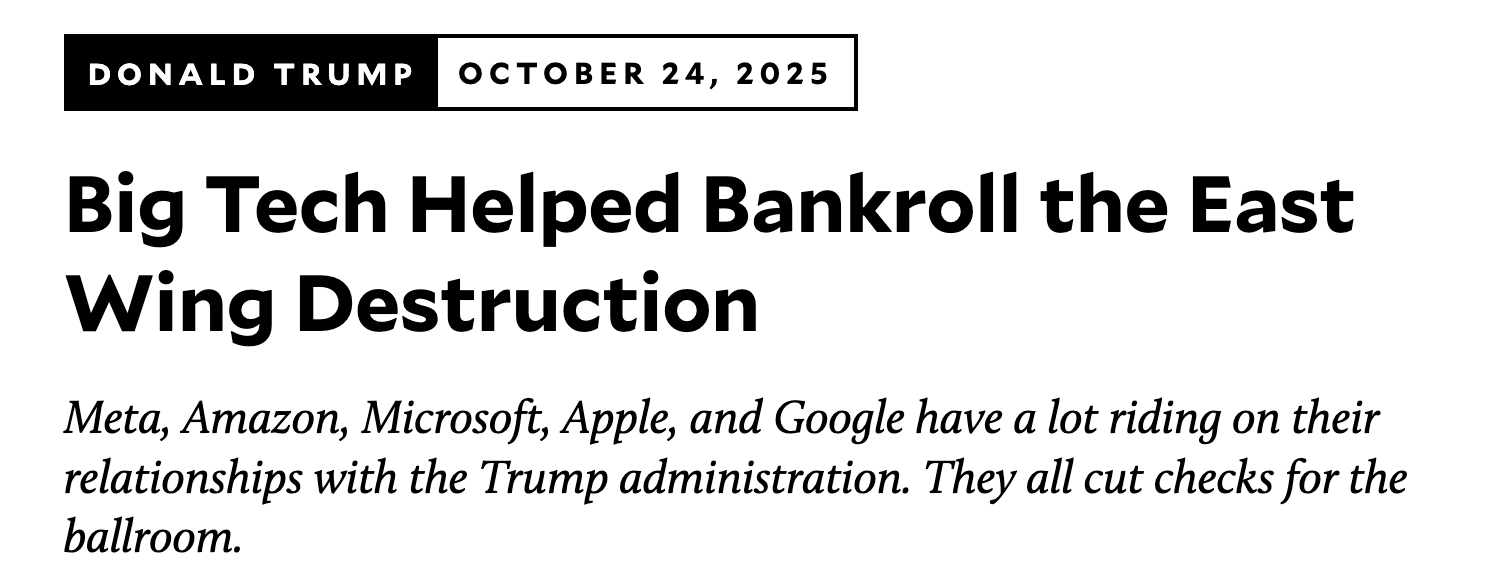
The list of donors released by the White House includes the usual deep-pocketed Republicans, such as casino magnate Miriam Adelson and private-equity mogul Stephen Schwarzman, but also a host of companies whose leaders have huge incentives to maintain good relations with an often vindictive head of state. They include telecom giants and the railroad giant Union-Pacific — which needs the Trump administration’s sign-off on a proposed $85 billion merger with Norfolk Southern. (Union-Pacific did not respond to a request for comment.) And then there’s the tech companies — Google, Apple, Microsoft, Amazon, and Meta.
I mean, of course they did. Why wouldn’t they?
Hand it to Jeff Bezos, though, he wasn’t hiding his light under a bushel here. He actually had his Washington Post write an editorial defending the demolition:

The editorial contrasts the bold move with the timidity of public works, which can no longer even build basic housing projects. After noting in horror the shocking spectacle in which wealthy visitors are forced to relieve themselves like day laborers:
Privately, many alumni of the Biden and Obama White Houses acknowledge the long-overdue need for an event space like what Trump is creating. It is absurd that tents need to be erected on the South Lawn for state dinners, and VIPs are forced to use porta-potties.
The piece concludes with a bon mot of bedazzled admiration for our bold visionary leader:
The White House cannot simply be a museum to the past. Like America, it must evolve with the times to maintain its greatness. Strong leaders reject calcification. In that way, Trump’s undertaking is a shot across the bow at NIMBYs everywhere.
Well, tech kingpins, you’ve certainly made your bed here. Hope in the end it’s worth it…

Flemingism of the Week
Presented without commentary:

From Deadline.