

And we’re back.
Please forgive the unscheduled absence last week. These times still can make the schedule a bit rocky, but we’re back with lots of stuff left on the table. So let’s take a little quick spin through where things stand with the remains of Hollywood this week.
One theme that pops up, again and again, this week: There are a lot of reasons to work here besides entertaining audiences and building successful businesses; a lot of people who have things on their mind other than winning the battle for the future. When the tide goes out, you see who’s in it to . . . live well on expense accounts and not mess up next quarter’s bonus. All in this week’s roundup.
Photo Follies
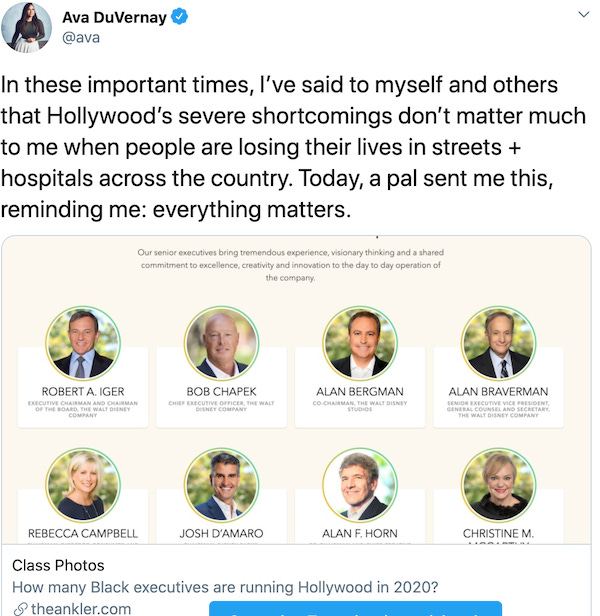
I’ve been getting tons of response to the last issue, the class pictures of Hollywood studios, and it overwhelmingly falls into one of two baskets:
1. Oh my God, that’s even worse than I imagined.
2. See, what did we tell you?
When I first browsed through the photos, my reaction was very much in that first basket, but there is no reason why it should’ve been. Looking back, what was the cause for optimism or any general sense that things are getting better?
The Ankler Law #211: If a company has any good numbers, they make sure you hear about them, one way or another. And when did we ever hear any good numbers on this?
(Not that Hollywood is big on commissioning studies of its executive ranks.)
God knows that there are a lot of causes that make their way through town. It’s interesting that the focus on representation on the screen never led to a deeper look at who is running the place, which should’ve been the next question.
But they are all tied together. Why we don’t make more films for Black audiences, and films about Black characters for general audiences is, we can see now, inextricable from the fact that the people who commission movies just happen to be, for all intents, zero percent Black.
As horrifying as this all is, as unbelievable as it is that this is the state of things in 2020, there are, beneath this smoldering ash heap, glints of cause for hope.
The thing is, it’s not just that the industry remains entirely in the hands of white people. It remains entirely in the hands of the *same* white people. The same clique of white baby boomers, who by and large ascended to the top of the entertainment world in the mid-90’s, more or less still runs things. Not every single job and division, but most.
So to some extent, Hollywood’s monochromatic leadership isn’t about a closed demographic renewing itself, but rather a cadre of people who took the throne a quarter-century ago and have held onto it ever since, admitting in the smallest and least challenging possible amount of new blood.
If you look at it that way, it’s not so much that Hollywood has resisted change but that progress has been frozen in amber since the mid-90’s. And nothing has moved since then. Not on social issues, not artistically or technologically. There hasn’t been any sort of change in anything.
Which is absurd and horrifying but offers a ray of hope in that, the march of time cannot be denied forever, and for the baby boomers, it’s coming on them fast. Very fast right now.
This cabal, as total as their power may be at the moment, is about to face one force that even they can’t deny. To quote Rocky Balboa in Creed: “Time’s undefeated.”
After that, perhaps there will be room for change. I haven’t done a study of the ranks below this top management level. I’d like to believe they are slightly better; they certainly can’t be worse.
I speak to this as a refugee of the profession formerly known as journalism, who watched my industry let two generations pass by without feeling the need to bring new customers into the news-reading experience.
An industry that can’t diversify itself is unlikely to have very much success broadening its audience. If you want to know why we make so few films either for Black audiences or about Black audiences, talk to people up and down the studio ladder about the dismissive reactions they get when they propose projects for these audiences, about how hard it is to get the agencies to take an interest in signing clients for these films.
On the rare occasions when these projects do sneak through the system, look and see how much support the studio gives them, how lost they are in how to market these movies, how mystified they are having to tiptoe into the “urban” market.
Which would all be well and good if this were 1994 and the corporate jets were passed out freely and you could feel confident that if you kept feeding audiences a diet of Twister and Batman Forever, they’d keep lining up forever.
But that’s no longer the world we live in. It is a completely open question whether today’s 6-year-olds will go to see movies when they are teenagers, just as it was once an open question whether they would start reading newspapers when they got older. (Spoiler: They didn’t.)
It’s not written in stone that in the age of TikTok, Snapchat, and YouTube that they’ll be watching 10 episode seasons of hourlong TV dramas either.
You can sort of tell a winning team from a losing team if you look closely. One sign of a winning team is, amazingly, that they have a hunger to win. They don’t do things like turn their backs on entire sectors of the audience. They are hustling to win over every new ally they can get.
Which is one reason why the Netflix experience has been so different from the studios over the past few years. You can say what you will about its financial model, etc. I’ve said plenty and am going to keep saying it. But Netflix plays like a team that is desperate to win, including in whom they hire, the deals they do, and the projects they take on. It’s a company that is openly trying to win over every single audience and viewer, individually and collectively, and not sitting around waiting for the distribution team to find some time to rethink their strategy before they do it.
Which is why Netflix was able to put together that Dave Chappelle live performance show addressing George Floyd’s death in a matter of days and get it up on the app, putting Netflix at the center of the national conversation in an important way while other companies were just promoting a handful of old movies from their vaults. What other company in Hollywood could’ve done that? What other company would’ve even thought about doing it?
Even if the world goes back to normal in a few months, the lesson of this time for Hollywood should be how fragile our relationship with the public is. The world can get by without movies, and in the end they just might. If this hundred-year-old tradition of high-end produced entertainment is going to live on, we’re going to have to fight for every eyeball and to fill every seat out there.
Which is why my glance at the industry’s executive ranks is so disheartening, on top of what we already know about how little Hollywood serves the Black community. A business that is so complacent that it feels no urgency about achieving even a minimal level of diversity is not a business that’s fighting to win in this new era.
Seats of Fire
You want to know who else doesn’t project “Winning Team?” The big theater chains who seem determined to turn this shutdown into a permanent state of being.
AMC boss Adam Aron’s comment about not requiring masks because “we did not want to be drawn into a political controversy,” would’ve been a laughable piece of idiocy if it weren’t so in keeping with the chain’s entire posture towards its customers.
This has been a preview of today’s edition of The Ankler, the industry’s secret newsletter. To read the rest of this issue, including stories about AMC, MGM, Live PD, Steve Bing, and Netflix subscribe today for just $10 a month.
This is a preview from today’s edition of The Ankler, the secret news of Hollywood. Want to see it all? Click below to subscribe. You never know who’ll be in the Hot Seat tomorrow…
If you are interested in advertising on the Ankler: write us at ads@theankler.com for rates and info.
The Ankler’s Got People Talking!!
In the Wall Street Journal on executive diversity
And in THR