

Voices, Chants, Pain: Amanda Seyfried & Daniel Blumberg on ‘The Testament of Ann Lee’
‘I made sounds I’d never heard in a film,’ says the actress of her collab with the Oscar-winning composer. ‘Everything was very out-of-the-box’


I cover where music & Hollywood meet. I broke big news from Stephen Schwartz about the future of Wicked, talked to Rian & Nathan Johnson about their cousin collab on Wake Up Dead Man, and wrote about Japanese Breakfast’s throwback song for Materialists. Reach me at rob@theankler.com

Amanda Seyfried knows all too well that her new film, The Testament of Ann Lee, puts the audience through an emotional wringer.
“We go on these Q&As (after screenings), and I love talking about it,” Seyfried told me during our recent conversation, “but I also think people need a little bit of space.”
Directed by Oscar nominee Mona Fastvold (who co-wrote The Brutalist with her off-screen partner, Brady Corbet; Corbet, in turn, co-wrote Ann Lee with Fastvold), The Testament of Ann Lee is a profoundly moving film built on a foundation of a passionately vulnerable performance from Seyfried, 40. Not that the Oscar-nominee for Mank is new to delivering powerhouse performances.
Still, what sets the 18th-century story of the Shaker movement's origin and its enigmatic leader, Lee, apart is that the film is drenched in music and dance. Utilizing vivid testimonial chants and rhythmic choreography framed in kaleidoscopic shots that are almost reminiscent of Busby Berkeley, The Testament of Ann Lee takes a wildly inventive approach to telling Lee’s epic story, from immigrating to America from England and the harrowing trials and tribulations of her people while growing her religious sect, which valued egalitarian ideals and equality between men and women much to the consternation of other Christians. Sometimes, it’s tough to watch as the Shakers are persecuted for their beliefs, often enduring great violence, which makes the musical breaks even more poignant.
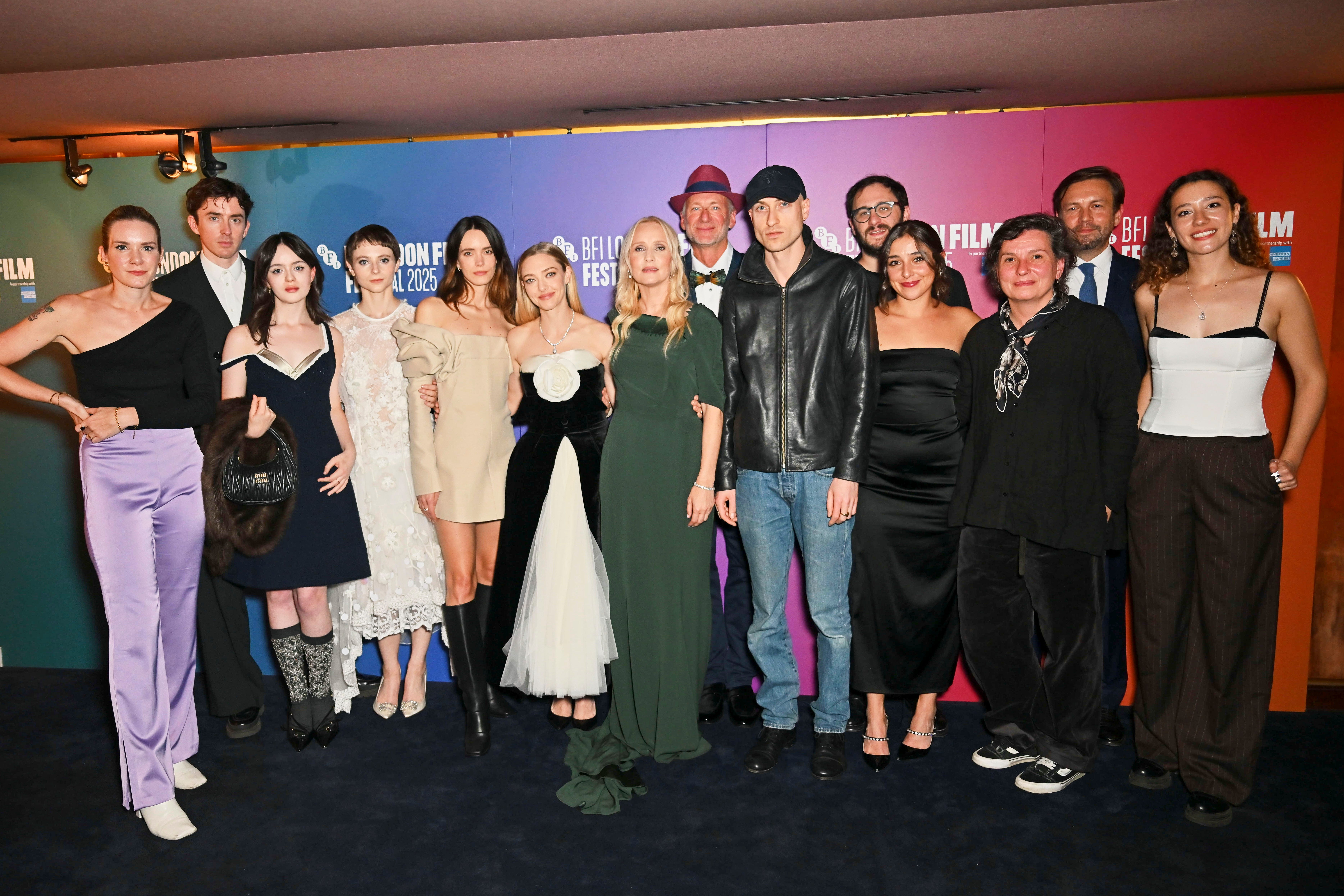
It was composer Daniel Blumberg’s job to bring that part of the story to life. Fortunately, he didn’t flinch at the unique mission of setting music to the fiery story and crafting the original songs Seyfried and company sang, sometimes live on set. I previously spoke to him on the eve of his Oscar win earlier this year for The Brutalist, where he took unique approaches to bring his sonic vision to life. I remember him telling me about recording in a quarry because he was chasing a particular sonic echo, for example. When it came to Ann Lee and working with the Brutalist creative team again, he utilized similar out-of-the-box techniques, including recording in a warehouse filled with antique instruments.
“I think Mona’s really good at putting people together,” Blumberg, 35, who also wrote the score for Fastvold’s film The World to Come, told me of his collaboration with Seyfried, including the original song “Clothed by the Sun.” “We were able to do something that we both felt was really engaging. We both really pushed each other.”

Rob LeDonne: A lot of this music is directly pulled or influenced from the era, including the song “Clothed by the Sun,” which borrows its title from a book about the Shaker movement.
Amanda Seyfried: The film was actually initially called The Woman Clothed By the Sun with the Moon at Her Feet.
The Testament of Ann Lee is probably better.
I think they’re both good.
Daniel Blumberg: They still have time to change it. (Laughs)
Though the first title wouldn’t really fit on a marquee.
Seyfried: That’s the problem!
Amanda, you’ve sung in other films like Mamma Mia and Les Misérables and went viral this year for covering Joni Mitchell’s “California” on the dulcimer, among other musical moments. This move is on an entirely different plane. What made you say yes to taking it on?
Seyfried: I said yes because Mona said, “I trust you with this.” That’s a powerful thing to feel from somebody that you respect and admire so much as an artist, but also as a friend. I felt like she was offering me a chance to get to know myself better with this project. I just had to choose between going with her and running away because it felt very scary. But the music brings me to something, and I’m a musician first, in my life at least. This allowed me to hear myself and my music differently. I had to shed, or almost completely shed, my own idea of what I should sound like.
This was a pure feeling. I’ve learned to sing with my body and my insides, rather than with my ear. And it’s completely liberating.
Was the reliance on music always a bedrock of the script, or did it reveal itself as the film developed?
Blumberg: The script had placeholders in it initially, but when I came on, one of the first things I did was work out what those songs were gonna be. The good thing about this project, in general — up until the sound mix, even — was that Mona kept everything quite open. So even when I started working with Amanda in Budapest on the music, we were tweaking things.
One of the problems with films is that when you make something on this scale, you have to be so organized, and then there are so many people, it sometimes dilutes the power of what you’re doing. But one of the things with this project is that everyone was so invested in a way. Amanda would come to my Airbnb to record after shooting for the whole day. We would send each other the recordings and stuff on the phone. But it was just constantly evolving.
Related:

Daniel, a belated congratulations on your Oscar win for The Brutalist. I remember us talking about your unique way of recording that score. So did you use any out-of-the-box techniques on Ann Lee? I know I heard wind chimes, for example.
Blumberg: Well, it was a really limited palette here. The idea was voices, bells and strings, and how far those things could be pushed. You mentioned the chimes, which started as handbells, and the idea that there could be a relationship between the church bells in the film and the bells in the Shaker scenes. That developed into a bell piano, which is otherwise known as a celeste, where they use these little hammers that hit these little metal plates. But then I was talking to our percussionist, and I was like, “What if we got huge brass plates, like the size of a window?” He was also playing giant church bells. We were actually recording in a percussion warehouse where you typically rent instruments.
Daniel, did the Academy Award win embolden you and make you more daring in your work?
Blumberg: I don’t think so. I mean, that stuff is quite alien to me in terms of affecting me. No. (Laughs)
Seyfried: Pretty much, no!
It’s a no, got it! Amanda, some of the testimonial scenes with your guttural chanting leap off the screen with such power. It really seemed like you were channeling something there.
Seyfried: It was about finding my voice. I genuinely have never made the noises that I made in this movie before in my life. Like screaming, yeah, sure, I’ve done that. But I made sounds that I had never heard in a film quite like this. So everything was very out-of-the-box.
Sometimes it’s painful. You’re like, ‘Oh. Did I just hurt myself?’ And then I realize, no, I didn’t actually, I’m capable of that noise! But it was crazy.
The film features vocals recorded live on-set. Why did you mix it up like that, and how did you decide when you’d sing live and when you weren’t?
Blumberg: The good thing about that was that we definitely had options because Amanda’s voice is, technically, really good with tuning. It was cool to see her perform live on set because I hadn’t really experienced that before. But we definitely did live singing where we thought it would be more effective, like in a jail cell scene, where there’s a mixture of both. But sometimes we’d prepare playback, and then some of her sort of improvised stuff on the set or in her dances would sound really good. And we’d either use that and clean it up a bit, or it would inspire us to do an additional take or something.
It was also the nature of the project. Sometimes, Amanda’s character is singing from the heavens because she’s a Christ-like figure. Perspective-wise, you can do lots of stuff with that. For the audience, subconsciously, they can feel that she’s really there singing. I remember when we were filming, and she’d be singing along to a little keyboard I was playing in her ear. But working with Amanda, we could swap it out, whether she sang live or to a playback, really quickly on set.
Amanda, what’s it like collaborating with Daniel? Because nobody is doing it like him.
Seyfried: I mean, he’s a hot commodity! But he’s singular. I know he has a different rhythm in his soul. I’m trained differently. But I really admire him. It’s so whimsical to me sometimes. I don’t even really know how to be metaphorical about this. It’s just that nobody else operates the way he does and is as free. I’m just trying to catch up all the time, basically.
But what he says goes. And so, even the other day, we were recording in this beautiful studio in London (in the live video above), and I always have to look at him because I know he goes with his body and feels things in ways I don’t.
It sounds like it takes a lot of trust and vulnerability.
Seyfried: Yeah. Daniel, it feels like you really appreciate my voice, and that goes a long way. I’d be like, I gotta put the kids to bed. But we’d say, Let’s do one more, because there’s always something more to find. I do wonder, though, Daniel, if you ever feel like you’re done with the soundtrack, or if you wish you could keep going?
Blumberg: No, I have a problem with that. I’ve got a perfectionist issue.
 | A guest post by
|