

Spike Lee and the Star Born in His DMs
The director and Aiyana-Lee tell me how they connected, then created the Oscar-contending song for ‘Highest 2 Lowest’

I cover where music & Hollywood meet. I talked to Amanda Seyfried & Daniel Blumberg about The Testament of Ann Lee, broke big news from Stephen Schwartz about the future of Wicked and chatted with Rian & Nathan Johnson about their cousin collab on Wake Up Dead Man. Reach me at rob@theankler.com

What better way to start the new year than a conversation with the incredible, Oscar-winning, Green Book-hating Spike Lee?
Last year, Lee, 68, released Highest 2 Lowest, the 24th feature film in a career that started with 1986’s She’s Gotta Have It and Lee’s reunion with Denzel Washington. (It was the fifth time they’ve worked together, but the first since 2006’s Inside Man.)
Inspired by Akira Kurosawa’s 1963 classic High and Low, Lee’s appropriately New York-infused take from A24 and Apple Original Films tackles crime and greed in the music industry through the eyes of Washington’s character, a music mogul named David King. As King attempts to wrestle back majority ownership of his record label, he’s faced with a moral conundrum: A kidnapper confuses the child of King’s longtime friend and driver (played by Jeffrey Wright) for King’s son, and the wealthy executive must weigh whether to pay up to save the other boy’s life or his company.
But to borrow a phrase from the industry the film inhabits, the crescendo of the film isn’t the resolution of its kidnapping plot — nor an extended sequence through the Bronx that includes a subway car full of aggressive New York Yankees fans with some strong feelings about the Boston Red Sox. Instead, Highest 2 Lowest comes to a stirring conclusion when, after much prodding from his son, King hears an audition from a fledgling powerhouse singer named Sula, who sings an anthem to perseverance in the form of the movie’s title ballad.
It’s art imitating life, as Sula is played by Aiyana-Lee (no relation to Spike), a fledgling powerhouse singer herself, who tells me she was nearly homeless when Lee first contacted her out of the blue.
After getting cast, the 25-year-old (who was first discovered by mogul L.A. Reid) actually wrote the song herself alongside her mother, Daciana-Nicole Anderson, an accomplished songwriter in her own right. So for my conversation, I spoke to both Spike and Aiyana-Lee, alongside a beaming Anderson, who said she was speechless about the success they’ve encountered so far, including a chance at an Oscar nomination: “Highest 2 Lowest” is one of 15 songs to make the Oscar shortlist in the category last year.
“I originally came from Romania, a communist country, and you can’t even fathom meeting certain people, or going anywhere,” Anderson tells me. “So coming from that to this and with Spike, it’s overwhelming.”
Rob LeDonne: Spike, what initially drew you to make this movie about the music industry? I’m wondering what made it fertile ground for you.
Spike Lee: Well, let me say, I got it. It’s right there. (He points to a picture behind him.) That’s my father, Bill Lee, a great bassist, composer. The Bob Dylan song, “It’s All Over Now Baby Blue,” that’s my father on bass. Gordon Lightfoot’s “Oh, Linda,” that’s my father on bass. And then also he did the scores for She’s Gotta Have It, School Days, Do The Right Thing and Mo’ Better Blues. So I grew up in a musical household and got my father’s ear. I love music, and so it is just natural for me that music be one of the foundations of my films. I give more importance to music than I do to cinematography, production design and costume design. But also, in Mo’ Better Blues, Denzel plays a musician, you know? So this is not the first time for me.
How did you first connect with Aiyana-Lee? I understand the power of social media was at play.
Spike Lee: Here’s one of the great things about social media. There was a time when young artists had to move. You had to be in New York or L.A. I mean, Madonna and all them people — like David Byrne could afford to move to the Lower East Side of New York City. But with rent, you can’t do that anymore. So I know that there are a lot of talented people in that situation who can’t get to New York or L.A., or who don’t have access to producers, directors, or record companies. So that’s one of the great things about technology. When I look for talent, here’s the thing: I’ll use the word “discovered.” But I don’t like that word. I gotta find another word. But I was on Instagram, and I saw my Lee sister.
So Aiyana-Lee, you get this message from Spike. What did you think?
Aiyana-Lee: I was in L.A., and it was 6:00 a.m., and I was awake for no reason. I’m just out of my bed, looking at my phone, and I see this DM from Spike Lee. I’m like, “Man, not a con again! Not someone scamming me.” You know what I mean? I even see the check mark, and I’m like, “Wow, someone must have just paid for the check mark.” He starts it off with something like, “This is the real Spike Lee.” And I’m like, “Of course that’s what an impersonator would say would start off with!” But there’s a long paragraph that he had listened to my music and my discography; a very nice message. But I don’t know if this is real. So, I woke my mom up.
Daciana-Nicole Anderson: I was like, “Girl, just go back to sleep.”
Aiyana-Lee: But he FaceTimed my mom later that day, and he reassured her that he was a real person.
Spike Lee: And that’s what a mother should do. Especially in this industry.
Once you started talking, what did Spike tell you about what he was looking for?
Aiyana-Lee: He was very adamant and very particular with what he wanted for the film. When it came to the thing that actually gets put into the movie, he really wanted it to be crafted and honed to capture the emotion of the film’s messaging. He had made sure that I read the script. So that was very important for me to understand the story, the journey and the character as well.
After, I wrote 10 songs. Literally. I always joke that I’ve got a folder full of Spike Lee joints on my computer for real. He’s not one of those people that you’re just going to give him one thing.
Aiyana-Lee, are you writing on your piano?
Aiyana-Lee: A lot of times, yeah. Like most of the stuff that I had written was with my mom, because I don’t play very well. She just was like, “Let me find some chords, she’ll record the chords.” Then I’ll go back to my room and work on it. I’ll send it to Spike.
Spike Lee: I want to get your mom in on this because she was a co-writer on this song, so let’s talk about how you guys work, mother and daughter. She just didn’t show up; she has the career of a very fine songwriter.
Aiyana-Lee: She’s a 17-time Platinum singer-songwriter, and she really inspired me to be a writer and really put the emphasis on telling a story with the lyrics.
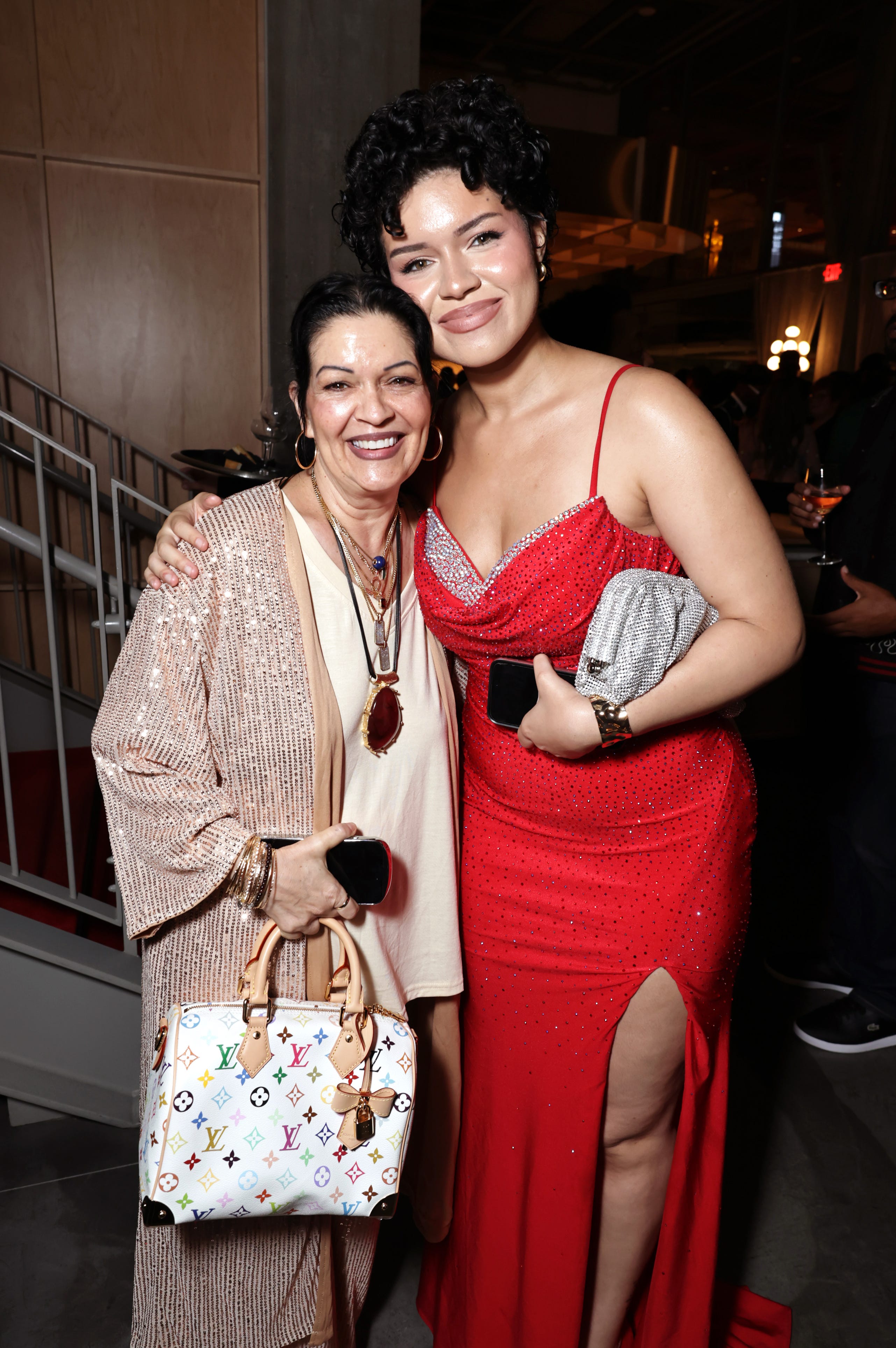
Anderson: Since she was little, she has loved music; she was fascinated by it. But one of the most important things I conveyed to her was the storytelling in the songs. Not just the emotions of the music, but also the lyrical content has to be a story, and it has to sound true. She grew up like that, so when Spike was asking about this movie and then the song and what the song is, it was so much about storytelling. Spike was talking like the best executive I’ve met in the music industry, and that’s for real. He’ll challenge and inspire somebody, not only someone young like Aiyana, but also me. It’s like, wow, I haven’t felt that for so, so, so long.
Aiyana-Lee: I’ve been through it all, and Spike is really, really great at bringing you out and making you feel comfortable as an artist to explore more. There’s no laziness, if that makes sense. There’s no shortcut, and that’s what I really like, to dig deeper.
In the big scene at the end, it feels like art mimics reality: You and your character are getting this big chance.
Aiyana-Lee: The whole song is literally my story and what I’ve been through, and funny enough, telling my story was exactly what the film needed. I’ve been in that same situation where you’re singing in front of different executives and trying to get signed.
Spike, you want to jump in?
Spike Lee: It is, like I say, circular because at the beginning of the movie, Denzel’s son is trying to get him to listen to her demo. And at the end, he comes back to what his son is trying to listen to. After all the trials and tribulations happened, he’s finally come back to what you might say is himself.
It’s like a musical Chekhov’s gun. I know this was shot live. What was that process like?
Aiyana-Lee: It was a very vulnerable thing to just sing it.
Even Denzel’s eyes were welling up.
Spike Lee: As Denzel might say, “Spike, this is what I do.” But as far as I’m concerned, from an outsider’s perspective, he’s being really moved. When we filmed this live, it was just my sister Lee accompanied by Ric’key Pageot on the piano. While we were editing, we cut to Denzel’s face. He’s playing a Quincy Jones-like character, and he’s been in this industry. He’s thinking about it, and he’s thinking about the orchestration. So I went back to our composer, Howard Drossin, and I said, “We gotta have orchestration.” By the end of the song, it’s a 90-piece orchestra playing. And that would never have happened if it weren’t for Denzel.
I think it’s a very old-school Hollywood moment, where the film reaches a climax with this last scene. So Aiyana-Lee, I know you’ve collaborated closely with L.A. Reid and now Spike. What have you both taken from being side-by-side with these visionaries?
Aiyana-Lee: The similarity is that they’re both passionate about what they do... Spike really cares deeply about music. And Spike really does care about this bridge between cinema and music, and knows how to do it in such a beautiful way.
Anderson: Even in caring about the artist as well, and the truth that the artist wants to say and convey.
There’s a line Denzel says when you finish singing, when he asks you if you’re ready for the hard times. But he’s not talking about the struggle. He says: “Can you handle the mayhem, can you handle the money, can you handle the success…”
Spike Lee: That was not scripted.
Wow. I know that was in the trailer, so as a director, that’s a little gift that he’s handing you.
Spike Lee: Oh, yeah, but here’s the thing, though. Not all actors get that green light from me. Some people you can’t. I mean, you gotta know who you cast. Aiyana, when he was breaking that down, what were you thinking?
Aiyana-Lee: Man, I was just kind of taken by the moment. It was cool that it kept putting you in the moment of, What’s gonna happen? I wasn’t sure. I think that’s the beautiful part about this experience: learning and knowing how to be on your feet and be more in the moment. I didn’t know if he’s actually gonna sign me by the end of this movie!
Spike Lee: Even though it’s written, you still, when he’s talking, think he might be going one way or the other? He’s gonna change the whole ending, huh?
Aiyana-Lee: I’m like, “Man, we might!” I was like, they must have agreed to something else behind my back. For real. They’re like trying to keep me on my toes.
Related:

We’re in the middle of Oscar season, and the song, about highs and lows, triumph and success, made it to the shortlist. What does that mean to both of you?
Spike Lee: I hope the voters take into account that the song is not just tacked onto the credits — and hopefully, they’ve seen this film. But this is a very important scene. It’s the end of the movie! I use the word crescendo. I’m gonna use another word: finale.
Aiyana-Lee: It’s incredible, especially from where we both come from and kind of the life we’ve been through; my mom being a political refugee from Romania, and then me from a little place in England. And then to get a random DM at the lowest point in my life, where I was almost homeless. It’s random.
Spike Lee: Oh, wait a minute. Don’t use that word: “random.” That was not random. Rewind now! I was in L.A. that day too! How could that be random?
Aiyana-Lee: Yeah, you’re right, you’re right.
Spike Lee: Random stuff does not happen. In my opinion.
 | A guest post by
|