

Meet the Brains Behind ‘KPop Demon Hunters’ Hit Songs
Executive music producer Ian Eisendrath reveals how he built Netflix’s big film also into a chart-topping soundtrack

I cover where music & Hollywood meet. I interviewed Billy Joel’s right-hand man, Steve Cohen, about the Piano Man’s health; producer Jerry Bruckheimer about F1’s blockbuster soundtrack; and Billy Idol about his wild career. Reach me at rob@theankler.com

What happened to the song of the summer?
It used to be that identifying the season’s dominant track was obvious, an answer agreed upon by almost everybody. Remember in 1996, when “Macarena” took over the world? Or in recent years, when Luis Fonsi’s “Despacito” (2017) and Lil Nas X’s “Old Town Road” (2019) were as all-encompassing as a modern-day media conglomerate?
For summer ’25, the consensus on the streets is that there’s not one song that has taken over the public consciousness quite like the singular summer anthems of the past, but rather an entire album: the original soundtrack for KPop Demon Hunters, which placed multiple songs inside the top 10 on the Billboard Hot 100, only the third time that’s ever happened for a movie soundtrack after Saturday Night Fever and Waiting to Exhale. (More on this in a bit.)
“I’ve never seen anything like it,” Ian Eisendrath, the film’s executive music producer, tells me. “It shows the energy between the film and the soundtrack, and how the two keep feeding each other.”
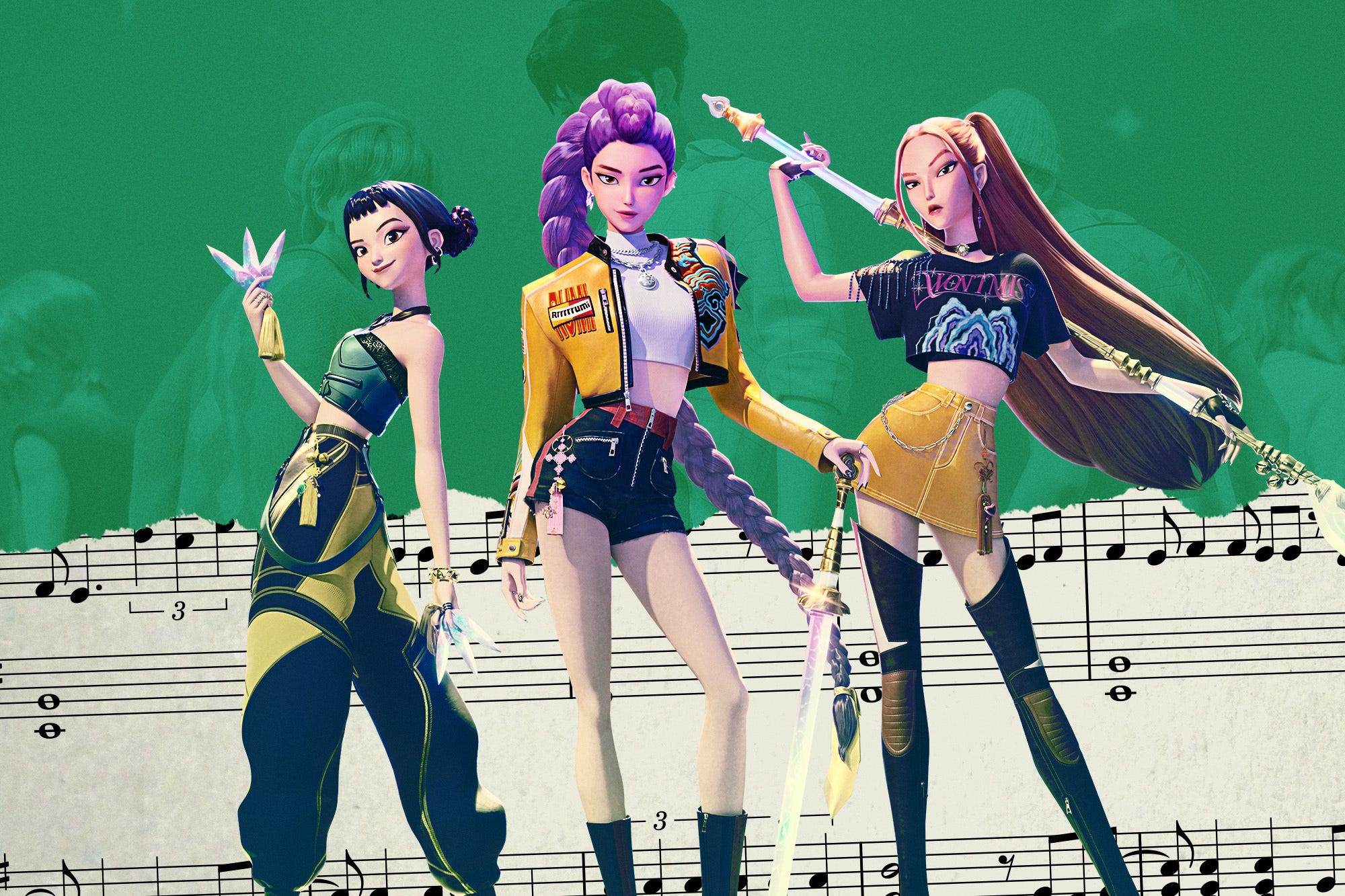
Indeed, the soundtrack has soared in concert with its source film: KPop Demon Hunters has stalked its way into becoming Netflix’s most successful animated project of all time — and, soon, its most popular original movie ever — with more than 210,500,000 views according to the streamer. The spectacularly colorful animated film, the brainchild of veteran story artist-turned co-director and co-writer Maggie Kang, follows that old clichéd trope of a K-pop girl group that sings by day and fights demons at night. Along the way, they grapple with a boy band who are (gasp!) secretly demons themselves.

To help bring the story to sonic life, the creative team (including co-director Chris Appelhans, producer Michelle Wong and Sony Pictures Music Group president Spring Aspers) set out to create an original soundtrack of K-pop jams from scratch. This daunting quest led them to Eisendrath.
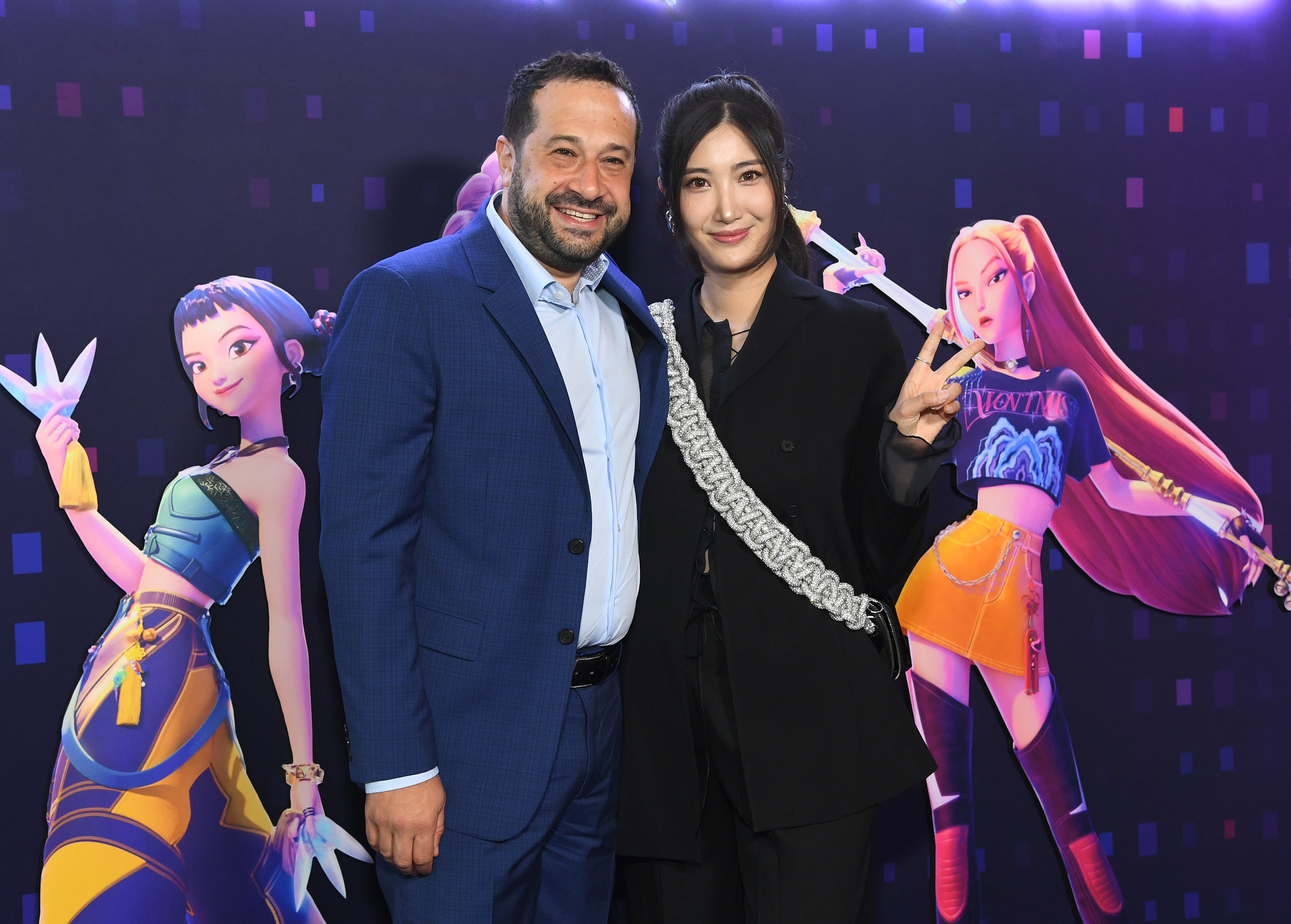
He’s a veteran of the stage, and I was blown away, touched and emotional when I saw the Broadway hit Come From Away, for which he served as musical director. Since then, Eisendrath has parlayed his acclaimed stage success into film, most recently as executive music producer for this past spring’s Snow White and Only Murders in the Building.
But Eisendrath has arguably never had a hit like KPop Demon Hunters. The team is sitting pretty on numerous accolades, most recently landing three songs in the top 10 of the Billboard Hot 100: “Soda Pop” and “Your Idol,” both performed by the fictional K-pop group Saja Boys (the demon boy band), and breakout smash hit “Golden,” which hit No. 1.
The song — performed in the movie by the fictional group HUNTR/X but sung in real life by actual K-pop recording artists Ejae, Audrey Nuna and Rei Ami — is the first track from a female K-pop group to ever top the Hot 100. The whole affair is such a blockbuster that the Netflix film is coming to theaters for a sing-along version this weekend (and tickets nationwide are selling out fast).
Eisendrath spoke with me from San Diego’s La Jolla Playhouse, where he’s already at work on mounting his next project — an EDM-powered stage musical he wrote with his wife, Anne Eisendrath, called The Heart, which spans 24 hours in the life of a man on his deathbed. Or, as Eisendrath explains to me, “a medical drama meets EDM.”
Needless to say, the composer is no stranger to unique projects. So, I was excited to ask him about his path from the stage to being behind a blockbuster K-Pop film and soundtrack, the creative journey and how he’s dealing with historic chart success.

Rob LeDonne: For a brand new property with a bunch of artists most people have never heard of before, the KPop Demon Hunters soundtrack has broken out in an unprecedented fashion.
Ian Eisendrath: Yeah, I’ve never seen anything like it. I think that’s one of the things I’m most excited about. There are songwriters on here who have had massive hits (including “Golden” songwriter Ejae), but for them, I think it’s next level.

So with a Broadway and Disney film background, how did this K-pop-fueled project come to you? And what was your familiarity with the genre before singing on?
Spring Aspers (president of Sony Pictures Music Group) called me immediately after we wrapped another film together at Sony, which was Lyle, Lyle Crocodile. I had such a positive time working on that one, with people like Shawn Mendes and Pasek and Paul. Spring said, “Hey, I wanna find something else to do right away together, and I have a really unique project. So trust me, you’re gonna wanna do this.” I do trust her, so I was like, “Great, I’m in!” And then she said it was K-pop, because she had set up a really positive collaboration with the South Korean record label, The Black Label. I’ve always been obsessed with the K-pop girl group BLACKPINK, so that was super exciting to me, and of course, it was an instant yes. But my K-pop familiarity was light, to be honest. I had listened to a lot of it and loved it, but hadn’t really studied it. What was fun was once I found out I was going to work on this show, I did a massive deep dive. I felt like it was such a crazy, bonkers, theatrical genre of music that would really lend itself to the film and stage spaces.
How so?
What I loved about it was the theatricality of it and the intense energy of the music. I could immediately imagine it just filling the vast atmosphere of a film, just popping with animation. I just thought, “Oh, what a brilliant marriage.” I met with (directors) Maggie King, Chris Hans, and (producer) Michelle Wong, who showed me artwork and talked through the story, which resonated with me at the time in my life. The movie is about owning your authentic self. That you know all the colors — the good, the bad and the ugly that make up who you are. It’s about welding all of that together and getting to live out loud in a lot of ways. It’s such a beautiful message for kids, teens and everyone. So with all those things, I was instantly hooked.
For those who may be unfamiliar, what are some tropes of K-pop music that set it apart from other genres?
First of all, K-pop just means Korean pop music, so there’s a wide gamut of it. But the things that felt like truisms to me were that it’s incredibly beat-driven. So working on the music, we spent a lot of time figuring out the grooves, which is often how we started because. That dictates the energy, tempo and pace. With K-pop, many production layers are complex in a beautiful way. Then the vocals have a very, very specific approach. It’s very clean and there are so many layers. These songs have immense stacks of vocals; we might have two to 400 tracks for backing vocals on some songs.
To ask a nerdy question, what’s the result of that? That many layers sounds insane to me, and complicated to put together.
A lot of films that I worked on, we do layer maybe 150 vocals. They’re much more homogenous, but you’re looking for depth and breadth. So 200 or 300 layers gives it that vast edge. And indeed, I think we have layered more vocals than a traditional K-pop track would to make it cinematic. But that was inspired by how K-pop vocals are traditionally arranged and produced.
You worked on this for three years. As a creative person, how do you keep engaged and excited about it? Are you acclimated to the process, or is this almost turbocharged to you compared to the Broadway world?
I mean, it depends. Come From Away moved really quickly. I feel like I’ve been really lucky to be at shows that move fast for Broadway standards. But this is the longest film process I’ve ever been on, alongside Snow White for Disney — but that was just because of the pandemic. So it feels like a very gentle pace. And I think what that breeds is a lot of opportunity for revisions and fine-tuning and developing relationships and figuring out how we can best collaborate.
We had the gift of working with a lot of people who hadn’t written for film yet, so there was a year of us all getting on the same page, and then it was diving into figuring out demoing the songs and that whole process. The other nice thing is that, unlike live action, animation works in a way where one sequence is put into production at a time. So you’re sort of only focused on a couple of minutes of film, and then when you figure that piece out, you move on to the next one. So it’s all very progressive, additive and cumulative.
Did you feel more creatively free concocting music for animation versus live action?
One hundred percent. I’ve really enjoyed my live-action projects, but there’s always this moment, the first time a character sings, where it’s very challenging to earn the audience’s buy-in for someone singing on camera. But when it comes to animated projects, it allows you to go to places that are not naturalistic, which I’m super interested in and really enjoyed on this project. This was my first animated project and I’m about to do a couple more, so I’m loving it so much.
Did the music come first or the animation?
Animation. The way we worked was through storyboarding, which we would put against temporary K-pop tracks just to feel the energy and the vibe and develop the sequence. We had a breakdown of what the song needed to say to serve the story. In a narrative context, unlike a pop song, the idea of the song cannot remain static. Something always needs to progress and happen so that it holds time in the film. In my experience, if the song doesn’t do something actively for character, story and action, it will get cut. We figured out what these songs needed to do, and then we would meet with the various artists involved and launch into the writing of these songs.

You said that once the K-pop group TWICE signed on, it was a game-changer. I’m wondering why that was?
For all of us, it was a question of whether these songs land with the K-pop audience, the K-pop music makers. When we got to work with TWICE, it was reassuring to me to know that there was this huge K-pop group who said, “We like this film, we like the songs, and we wanna sing one of them.” That was the first moment when I was like, “Okay, I think we’re definitely going in the right direction and this might have a chance of being something that resonates.”
Speaking of, and you know I had to ask this, would it be possible to envision a world where KPop Demon Hunters would head to the stage?
I completely can see it, and I think there absolutely should be a world where that exists.

Have there been any talks?
Not that I have been a part of. A lot of people in the theatrical community have expressed great interest, and I know that there are a lot of producers who could do a great job on this show. But I’m not in the loop on the Sony side and the Netflix side. But it does seem like a fairly perfect source material for a stage musical, or at least a live performance event.
Now that we’ve got that out of the way, have there been any talks of a sequel?
I know the same thing that’s printed in all the articles, which says there will be. But I’m reading coverage about it, which is how I’m finding the information. So there’s nothing official, but there’s so much buzz around it, and it’s exciting to think about.
How did the sing-along idea come about? It seems like a badge of honor, considering other movie musicals that have gotten the sing-along theatrical treatment have been hit titles like Wicked and The Sound of Music.
I wasn’t privy to it. I actually recently heard, and I’m thrilled. When we mixed the film in a theatrical environment, it was so exciting. It’s just a whole other experience, and at the level of what we’re able to do with sound and music. I’m just beyond excited that people will start to experience this in the theater on the big screen with a full Atmos mix. It feels like a huge win and opportunity, and I’m just very, very excited about this happening.

What do you think are the takeaways for creative people when it comes to the success of KPop Demon Hunters?
I think there are a few things. First, a model that excites me is bringing in writers from the pop music space; people who authentically own these genres that we are pulling from. The songs are resonating because we have these hitmakers who wrote these songs who are adapting to and embracing the world of narrative songs for film. It also shows the energy between the film and the soundtrack, and how the two keep feeding each other. I happen to believe that the soundtrack is more successful because of the film. And the film is more successful because of the soundtrack. It’s an incredible synergy that doesn’t always exist when you make an album or doesn’t exist when you make a film without a soundtrack. Finally, I think it shows that animation like this can be for all ages. It really feels like this is being embraced by all demographics, and that’s really exciting.
 | A guest post by
|