

Transcript: Art & Crafts LIVE: Behind the 'Phantasmagoria' of 'Emilia Pérez'
Michael Ruscio, ACE, speaks to three key collaborators on Jacques Audiard's genre-bending Spanish-language musical: editor Juliette Welfling and composers/songwriters Clément Ducol and Camille

Elaine Low: All right, so welcome to the stage, our moderator, Michael Ruscio, ACE, best known for his work on Six Feet Under, True Blood, and The Leftovers, and was most recently nominated for an Emmy, for outstanding picture editing in a drama series, for 3 Body Problem.
Come on up, Michael.
Michael Ruscio: Hello, everyone. You’re in for a real treat because this is such a sensational film, which I saw a couple weeks ago.
Welcome to the stage composer-songwriters Clément Ducol and Camille and editor Juliette Welfling.
Thank you so much for being here. I wanted to talk a little bit about the origin of the film. And I had the pleasure of attending a screening with Jacques Audiard, the director. And he spoke about how this was from a story, and he took a little piece of it with a gangster who wanted to go through a transition.
And then he made this film from there. And initially it was designed as an opera. Were you involved in that conversation?
Camille: Yes, we were involved in the conversation. Jacques came to us with questions rather than with directions. And his questions were, is this story meant to be an opera? Is it meant to be a film, a musical?
He had the intuition it was meant to be a musical, because it was like a phantasmagoria and that, you know, the music would help making it believable. And then we started working from there, really from the start.
Clément Ducol: Yeah, we hadn’t a script yet, it was just a treatment. And Jacques wanted us to be involved from the very beginning of the script’s construction. So we were stuck in Périgord. And, in the morning we would sit around the table reading the treatment and pointing out the scenes that could be used for a song.
And in the afternoon we’d go to the studio, writing the music. Jacques and Thomas Bidegain, his collaborator, would come to listen. And sometimes there was a sense of jubilation because the songs are a catalyst for emotions and for narrative. It make the action move forward, and it made it possible to throw away dozens of pages of script, you know, sometimes.
MR: And that also to understanding that you were propelled, this had to be a song. There was no other way to convey the emotion other than through music and song.
C: Yes. Or get information in an entertaining way, too. And soon we had the confirmation that it was meant to be musical, and that it was meant to be a film rather than an opera, because Jacques is a filmmaker.
So after a few months, Jacques decided, and we encouraged him to make a film, rather than an opera, but it still has a moment of opera, some moments.
MR: And Jacques also was very influenced by the casting. Initially, he had said that he wanted younger actors. And then when he discovered that really the depth of the roles required women who had gone through life, and especially Karla Sofía [Gascón], who has gone through a lot of life. How did that back and forth between you and the actors work when you discovered who they were and what their voice was?
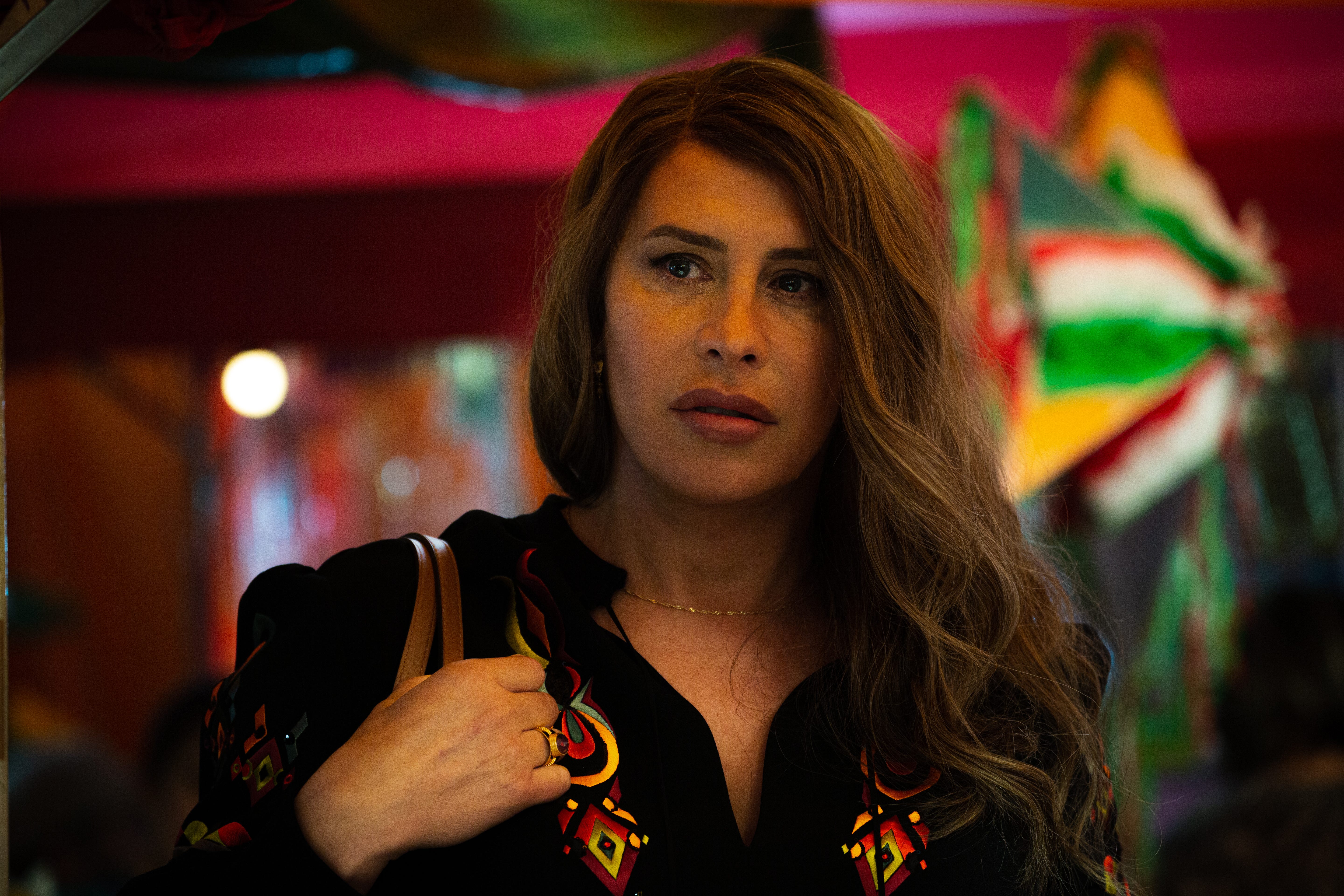
C: Yeah, originally Rita was a man. Remember the moment when Jacques told us one morning, well, Kaminsky is going to become a woman, so yeah, Kaminsky went through transition and became Rita. And then, yeah, they became, like, more mature women, and especially the character that Selena [Gomez] plays, Jessi, was much more superficial at the start.
She was younger. Young doesn’t mean superficial, but she was more hysterical, more in a prison. She wasn’t as attachante — we have that word in French — attaching as now. Maybe you can talk about the way “Mi Camino” came to us.
CD: Yeah, because the music shifts along with the characters, and maybe even with the actresses who play them, actually.
When Jacques met Selena, we had written a punk song.
C: Called “Bienvenida,” her first number in the story.
MR: So was it Selena’s punk song became something different when you —
C: No, she kept this punk song and then she had a punkier song. Basically, she was saying, “I’m going to rebel,” and then she was saying, “I’m rebelling.” And it was a little redundant, you know.
CD: And Jacques met her and said, “OK, help me find a song that tells the story of her as a woman, and not only for the character.”
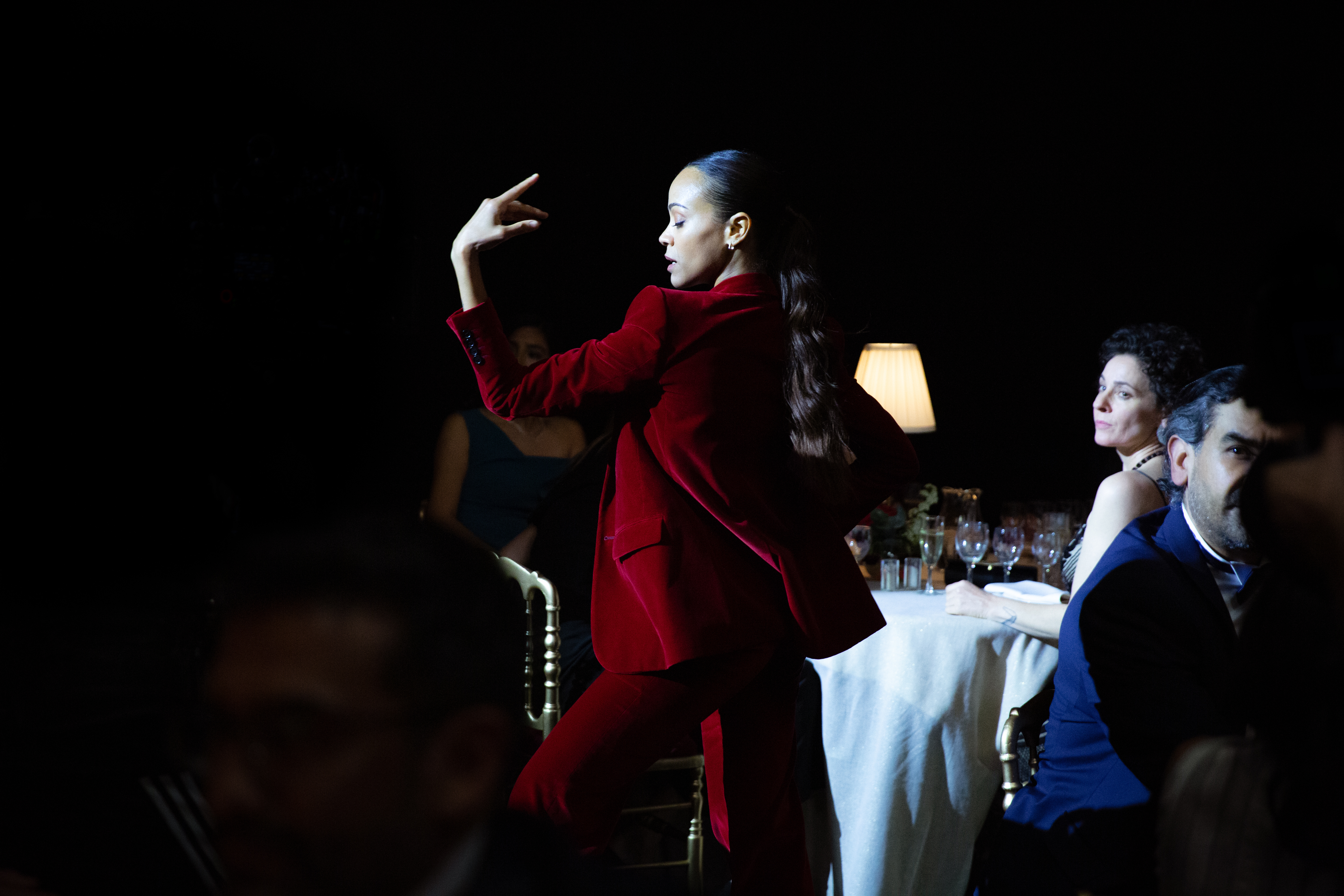
MR: And this clip that we saw [of the song “El Mal”] takes place later in the movie, obviously. Emilia has already gone through the transition from Manitas. And what struck me about it editorially was the melding between the music — Rita [Zoë Saldaña] is a lawyer and she has, this is a fundraising event at this point in the movie, and she has come to have agency and authority and very much integrity and has, through the process of becoming sort of the best friend of Amelia, she has this strength. And I wanted to talk about the music and the syncopation between the music and the lyric and also how that worked with the editing, because it all feels like it’s of a piece.
C: It took a long time to write that song. The lyrics came very quickly, but the tone took time to find, the atmosphere, and we ended up with that rock. And Zoë helped us a lot cause she’s very accurate, and she’s got this steely voice that evokes precision. She’s very precise and you need to be precise when you want to render justice and these words are very fast.
I remember demoing this song, I was crying. It was like, the hundredth time I was demoing. It’s really tricky. It has little silences, it’s very, da da da da da da da, a little, yeah. And she really nailed it. And this operatic feel with Emilia in the back is very important too. And it’s important in the scene because we had to make Emilia present in a musical way.
She’s in the background of Rita’s phantasmagory, but she needed to exist. So we came up with a very operatic you know, “perder a un ser amado,” that thing that we hear in the back. And that came later on. It was Jacques’ idea. “We need to have something,” he referred to Prokofiev’s “October” Cantata.
MR: I love that word phantasmagoria.
C: Phantasmagoria?
MR: Phantasmagoria.
C: Yeah.
MR: And I noticed this time seeing the clip that the way that you introduce Emelia is, you hear her voice first before we cut to her. There’s like several lines. And so you’re having to understand that there is this other voice that’s there. And was that always the decision? Did you have an earlier piece where you went right to her? How did the reveal unfold itself? To reveal that actually that Karla was there as well, singing.
Juliette Welfling: Well, you always, we always heard her in the back, and Karla Sofía starts her speech, like a regular speech, and then all of a sudden, Zoë starts going into her fantasy like she’s in rage and she’s raged against all these terrifying people, and Karla Sofía was always in the back, and sometimes.
I think when we see Karla Sofía, she speaks about Rita, so it’s more about Rita’s fantasy. And when she’s off screen, when she’s on, in kind of voiceover, she, it’s like her regular speech of the fundraising going on — but when we see her, it’s always in Rita’s fantasy.
MR: And this is pre-recorded, and so then you have that, or how much of that was live parts?
C: In terms of Zoë’s vocals, you mean? We pre-recorded a playback, then she danced it live, lip-syncing. And then we did the rest in post synchronization.
JW: ADR. ADR.
C: And she, she really had a, I mean, it felt like a performance, like a live, she was like a lion.
I remember her in front of the screen like, with Jacques — amazed. I mean, she’s a rock star.
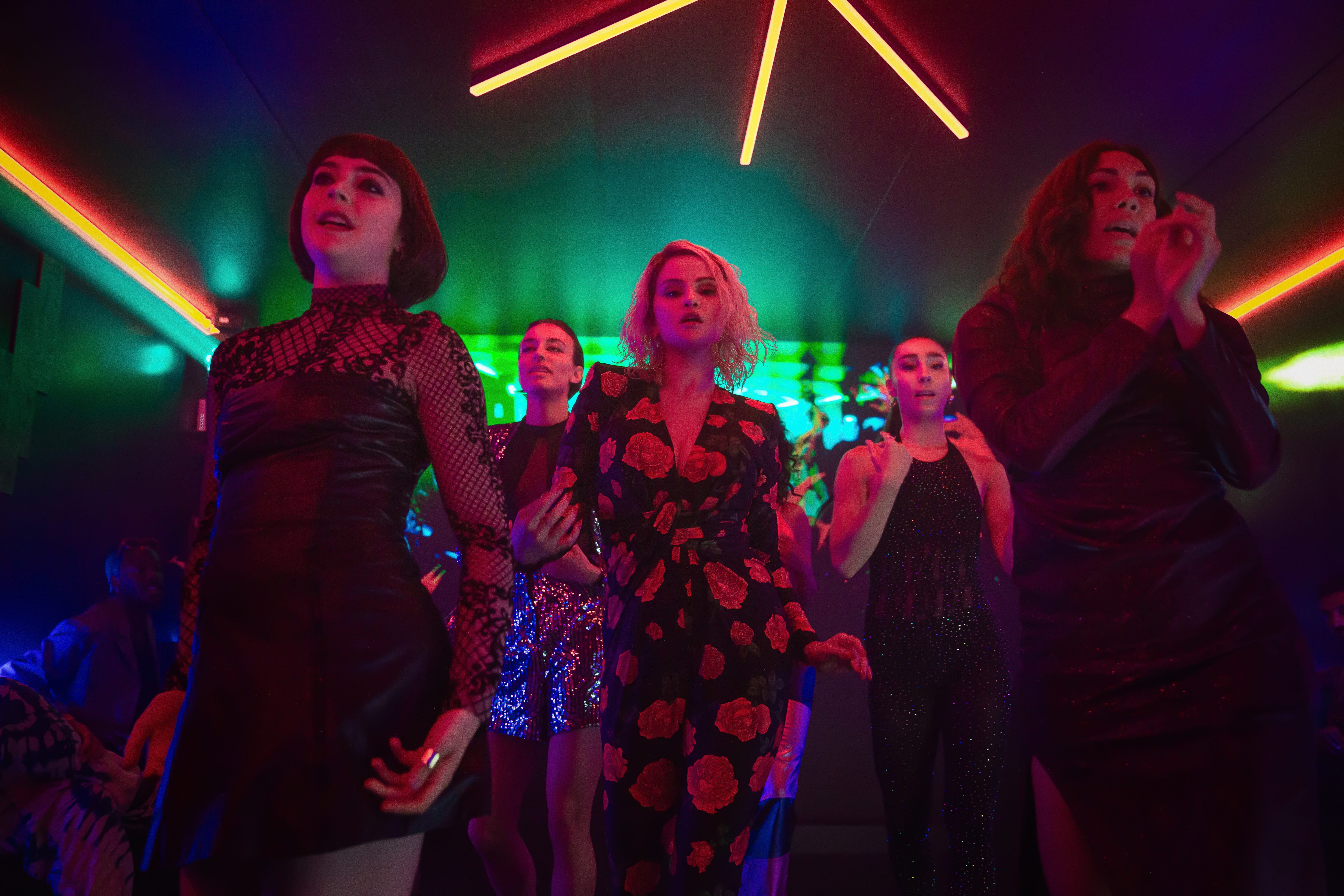
JW: Yeah, that was really nice about, and I can tell that maybe about all the songs, is that of course there was previous playback that they were acting on and often there was also production sound — not on this song, but on many songs there was also production sound, they were singing in the production sound that we also used sometime.
And then, the rest of it was done in ADR, not in a music studio. It was done like they were — and in France, the ADR, I think, is a bit different than in the U.S., because actors are not in a booth, you know, in a big studio. They can move. They can, they have the same mics as the —
C: Zoë was dancing.
MR: Zoë loved that, she was doing a dance.
C: Selena did the same for “Bienvenida,” she was really …
JW: It was for every song.
MR: And so you had three tracks with which to work, with the production sound, the pre-recording and ADR. So you could determine performances based upon what was the best, even if you use a syllable or a phrase.
C: Exactly. Exactly. It’s been a long process.
JW: It’s a mix of all.
C: We wanted to feel real and no matter what, you know, what we used, everything was — Jacques is very like that, he’s very experimental. There’s no dogma. We just need to get there and tell the story.

MR: Clément, you and Camille are always on set. Do you ever go to set, Juliette?
JW: Um, I mean, once.
C: She was already working, while we were shooting.
JW: I had a lot of work, and I started day first from shooting, and I went once, but it was far away.
MR: And Clément, what was your experience on set with Jacques?
CD: It was incredible. We were coaching all the dancers, the singers, the choir. Yeah. It was great to feel our songs embodied by all these characters.
MR: How closely did you work with, in a day-to-day basis, in terms of the dailies and how you dealt with it, talking to Jacques about what you saw from the day before?
JW: Jacques never watches the dailies, because I think maybe first of all he’s busy preparing next day, and I don’t think — he doesn’t want to, you know, have too much in his mind, and he can’t watch the dailies, so he never watches them, but he knows what he has done, obviously. And sometimes he’s very worried, and so we speak every day, or I write him memos every day about what I see. But not — I mean, this is very French — only for things that are not okay. [Laughs]
We don’t bother speaking about what’s okay.
C: We know we’re great.
MR: Was there anything that wasn’t okay that he redid?
JW: Sometimes, yes. And sometimes when it was not okay, or he worried that it wouldn’t be okay, I would cut the scene pretty quick so that he can have it on set and watch it. Because it was all in a studio, so they have to destroy the sets, not every day, but — he wanted to be sure that it would be okay.
But otherwise he doesn’t watch his dailies, and I cut, and then when he comes, when he arrives at the end of shoot, he doesn’t want to see a movie that’s longer than what’s planned. If the movie is planned to be, like, two hours, he doesn’t want to see more. He says, “Oh, even the first cut I want it to be like maybe two hours 10 minutes, two hours 15, but not more because I’m gonna be too bored.” So that’s how we work. But I yeah, we speak every day during shoot.
MR: For those who don’t know, this is actually a Spanish-English-language film shot primarily on French soundstage.
JW: Yeah. Weird.
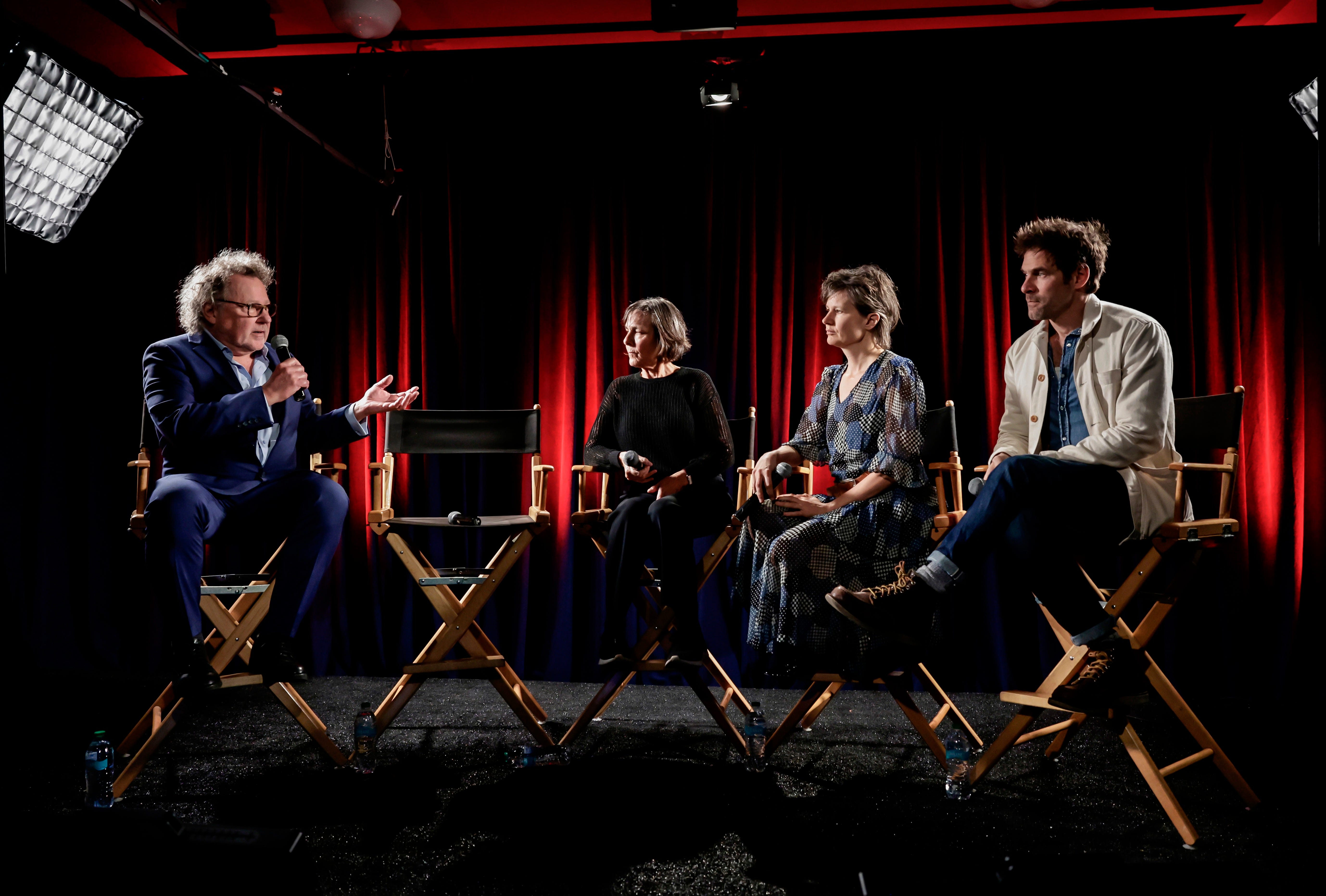
MR: Just very briefly, what did you learn from this film? The making of it?
CD: Patience.
C: I learned to say, “This song is for you.”
MR: I love that. And Juliette, you have a long collaboration with Jacques, so this must have exploded it into a whole different direction.
JW: Yeah, totally. It was crazy. And I learned that he was even more crazy than I thought. And that I could follow and that it would be so great to go this way, and if he could stay crazy, I would love it. “Please, Jacques, stay crazy! Remain crazy.”
MR: So the film does premiere on Netflix tomorrow, November 13th. But please try to see it in theaters. It’s just really sensational. And thank you so much, the three of you. This has been great.