

Timothée Chalamet Was Foreshadowing ‘Marty Supreme’
Plus: Kino Lorber’s Richard Lorber on his ‘uplifting’ Gaza doc about a photojournalist killed before its premiere



It’s rare to talk with someone who knows how to pack a theater for both a heartbreaking war documentary and a silent film classic, and who — despite all the conventional wisdom that says otherwise — thinks there’s a bright future ahead for independent film. But that’s how Richard Lorber, chair and CEO of the international film distribution company Kino Lorber, sees the industry — and it was great talking to him for today’s newsletter about Kino Lorber’s model and its buzzy awards contender, the documentary Put Your Soul on Your Hand and Walk.
But before I get to my conversation with Richard, I wanted to swing back to the Oscar race and the wide range of news that dropped this week about the best actress field and Kate Hudson. It has been confirmed that the former supporting actress nominee for Almost Famous will campaign in the lead actress race for Focus Features’ Song Sung Blue. (Shout out to the network of various publicity houses working on Song Sung Blue, who e-mailed multiple times to make sure I was alerted to Hudson’s plans.) I don’t know much about Craig Brewer’s film beyond what I heard from Tyler Coates’ loose lips on the podcast in August (he liked it!). Still, I’m excited by the prospect of a feel-good musical arriving around Christmas, with Hudson starring opposite Hugh Jackman as members of a Neil Diamond tribute band.
There’s been a lot of movement in the best actress race over the past few weeks (make sure to bookmark the Prestige Junkie pundits page for the latest updates). The Testament of Ann Lee was picked up by Searchlight Pictures, officially putting Amanda Seyfried firmly in the mix. Meanwhile, as One Battle After Another continues to dominate the conversation, news came yesterday that breakout star Chase Infiniti will campaign for lead recognition (leaving Teyana Taylor and Regina Hall as the film’s supporting actress contenders). But I’m guessing Hudson’s lead campaign might be specifically aimed at the Golden Globes, where the best actress in a musical or comedy category currently feels like slim pickings: Cynthia Erivo will loom large for Wicked: For Good, and Hudson’s studio cohort, Emma Stone, will likely be there too for Bugonia. But there’s still a lot of real estate, and with Song Sung Blue not opening until Christmas, Hudson’s team is wise to get her name in the mix early. Hopefully, I can see it soon and judge for myself!
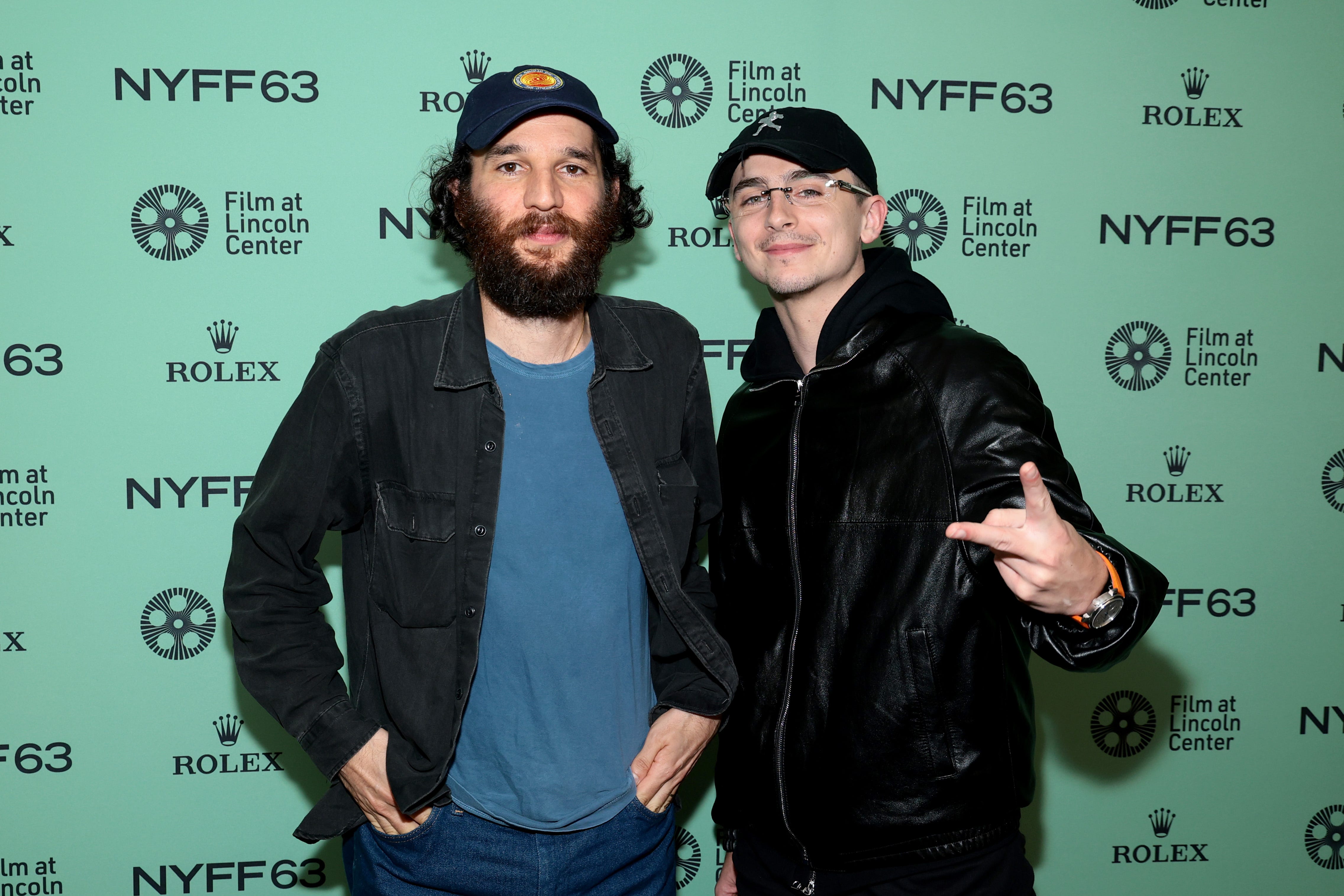
And speaking of things I cannot wait to see for myself: Josh Safdie’s Marty Supreme finally made its debut this week, as a secret screening at the New York Film Festival on Monday. I couldn’t be there myself, but Christopher Rosen was, so I’ll hand the newsletter over to him as we add yet another serious best actor and best picture contender to the mix. For more on Marty Supreme and how it figures into the Oscar race, subscribe to Prestige Junkie After Party before Friday, when I’ll release the new bonus podcast episode Chris and I did with a very special returning guest. (Here’s a hint: They have a nice history with Chris.) Stay tuned!

A Supreme Being Enters the Oscar Chat
When Timothée Chalamet won best actor at the Screen Actors Guild Awards earlier this year, he gave what was, to my ears, one of the most honest and invigorating acceptance speeches of the modern era.
“I know we’re in a subjective business, but the truth is, I’m really in pursuit of greatness,” Chalamet, 29, said after winning for A Complete Unknown. “And I know people don’t usually talk like that, but I want to be one of the greats. I’m inspired by the greats. I’m inspired by the greats here tonight. I’m as inspired by Daniel Day-Lewis, Marlon Brando and Viola Davis as I am by Michael Jordan, Michael Phelps, and I want to be up there. So I’m deeply grateful. This doesn’t signify that, but it’s a little more fuel. It’s a little more ammo to keep going.”
Little did I know at the time, but that speech also had another purpose: It’s basically the elevator pitch for Chalamet’s new movie, Marty Supreme. In the latest film from Josh Safdie, the actor plays a fledgling table tennis star in 1950s New York named Marty Mauser, a young man so full of confidence and arrogance about his skill that he sometimes shocks those closest to him — including a once-acclaimed actress named Kay Stone, who has stepped away from performing (played by a once-acclaimed actress named Gwyneth Paltrow, who returns to the screen for her first non-Marvel movie in a decade) — into a stunned silence.
Those quiet moments, however, are few and far between in Marty Supreme. Like Safdie’s previous movies (those co-directed with his brother, Benny Safdie), Uncut Gems and Good Time, this latest offering is often a runaway train of bad decisions and overlapping dialogue, as Marty tries to scheme and hustle his way to the top against mounting evidence that his dreams are just too big to pull off.
Through it all, Chalamet’s performance is undeniable. Josh Safdie said he wrote the part expressly for Chalamet, and Marty’s energy, confidence and belief feel like an extension of the star’s public persona. In a righteous world, Chalamet should be an immediate frontrunner in the crowded best actor race.
That would help the New York native, who turns 30 in December, continue on his march toward being one of those greats he mentioned in that SAG Awards speech. He’s the youngest actor since James Dean to score two best actor Oscar nominations, and if Chalamet were to win an Academy Award in the next few years, he’d join Brando and Day-Lewis on the short list of lead actors to earn that honor before turning 35.
While reviews are currently embargoed, the “social sentiment” and Letterboxd curve indicate that Marty Supreme is joining those Safdie predecessors as a favorite among film bros. It clearly already has a big supporter in its star.
“This is fucking awesome,” Chalamet said before the screening on Monday night. It was a shorter speech than his SAG oration, but no less honest. — Christopher Rosen

Kino Lorber’s Face from Gaza
When you’re a distributor trying to get your tiny film to make a splash at a film festival, you usually do everything you can to have your onscreen star right there in person, bringing the power of the movie into the real world. For the documentary Put Your Soul on Your Hand and Walk, that’s a complicated request. The film is a portrait of the Gaza-based photojournalist Fatima Hassouna, captured vibrantly through video calls with the film’s director, Sepideh Farsi. However, weeks before the film’s world premiere at the Cannes Film Festival, Hassouna and 10 members of her family were killed by an Israeli missile strike.
The documentary is a moving testament to Hassouna’s life and work, which continues off-screen. An exhibit of Hassouna’s photographs accompanied the film’s Cannes premiere, and ahead of its sold-out New York Film Festival bow this coming Monday, there are also plans for her pictures to be put on display for more audiences.
“We want her photographs to be more widely seen as well as her poems,” says Richard Lorber, the CEO of Kino Lorber distribution, which is releasing Put Your Soul on Your Hand and Walk in U.S. theaters on Nov. 5. “We want to be very careful about how we present the film, because it got so much attention for tragic reasons. We won’t divert people from that awareness, but we want to re-emphasize the intrinsic character and the quality of the film. It’s really an uplifting film.”
An uplifting documentary about the death of a journalist in Gaza probably sounds like a tough sell, but tough sells are more or less Lorber’s business. Since 2009, when he merged his own distribution company with the venerable arthouse distributor Kino International, Lorber has made a business out of the challenging, fascinating and beloved international and arthouse films that many people would tell you have no audience at all (including best documentary Oscar nominee Soundtrack to a Coup d’Etat, Agnieszka Holland’s Green Border and more). Not only is the audience there, both online and in theaters, but it is also growing among new generations.
“Even as some of the older audiences have stopped coming to see the new films, there are younger audiences coming to see older films and discovering some of the new films,” Lorber told me in a recent phone call, the morning after Kino Lorber had screened a restored print of the 1928 melodrama Queen Kelly, starring Gloria Swanson. “It was very rewarding last night to be in a packed theater and have people just agog looking at this film with glorious Gloria.”
As I learned for myself, watching people wait in line for hours to visit the mobile Criterion Closet at the Toronto International Film Festival in September, there’s a sizable cohort of younger moviegoers eager to unearth past treasures. Revival festival screenings like Queen Kelly are one option. Still, Kino Lorber is also investing in the Kino Film Collection, a subscription-based digital platform that highlights both vintage classics — such as Charles Burnett’s 1977 landmark Killer of Sheep and Fritz Lang’s 1927 silent masterpiece Metropolis — and more recent discoveries. Kino Lorber has earned two best documentary Oscar nominations in the past two years, for Four Daughters and Soundtrack to a Coup d’Etat; both are streaming on the Kino Film Collection. In addition to Put Your Soul on Your Hand and Walk, Kino Lorber is backing another documentary this year, Riefenstahl, about Nazi-propagandist filmmaker Leni Riefenstahl. It’s in theaters now and will be on the Kino Film Collection starting Nov. 18.
Unlike some bigger indie distributors like A24 and Neon, which have had major box office hits with horror-inflected titles like Midsommar and Longlegs, Kino Lorber doesn’t traffic much in genre, says Lorber. “We know that genre is driving the box office right now, there’s no way around that, but that’s not our strong suit,” he continues. “We don’t grovel for the latest horror film.” Instead, he tells me, “We look for a unique voice of a filmmaker. We look for character development. We look for a visual experience that goes beyond just linear narrative storytelling. We look for issues that touch a nerve.”
This strategy has led the company to release some earlier films from now universally acclaimed auteurs like Yorgos Lanthimos (Dogtooth), Jafar Panahi (Taxi) and Kleber Mendoça Filho (Bacarau), all of whom have new films that are part of this year’s Oscar race (respectively, Bugonia, It Was Just an Accident and The Secret Agent). Kino Lorber isn’t distributing any of their newer films, but Lorber is gracious about it: “We’re happy that their success was built on the good work that we did to bring them to the Oscars.”
Deciding to release any movie is a risk; choosing to release the kinds of movies that Kino Lorber backs — bold, unusual, sometimes even inscrutable — is a risk so much of modern Hollywood tries hard to avoid. However, Lorber has made it a thriving business, with revenue that extends far beyond the box office. Kino Lorber has partnerships with everything from Amazon to your local library (via streaming services Kanopy and Hoopla), and an educational division that distributes directly to schools. Lorber’s not revealing exact subscriber numbers for the Kino Film Collection, but “you’d be kind of surprised if you knew what they were,” he teases.
“Our films don’t play thousands of screens, but we get our films seen,” Lorber continues, with more than a hint of pride. “We’re patient, and the films accumulate an aura based on the reviews and word of mouth. I like to say that our films have a bigger footprint than shoe size.”