

The Surprise ‘Avatar’ Costume Design Nom, Years in the Making, in an AI Era
Deborah L. Scott on an ‘uphill’ battle to earn recognition

Amid some tried and true Oscar season promo stunts over the weekend — Stellan Skarsgård crashed his son Alexander’s Saturday Night Live hosting gig, just as we predicted on the podcast last week — another Oscar nominee made his way into the news for reasons much more sobering. Mehdi Mahmoudian, a co-writer of It Was Just an Accident, was arrested in Tehran on Saturday after signing a statement condemning the actions of Ali Khamenei, the leader of the Islamic Republic of Iran.
Mahmoudian’s arrest, confirmed by the film’s distributor, Neon, in a press release on Sunday, comes nearly two months after the film’s director and co-writer, Jafar Panahi, was sentenced to a year in prison for “propaganda activities against the regime.” (Panahi has yet to return to Iran or serve that time.) The director issued his own statement about Mahmoudian’s arrest over the weekend, saying that the two had met in prison years ago, and calling Mahmoudian “not just a human rights activist and a prisoner of conscience; he is a witness, a listener, and a rare moral presence.”
It Was Just an Accident, filmed in secret in Iran like most of Panahi’s films, was made at enormous political risk for everyone involved; the stakes behind it are huge, even if the film itself — about a group of former political prisoners seeking their own form of revenge — is more lively and even funnier than you might expect. Ever since It Was Just an Accident earned a fairly modest tally of two Oscar nominations, for best original screenplay and best international feature, I’ve been wondering whether some Oscar voters assumed it was too depressing and didn’t seek it out.
Mahmoudian’s arrest, and the ongoing threat to free speech in Iran, are of course important for reasons that have nothing to do with the Oscar race. But I don’t think it’s too frivolous to hope the news inspires a few more people to watch the film, Academy voters or not. It’s available on most rental platforms now.
Before I get into today’s conversation with perhaps the year’s most unexpected Oscar nominee — Avatar: Fire and Ash costume designer Deborah L. Scott — a moment to acknowledge the other terrible news that emerged late last week. On Friday, Richard Rushfield, Christopher Rosen and I gathered live to discuss the sudden death of Catherine O’Hara, who died after a “brief illness” at the age of 71. Revisit our conversation and tribute to an actress who, as Richard said, belongs “on the Mount Rushmore of comic actors” below. But a better tribute, no disrespect to us, might be to simply watch some of O’Hara’s incredibly varied work, from the SCTV sketch classics Richard bombarded us with on Friday, to her glorious Emmy-nominated supporting turn on the first season of The Studio, which now somehow has to go on without her. (O’Hara is a nominee for The Studio at the upcoming Screen Actors Guild’s Actor Awards, where she’s up for best comedy actress alongside The Studio co-star Kathryn Hahn, Wednesday star Jenna Ortega, Palm Royale actress Kristen Wiig and three-time winner Jean Smart, for Hacks. O’Hara won in the category in 2021 for Schitt’s Creek, and it will be interesting to see how SAG-AFTRA members choose to honor her at the ceremony next month.)
A few more programming notes for this week: Tomorrow on the Prestige Junkie pod, I’ll discuss the winners from the Sundance Film Festival with special guest Mike Hogan, and also bring you the first of a series of video conversations with this year’s Oscar nominees. Meanwhile, over on Prestige Junkie After Party, subscribers can still catch up with last Friday’s reunion with beloved returning guest Joyce Eng, with a new episode coming Friday, going deep on the part of awards season that might actually matter most: the parties!

Cut from a Different Cloth
Deborah L. Scott had every reason to expect that the awards campaign for Avatar: Fire and Ash would end the same way it had for the previous two Avatar films: A best picture nomination, but no recognition for Scott’s costume design.
Instead, Scott and the film’s visual effects artists are the only nominees for the third Avatar film, a bittersweet twist that is also long-overdue recognition for Scott’s work on the blockbuster franchise. An Oscar winner already for her work on Titanic, Scott reunited with director James Cameron to try something entirely new in the Avatar films: Costumes built with intricate detail in the real world and then digitally scanned to become part of the film. As she told me in a phone call last week, it’s a process that’s been widely misunderstood even by her fellow costume designers, and even as the Avatar films have become one of the most successful franchises on earth.
“It was an uphill climb to get people to realize that we actually made the costumes,” Scott tells me. “Costume designers in general used to be so narrow— if it wasn’t a period film, it didn’t get nominated. I think we’ve realized through time that if we don’t embrace the future and all the ways that costume design can be important, then who will?”
Still, Scott isn’t sure why her work was nominated for Fire and Ash but not for the first two Avatar films — even though they had many more nominations (nine for 2009’s Avatar and four for 2022’s Avatar: The Way of Water). “Last time the production designers got nominated, and they didn’t this time, which I was a little shocked by,” she tells me. “It’s a weird numbers game, and this time I lucked out.”
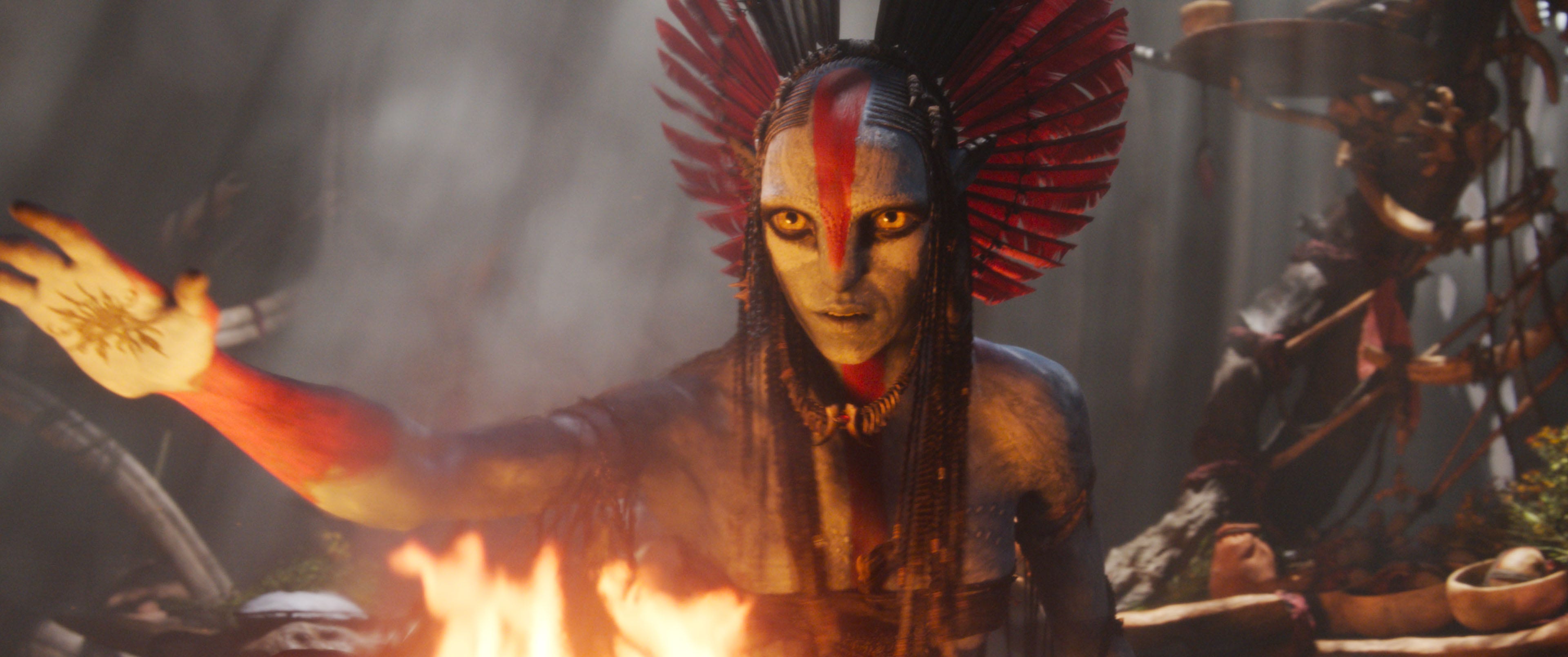
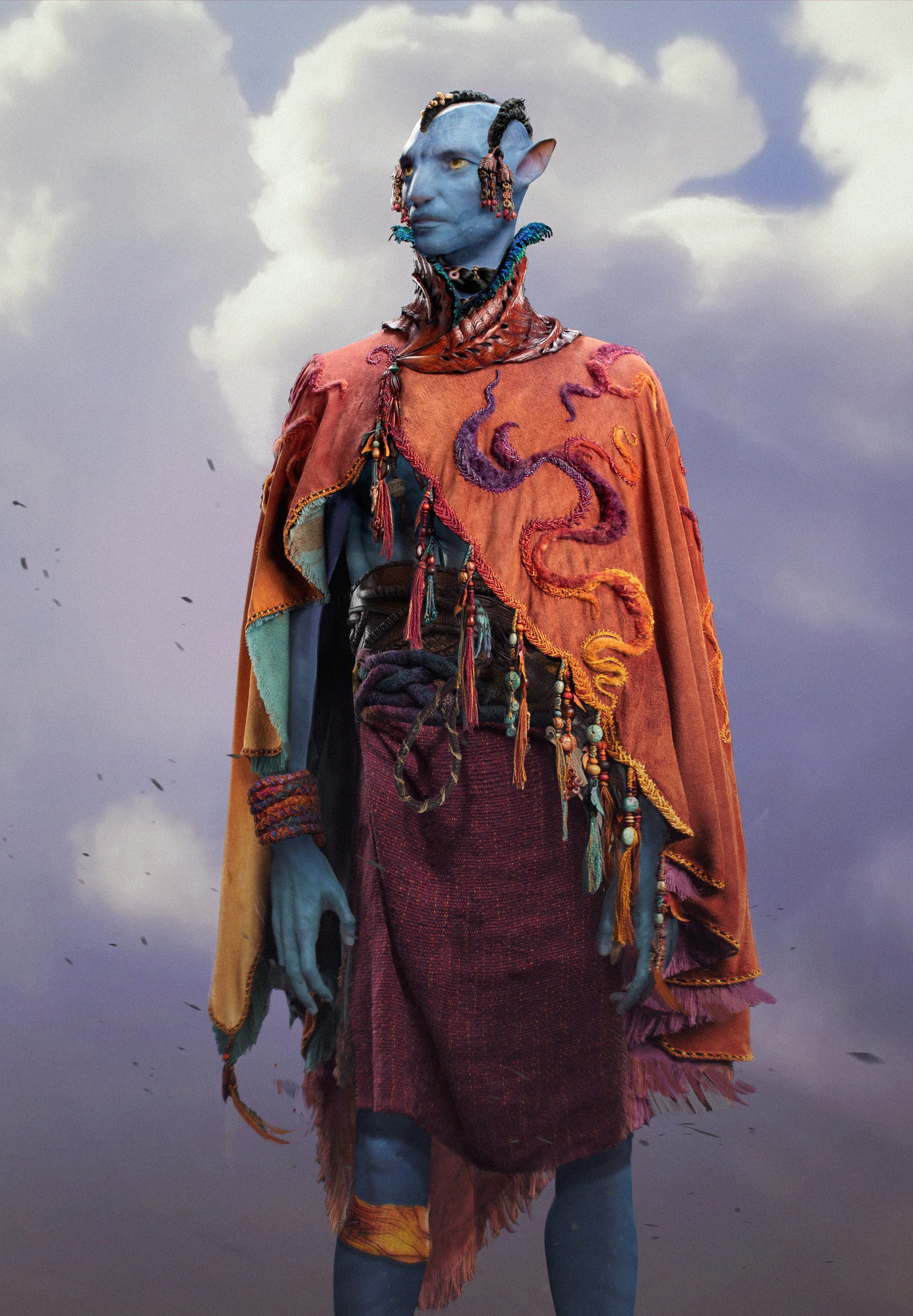
With just 195 members, the costume designers branch is the second-smallest in the entire Academy, meaning you may only have to win over a small number of voters to make it into the final five. The marketing materials, as well as the awards campaign for Fire and Ash, emphasized how much of the film is made outside of computers, with Oona Chaplin — who plays the new Na’vi villain, Varang — talking about her performance on the motion-capture stage, and Scott’s costumes often set up in theater lobbies before and after industry screenings. A brief but impressive four-minute video released online showcases the frankly astonishing amount of work Scott and her team put into the costumes, both the ones scanned by the visual effects teams and the items worn by the actors on set to get into character.
That’s the level of detail and real-world commitment that’s gone into all of the Avatar films, to be clear. But with the rise of generative AI now so prominent that Cameron recorded a personal introduction for Fire and Ash, promising it was not used to make the film, I suspect the tactile quality of Avatar is now standing out even more. As the films expand their reach across the fictional planet of Pandora, so does the technical dazzle. As Scott puts it, “You can see progression in the reality of it somehow.”

Looking to the Future
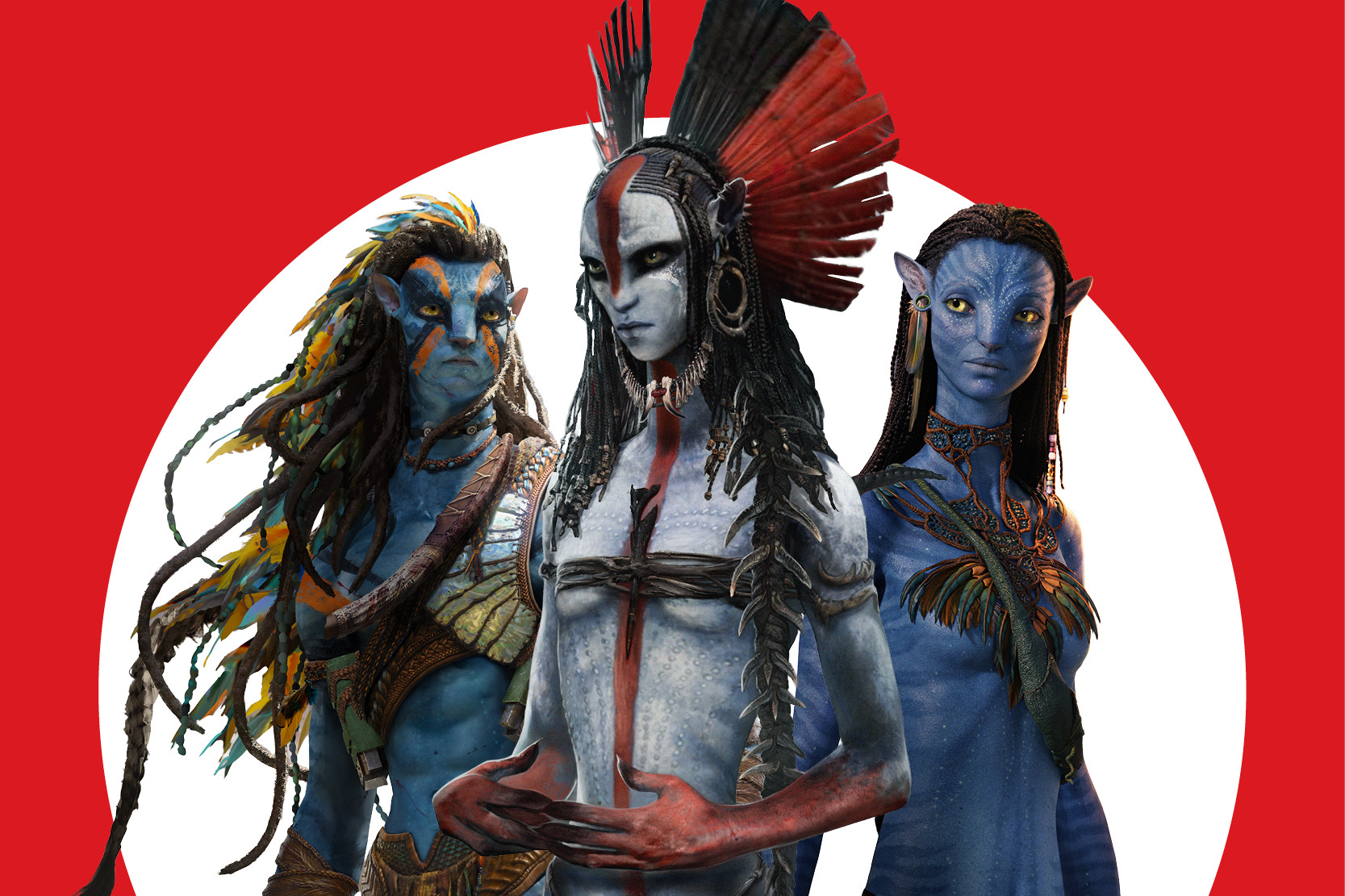
Each Avatar film has introduced a new Na’vi tribe, with the forest-based clan central to the first film, where American soldier Jake (Sam Worthington) meets and falls in love with Na’vi Neytiri (Zoe Saldaña), making way for the reef-dwelling clan at the center of The Way of Water. In Fire and Ash, we meet two new Na’vi communities — the traveling Windtraders, who traverse the planet on what are basically alien hot air balloons, and the vicious Mangkwan Clan, led by Chaplin’s terrifying Varang.
All of these cultures have been created from scratch by Cameron and require Scott and her team to fill in the details, from the materials that make up their jewelry to the appearance of Varang’s feather headdress when wet. “We world-build together,” Scott says, explaining that as the actors do their work on the motion-capture stage, she and the production design team have the opportunity to add elements or redesign parts of the costumes and set that will come to life digitally — a collaboration that could never happen on a live-action set.
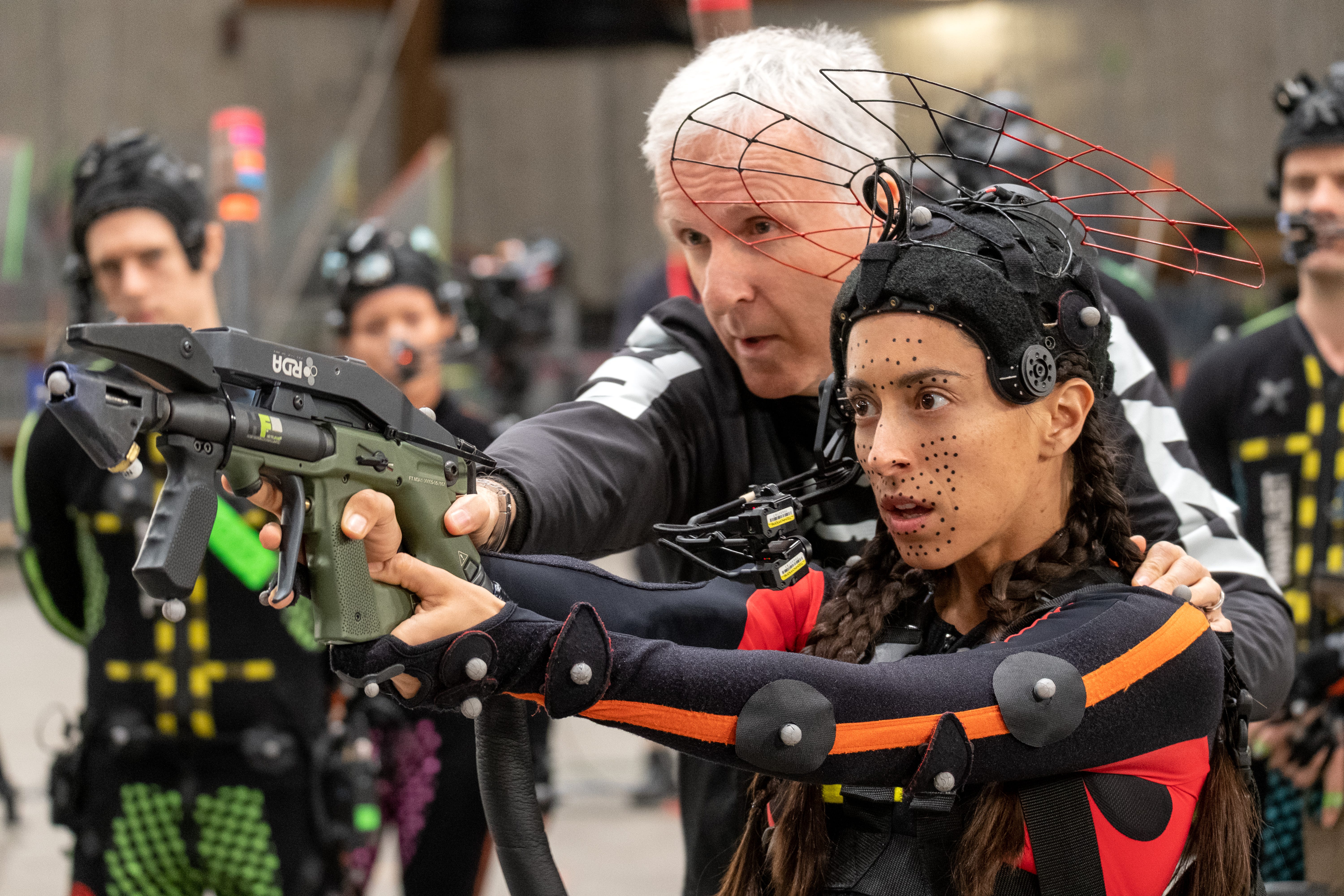
Scott continues, “As Jim gets into his camera work and you see the performances come alive, you’re like, ‘Oh, wow, there’s a good moment for her to come through a beaded curtain with a skirt that sways.’ We work together, we redesign, and all the elements kind of come together under Jim’s guidance.”
As she did on Titanic, creating multiple versions of costumes as they were dunked in water tanks, Scott produced multiple versions of Avatar costumes, whether simpler ones for the actors to wear over their motion-capture suits or exact replicas for VFX tests. For example, she tells me, “There’s a moment in film three when Neytiri has this big leather cape, and she has to throw it off and it flies in the wind. We made a very close duplicate and placed it on a performance actor in front of a huge Ritter fan. There’s a ton of proof of concept, which gets to not only Jim’s realism, his professionalism, his attention to detail, but also kind of the science around it.”
With Cameron himself claiming he doesn’t know if a fourth Avatar film will happen, Scott also doesn’t know if she’ll get to revisit the world of Pandora. But she’s hopeful that, as Hollywood moves toward even more visual effects-dependent films, her collaboration with the effects artists on Avatar and Cameron himself can inspire more costume designers to make their voices heard through every step of the process.
“We have a place at the table— we’re constantly shaping each and every garment,” Scott tells me. “People think that VFX did some magical world, but they’re actually getting backed up by all the departments. I think people will recognize that Jim’s approach delivers much higher quality. Other films could benefit from this, and costume designers can also speak up — ‘Oh my god, I could do that too.’”