

The Spinoff Trap: ‘Testaments’ Puts Emmy’s Old Habits to the Test
From ‘Better Call Saul’ to ‘House of the Dragon,’ voters rarely reward the follow-up


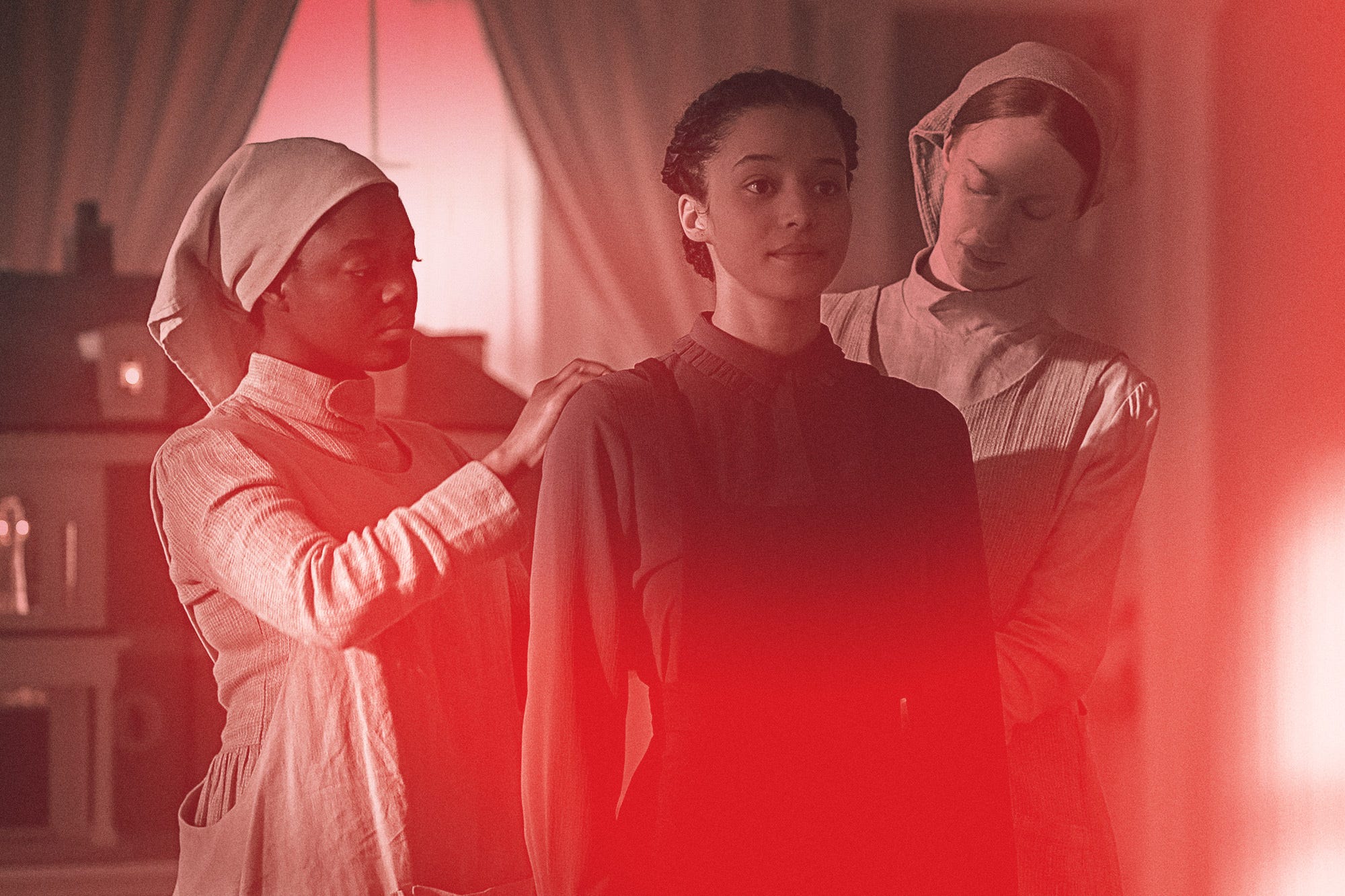
To put it in terms that the people of Gilead would understand: In the beginning, there were spinoffs.
Quite literally, from the earliest days of television, characters and ideas born in one TV series have jumped onto another. (Trivia time: 1949’s variety show Cavalcade of Stars was the original birthplace of The Honeymooners.) This Wednesday, Hulu’s The Testaments becomes the latest effort in that proud tradition, more of a sequel than a spinoff, set four years after the events of The Handmaid’s Tale.
Primarily focused on a group of teenage girls at a prim prep school, and led by One Battle After Another breakout star Chase Infiniti, The Testaments has enough to set it apart from its predecessor while also sharing a lot of DNA with the original — including Ann Dowd reprising her Emmy-winning role as Aunt Lydia. That’s probably for the best, not just in terms of breaking new storytelling ground, but for getting potential Emmy attention from a group that seemed to be burnt out on The Handmaid’s Tale by the time the show concluded last year. The first-ever best drama series winner for a streaming service, the original Handmaid’s Tale earned 15 Emmys over the course of its run, but received just a single nomination for its final season, which wrapped last spring. Can The Testaments bring the world of Gilead back into the Emmy fold?

After watching the first episode of The Testaments — and having tapped out on The Handmaid’s Tale after just a few seasons, apologies! — I think there’s enough intrigue to get people talking. Infiniti, who had a small but memorable role on Apple TV’s Presumed Innocent and then exploded with One Battle After Another, is once again playing a wide-eyed daughter making sense of a dangerous world. (Her Agnes is the daughter of Offred, Elisabeth Moss’ character from The Handmaid’s Tale.) But the series itself feels different from its mothership, mostly because of Infiniti’s performance and the show’s focus on Agnes’ school, where gaggles of girls publicly follow Gilead’s strict rules but find their own ways to act like, well, teenagers.
Shows about powerful, just a little bit scary teenage girls are not exactly new on television, nor is the use of “Dreams” by The Cranberries, which closes out the first episode of The Testaments and has been heard in multiple shows like I Love LA, The Summer I Turned Pretty and Yellowjackets. But TV tropes exist for the same reason as spinoffs: They work! Whether those tropes help shows take off at the Emmys, on the other hand, can be a trickier question.
Modern television is rife with spinoffs and shared universes — does Ryan Murphy even know how many versions of 9-1-1 are currently airing? — but only a handful make it through the prestige TV filter and into Emmy consideration. Even then, the road can be rough. Breaking Bad won 16 Emmys over the course of its five-season run, but its follow-up, Better Call Saul, produced not a single win from its 53 nominations across six seasons. Game of Thrones won a record 59 Emmys during its run, but its first spinoff, House of the Dragon, has earned just two.
The new season of House of the Dragon won’t premiere until June, outside of this year’s Emmy window, but there’s now yet another Thrones spinoff trying to make it in the race. Like The Testaments, A Knight of the Seven Kingdoms is a small-scale, somewhat thematically lighter return to a very familiar world. Focused on an insignificant hedge knight (played by breakout star Peter Claffey) and a low-rent jousting tournament, A Knight of the Seven Kingdoms significantly lowers the stakes for a story set in Westeros. Even when some powerful royals eventually become part of the story, it’s all distinctively human-scaled, right up to the quiet but moving final shots of the brief six-episode season.
A Knight of the Seven Kingdoms will be competing in the drama race despite its moments of comedy and brief running time, straddling genres in a similar way to another spinoff in this year’s Emmy race, CBS’ Elsbeth. Starring Carrie Preston as the quirky attorney she first played on The Good Wife, Elsbeth has struggled to break in for Emmy consideration on a level comparable to The Good Wife — 43 nominations in total — but this year that might change. CBS is shifting the show to compete as a comedy series, an unusual but not unheard-of move in our tragicomic era of television. If that’s what helps Elsbeth and Preston break through at the Emmys in its third season, I wouldn’t be surprised if other on-the-bubble contenders attempted a similar shift in the future.
In theory, all of these spinoffs should be offering Emmy voters something they’re notorious for seeking out: more of the same. That tendency to pick repeat winners will be especially relevant in this year’s drama series race, where The Pitt is hoping to repeat last year’s major victories (best drama series, best actor in a drama for Noah Wyle, best supporting actress in a drama for Katherine LaNasa and best guest actor in a drama for Shawn Hatosy), and maybe add another acting statue as well (Patrick Ball, perhaps, in best supporting actor in a drama). The HBO Max series is the strong presumed frontrunner at the moment, still powerfully combining the classic medical procedural with prestige TV twists as its second season nears the end. The steady presence of The Pitt means that Knight of the Seven Kingdoms and The Testaments seem fresh and new, despite their origins in familiar worlds. If Emmy voters find themselves looking for something different this year — hey, it’s not unheard of! — that could be a real advantage after all.


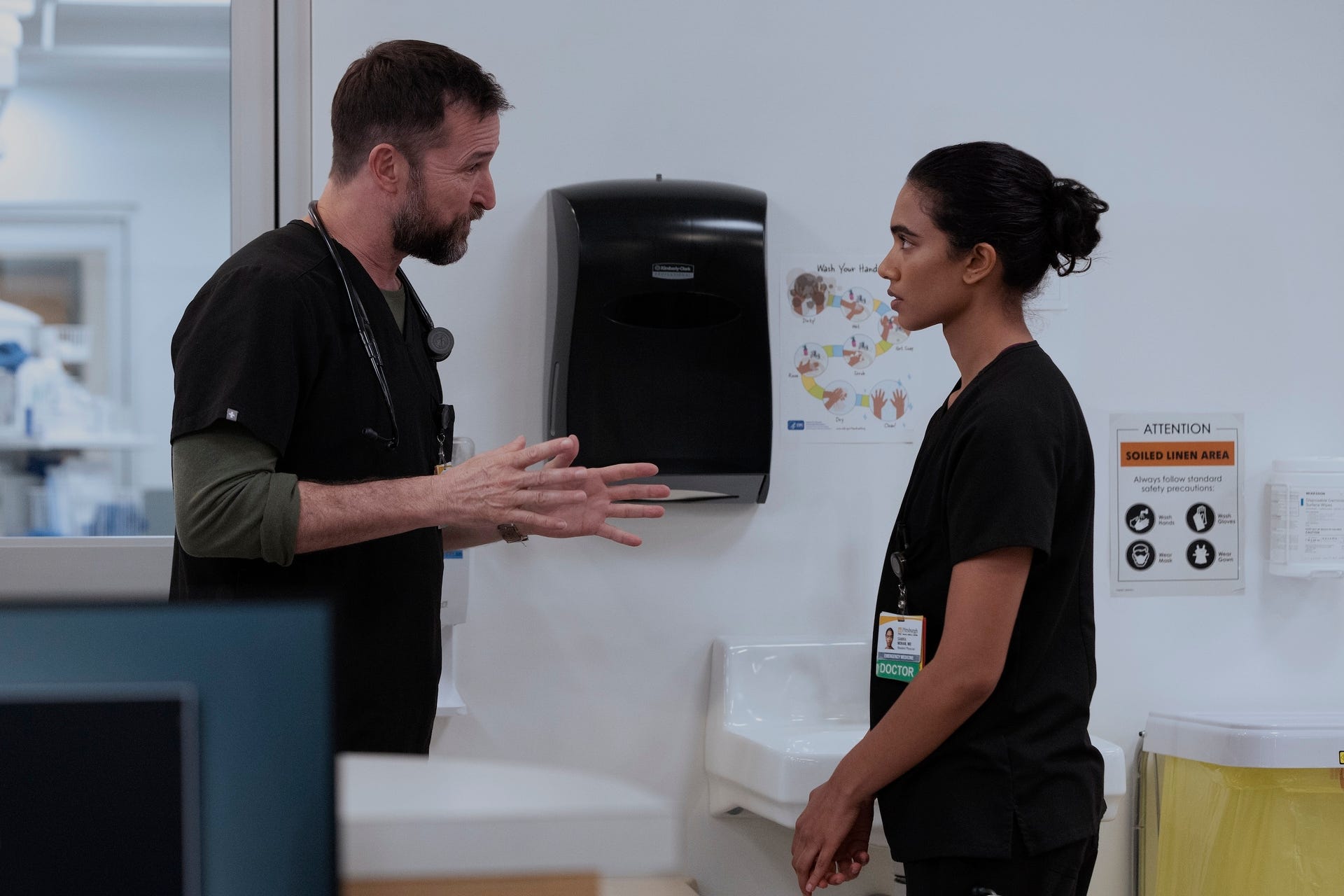
Speaking of The Pitt, if you haven’t yet read my colleague Lesley Goldberg’s expert untangling of the show’s latest controversy, head over to Series Business this instant. Lesley did a great job explaining why so many fans are upset about the upcoming exit of Supriya Ganesh’s Dr. Mohan, who will not return for the show’s third season, while also pointing out that the strength of a medical drama like The Pitt or Grey’s Anatomy is that characters can come and go as they would at a real teaching hospital. I’ll write much more about The Pitt ahead of its finale next week, but I’m especially intrigued to see how Dr. Mohan’s exit is explicitly written into the show, if at all, given her ongoing tensions with Noah Wyle’s Dr. Robby this season. Robby has been hard on Mohan, and he — and the show’s creators — are probably correct that her future as a doctor is unlikely to be in the emergency room. But will Robby acknowledge he didn’t have to be such a jerk about it, and will Mohan get to exit on a well-deserved high note? The Pitt has a lot of planes to land in its final two episodes — and since it takes place over 15 hours in a single day in the E.R., tidy closure is probably not what the show will offer. Now that Ganesh’s departure is confirmed, the Mohan storyline may have the highest stakes of all.

It’s perfect that The Drama, starring press tour champions Zendaya and Robert Pattinson, is opening to almost the exact same box office as Zendaya’s spring 2024 hit Challengers. She’ll be getting lots of attention for her roles in guaranteed blockbusters like The Odyssey and Spider-Man: Brand New Day this year, but the fact that Zendaya is one of the precious few young stars who can open these kinds of spiky, challenging romances ought to be celebrated even more. That said, I’ll attempt to learn my lesson from my doomed efforts to get Challengers serious awards consideration and leave any drum-beating for The Drama for others. Sometimes a springtime hit can just be a springtime hit!
