
If this column has a mission, it’s to try and be the one corner of Hollywood that says what its author actually thinks rather than positioning or carrying water for this or that source or interest. For better or worse, even when my instinct is completely out to lunch — as it no doubt often is — I can look any reader in the eye and say I have never published a syllable here that I didn’t in my heart believe to be the truth.
Which is why writing today’s column was so hard. Because I write it with the deep, almost religious affection for Sundance and all I’ve gotten to be a part of for more than 20 years of festival going. As much as Sundance can be blind to its own paradoxes — for all the hassles, the burdens, the silliness of the circus — I’ve always come away with so much to love every year.
For all its contradictions, you still squeeze onto the shuttle bus and see super-agents shoved in next to retirees and volunteers, all asking, “What’ve you seen? What’ve you liked?” More than four decades after this event exploded out of the sleepy little U.S. Film Festival and the then-cloistered arthouse world of the 1980s, every year you still get to witness the Sundance dream: A little filmmaker no one has ever heard of shows up with a movie no one knows anything about that blows the rafters off the auditorium and changes their life forever.
No other festival does anything close to that, or has the proven track record of doing it year in and year out for closing in on half a century.
Which is why the sense that we might be on the brink of losing that produced deep melancholy among festivalgoers this year. And the sense of what that loss would mean both to Hollywood and independent film struck real terror in their hearts.
But frankly, not as much terror as there should be.
Sundance’s Limbo Event

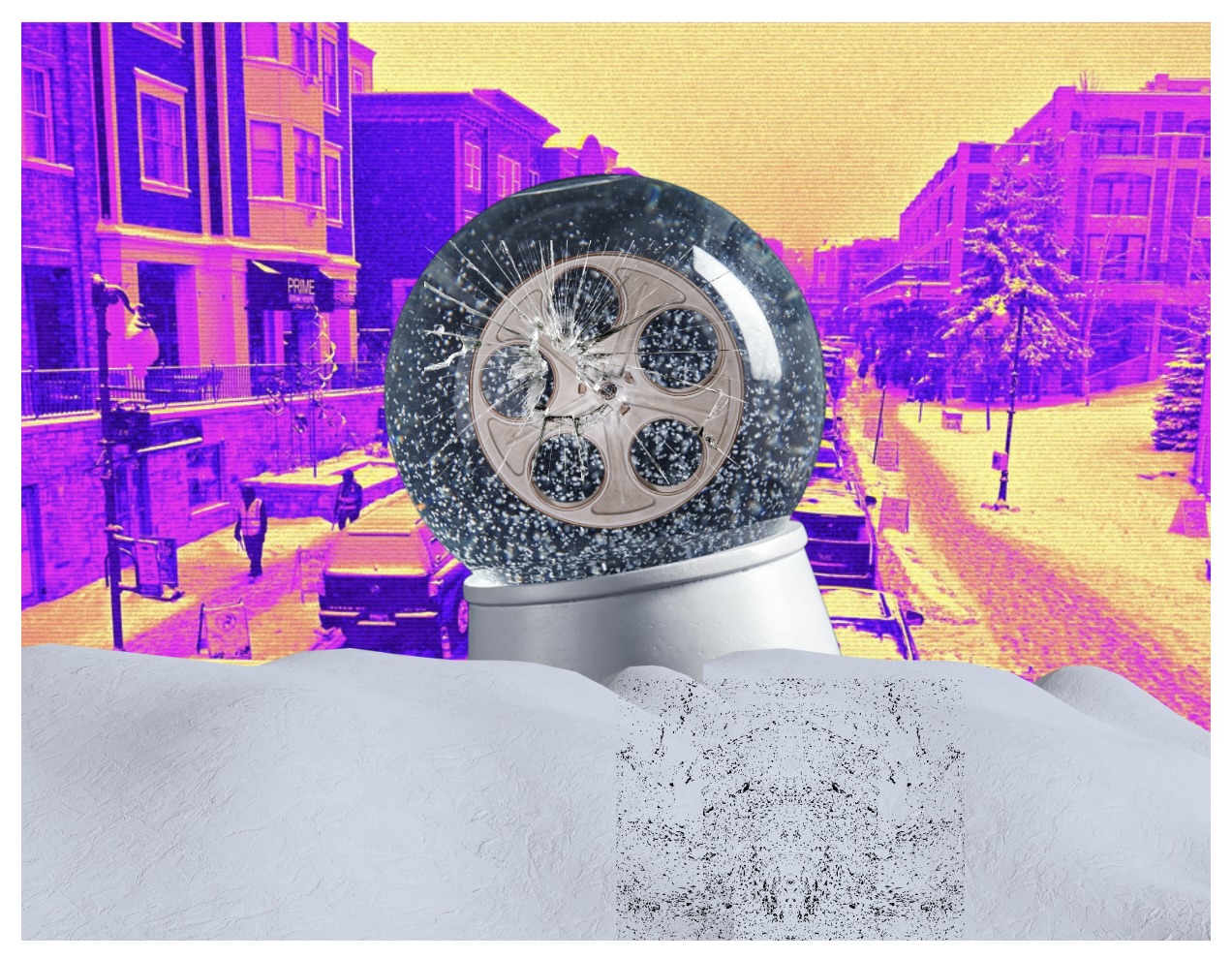
This year’s Sundance felt like a festival in limbo — hanging in the frigid air of Park City like condensation — a festival suspended between a golden past and its future looming just over the horizon. The future will be very different, perhaps for good, perhaps for ill, but with the assurance that it can’t go on like this.
“Can Independent Film Survive?” has been the perennial Sundance headline since Sundance began, and yet both the sector and the festival have always defied expectations of imminent doom. But something is definitely changing, or going away; the feeling was everywhere, along with a sense that at this moment, the indie world is more bracing for the future than striving to shape it.
The pervading sense at Sundance was of a moment fading away — and nothing stepping forward to seize the new moment. So far.
With Sundance’s impending departure from Park City, the big conversation was backwards looking: How many years have you been coming? How many Sundances is this for you? For all of Sundance’s foibles and ups and downs, there are not many events that inspire the kind of deep affection that Sundance does among its devoted attendees. Sundance is the critical meeting place between Hollywood and the independent filmmaking world. It’s a neutral territory beyond the narrow (increasingly, terrifyingly narrow) confines of studio filmmaking, this little, sealed-off snow globe where a whole town wanders around for 10 days just talking about movies.
There are many other festivals certainly. But the big international ones — Cannes, Venice, Berlin, Toronto — have become gilded spectacles too large to sustain any ties to the grassroots. Meanwhile, the zillions of local festivals are too parochial, too desperate for relevance to qualify as major moments like Sundance does.
Only Sundance has traditionally struck the perfect balance between the industry and the pure craft of filmmaking.
You Never Want a Serious Crisis to Go to Waste
Okay, I have a built-in penchant for hysteria and doomsaying. We’ve all got our quirks. But Sundance 2025 happens while so many questions loom over the entertainment business, little things like What becomes of Hollywood? What becomes of filmgoing? Can the indie world fill the void being vacated by the studios? And, of course, what will Sundance itself look like after it leaves Park City, an announcement expected in the coming months?
If you’re still looking at the upheaval in the studio world — including the tech world encroachment and rise of the creator economy — and not seeing the possibility that this could be going in some unpleasant directions, then I have to say, I’m not the crazy one in this conversation. Particularly vis-a-vis their commitment to a robust theatrical market which remains, shall we say, a work in progress. Particularly as they seem to have largely given up on anything beyond a few giant bland tentpoles a year, and where that leaves all this.
The landscape feels like it is in crisis. But it’s a crisis with an opportunity: For the independent world and new forces to seize the newly created void.
But wandering around Sundance, that is not what one feels like is happening. Instead, it felt like the indie world was retreating into the comfort of the arthouse niche — and that was what was terrifying.
At some level, there’s nothing to be that scared about. If you look back just to last year, the festival produced a more than decent number of films that had lives beyond Park City. A Real Pain has racked up major Oscar nominations. Thelma, My Old Ass, Will & Harper and Didi all found significant audiences out there. A good handful of other films became grassroots phenoms at one level or another: A Different Man, Loves Lies Bleeding, Your Monster, Skywalkers: A Love Story, Super/Man, to name a few more. So what’s with the alarm bells?
Well for one thing, while these films have variously found audiences, of sorts, none of them are what you’d call runaway box office sensations. A Real Pain was acquired out of Sundance for a reported $10 million; it’s grossed $8 million domestic and another $8 million internationally.
In fact, here’s a little quiz for you. In 2024, how many films from indie labels or specialty divisions grossed more than $50 million at the box office? Not just Sundance films but from all those divisions and all those celebrated labels, how many crossed the $50 million mark?
The answer is five: Civil War, Longlegs, Challengers, Nosferatu and A Complete Unknown.
Only five films in the whole year, a year in which the major studio output was very scaled back.
So that’s pretty rarified air to get anywhere in the neighborhood of . . . something the studios would lay a finger on. Along with that, documentaries have just disappeared as a box office category, as have international titles. Despite the occasional outlier like Nosferatu, this is starting to look like a depopulated land.
Indie film success has never come easy, but for 40 years, there’s always been a path to success. That path is looking tenuous now. To make matters worse, with the streamers buying up international rights to titles, the opportunities are drying up for an independent filmmaker to make their money back piecemeal. Which is of course leading to a retreat in financing.
Can independent film survive as a streaming genre? Maybe, but its destiny will be in the hands of an increasingly consolidated group of likely tech-led streaming companies. Whether you think supporting and acquiring small independent films is going to be a priority for them in five to 10 years depends on where you sit. But it’s taking indie films’ destiny out of the hands of moviegoers and putting it into the trust of a very small number of companies. Maybe that will work out. Unfortunately, we might get to find out pretty soon.
Nothing is irreversible, but something has to reverse it. When you get a Tarot card reading, the reader always cautions that the cards merely reflect the road you are currently on and if you step off that road, your fortune changes.
Navel-Gazing Triumphs Over Thrills
Which brings us to this year’s Sundance. If you think that the urgent pressing business of independent film is to make, market and distribute movies that will convince audiences to return to the theaters to see smaller, non-tentpole movies — even if they can see those things at home on the services they already pay for — this has been an especially dire Sundance by that standard.
The festival is only half over, but so far it’s been one without a breakout smash, which is the big question mark of every Sundance. There’ve been a bunch of movies that have people enjoyed, and there were a good handful I really liked. (More about those later in the week.) But more often, the films this year have underwhelmed — or played to obscure committed corners of arthouse-dom.
There was a feeling that the indie world was not playing to win here. Too many films felt like first drafts, that didn’t stop to have a few more conversations such as What is this film really about? What does it have to say about the concept it’s working with?
In the past, the defining characteristic of Sundance filmmaking was people with limited means swinging for the fences, taking ramshackle productions and trying to be as full and complete an experience as you’d get from any $300 million Marvel production. This year, too much felt like it was playing to the Sundance peanut gallery.
Why Hollywood Needs A Vibrant Indie Scene
So why does this matter to Hollywood? What’s Disney or Paramount care if Sundance and indie film jump off a bridge? They care because a world of bland giant tentpoles and nothing else is a world that soon bores audiences into losing interest in the entire cinematic form. This needs to be a vibrant conversation to survive, and I’m not just talking about movies but about scripted entertainment period.
In the 1990s, a revolution burst out of this very festival, and the entire entertainment industry is largely living on its fumes to this day. Everything from the Marvel Cinematic Universe to The Sopranos was indebted to the new language of entertainment that came out of independent film at that time, which has, in fits and starts, refreshed itself, largely from the conjunction of Hollywood and independent filmmaking brought together at this festival.
On one hand, we now have an industry that has calcified to the point where it barely knows what to do with anything that’s not a giant tentpole and which is strangling the distribution potential for everyone else. And on the other, we have an independent community which has lost hope, interest or the ability to communicate with anyone outside its committed inner circle. All this feels like to me like the pre-indie, inward-looking arthouse world of the mid-’80s, when all the elements were lined up for an explosion, but it would need a few more years and a big push before that would happen.
Which is to say, now that we’ve got the bad news and my warnings of the apocalypse out of the way, on Thursday I’ll look at the elements of hope out of Sundance, the things I saw that made be believe that something big may be coming — albeit not yet.
Can’t afford The Ankler right now? If you’re an assistant, student, or getting your foot in the door, and want help navigating the craziness of this business but don’t have the money to spare, drop me a line at richard@theankler.com and we’ll work it out. No mogul or mogul-to-be left behind here at The Ankler.