

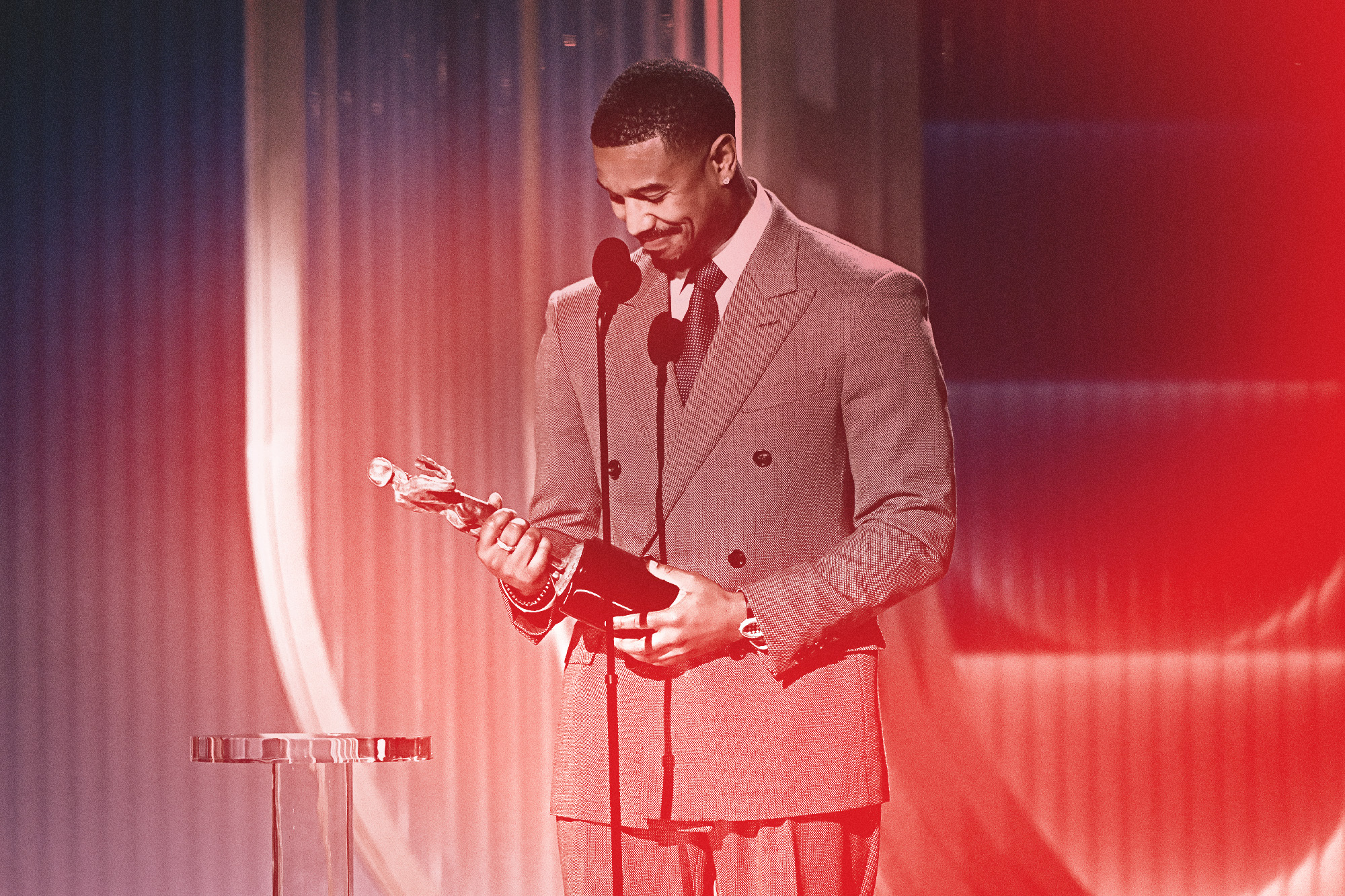

You know you’ve got a good Oscar season on your hands when the most viral image from an awards show looks like something out of a sci-fi movie — a world-famous actress making an expression of immense joy, the camera swirling around her as if she or maybe the entire ballroom is being raptured.

Somehow, the video is even better: Viola Davis announcing Michael B. Jordan’s surprise best actor win at the SAG-AFTRA Actor Awards with breathless enthusiasm, then whooping a few times for good measure as Jordan hugged his Sinners co-star Delroy Lindo before taking the stage. Davis quoted the August Wilson play Joe Turner’s Come and Gone (“You are shining, Herald Loomis”), which also served as an indirect reference to Lindo, who earned a Tony nomination for playing Loomis in 1988. Davis, of course, won an Oscar for an adaptation of another Wilson play, Fences. This is an awards show moment with layers.
Jordan’s speech somehow lived up to all that hype. He thanked his mother, Donna Jordan — seated right up front next to him — for driving him to auditions as a child and emphasized how unlikely it once felt that he would ever become one of the people in a nice suit standing on an awards stage. If you think of precursor awards speeches as Oscar auditions, Jordan truly nailed it.
And Jordan wasn’t even the only shocked and overwhelmed winner during last night’s Actor Awards! Shout-out to The Diplomat star Keri Russell, who won her first major award since a Golden Globe for Felicity back in 1999 (beating presumed favorite Rhea Seehorn for best actress in a TV drama), as well as Seth Rogen, who won expected awards for The Studio (best actor in a TV comedy, best comedy ensemble) and was also tasked with accepting Catherine O’Hara’s posthumous best actress in a TV comedy statue on her behalf. He had much of the room in tears by the end of his speech.
Still, at this point in the awards season — with the Oscars less than two weeks away — hopefully you’ll forgive me for mostly focusing on the movie winners. I had a hunch after recently moderating a Q&A with Amy Madigan for SAG-AFTRA members a few weeks ago that the Weapons star might be popular enough with her peers to win for the horror thriller, but I was nonetheless thrilled to see her take the stage last night (running like one of the Weapons kids for good measure). Following Sinners star Wunmi Mosaku’s BAFTA win last week, and One Battle After Another’s strong role in the race (which bodes well, one would assume, for Teyana Taylor), best supporting actress now feels like a true three-way split. Whomever I might predict to win today, I’ll probably change my mind by tomorrow. Thrilling!
Supporting actor had seemed like the more chaotic category for a while, but Sean Penn’s Actor Award victory last night, just a week after a BAFTA win, is extremely strong evidence that Penn’s villainous turn in One Battle After Another will lead to his third Oscar win. The numbers and the narrative add up — Oscar voters love a villain in this category, Penn is a genuine legend, One Battle is very popular, etc., etc.
And yet! Watching Delroy Lindo give the speech on behalf of the Sinners cast at the end of the night, commanding the stage and looking every bit the Hollywood elder statesman that he is, I couldn’t help but wonder… could this Sinners surge lead to a Lindo victory? Even after losing at the Producers Guild Awards on Saturday to One Battle After Another, the movie is undeniably on a hot streak right now, just as Oscar voting is set to close Thursday. And though Michael B. Jordan might be the obvious acting winner from that cast after last night (with the assumption being that if Sinners is going to pull off the best picture win, it will likely also win an acting award), Lindo has a very strong narrative behind him and has been absolutely everywhere. Penn, meanwhile, hasn’t been seen in a while — his last major public appearance for the movie was at the Santa Barbara International Film Festival in early February — and he didn’t even show up to accept the last two awards he’s won. Lindo’s visibility might not be enough to overcome the stats — winning SAG and BAFTA has, historically, been an unbeatable combination — but I still refuse to rule him out.
Last night, after the Actor Awards wrapped, Christopher Rosen and I hopped on YouTube to discuss it all, so you can watch us get much more in-depth on the awards and what they mean over there. And thanks to all the Prestige Junkie After Party subscribers who watched the awards live with us — if you’re not a subscriber yet, join us! We’ve got an exciting announcement coming tomorrow just for After Party paid subscribers.
On tomorrow’s episode of the regular Prestige Junkie podcast, Chris and I will discuss all of the short film nominees, and if you want to prepare, keep reading — I caught up with the directors behind two short film nominees and attempted to answer the question that I think a lot of Oscar voters ask at some point during the ceremony: Why short films? The answers, it turns out, may surprise you.


The Big Shorts
Talk to anyone who has made a movie, and it will leave you walking away with the impression that it’s an absolute miracle that any movie gets made at all. That goes double — maybe even triple — for short films. In theory, shorts are quicker and cheaper to make than feature-length films, but they’re also a whole lot harder to market or get to audiences.
That is, unless your short is one of the 15 Oscar nominees in the three short-film categories, which have stubbornly remained part of the ceremony even after years of efforts to streamline the show. The short film winners are rarely famous, usually flustered and often represent movies that the vast majority of viewers — and probably even Oscar voters — haven’t seen. But watching the short films, especially the live-action ones, offers a fascinating glimpse into the future of filmmaking, and major new talents who have both brilliant ideas and the sheer stubbornness to get a short film made in the first place.
Last week, I talked to the filmmakers behind two of this year’s live-action short nominees, and asked them a brief but also tricky question: Why make a short film in the first place? One film began with a beautiful department store; the other had origins in a Russian short story, then a viral video that seemed to speak directly to it. The three other nominated films range from a sweet story of intergenerational friendship to a fable set in a Tel Aviv grocery store to a sharp spin on Jane Austen. The answer to “why make a short film?” turns out to be as varied as the stories tackled in the films themselves.
For Natalie Musteata and Alexandre Singh, the married filmmakers behind the French-language Two People Exchanging Saliva, the entire world of filmmaking is a new experience. “We don’t come from the film industry, we come from the art world,” says Musteata, an art museum curator by training. She and Singh had made several films together that screened as part of gallery exhibitions, but when presented with the opportunity to film inside Paris’ Galeries Lafayette department store, they knew it was time to do something different. “It would be malpractice not to suggest doing a narrative film in this location,” Singh says. Adds Musteta, “We basically tried to make the biggest thing that we could possibly make within the constraints that we had.”
The stunning location and black-and-white photography go a long way toward making Two People feel genuinely epic, but so do Musteata and Singh’s bold ideas. Set in a world where slaps are currency and kissing is forbidden, Two People unspools the forbidden love story between a wealthy department store customer (Zar Amir Ebrahimi) and a young woman who works there (Luana Bajrami). If you don’t totally understand why a society would bother to ban kissing, that’s very much the point.
“We were trying to make a film that spoke to our contemporary, crazy times,” says Musteata, saying they took inspiration from the Woman, Life, Freedom movement in Iran, but that recent events like the Iranian protest crackdowns and ICE activity in Minneapolis felt just as relevant to the story they were trying to tell. As they have screened their film at festivals around the world alongside other short films, Singh says he’s realized that the short film format is especially well-suited to punchy, provocative ideas like the one at the center of their film. “Especially in an age of streaming — if there ever was a time where short films really made sense as a medium, I think it’s today,” Singh says. “The ghettoization of short films, I don’t think, is necessary. It feels like a hangover from how people used to think in the past.”
Short films can qualify for the Oscars with a traditional theatrical release — a tall order for nearly all of them — but most do it by playing at one of dozens of film festivals around the world, which puts short filmmakers on the festival circuit alongside all the other Oscar contenders. Musteata and Singh knew that their film’s title would grab some eyeballs, but they’ve been pleasantly surprised by the audience response. “Sometimes people have readings of our films, of our film that’s even better than what we had imagined,” Musteata says, saying that at the Clermont-Ferrand International Film Festival, they overheard people at the next table in a restaurant discussing their film.
“You feel spoiled,” Singh says, remembering the experience. “You’re suddenly like, ‘Oh, this is what it’s like to make a feature film.’”
All of the Oscar-nominated shorts were released in theaters by Roadside Attractions last week, but the streaming era has made many of them easy to find online as well — Two People Exchanging Saliva is available at The New Yorker, and Netflix acquired The Singers just a few days before nominations were announced. Unlike Musteata and Singh, The Singers director Sam A. Davis has been through all of this before. He was the cinematographer for the Oscar-winning documentary short Period: End of Sentence in 2018, and was nominated in 2024 as the co-director of another documentary short, Nai Nai and Wai Po. By now, he’s gotten used to people making the wrong assumptions about why he makes short films.
“Usually it’s a really common question — ‘Are you developing this into a feature?’” Davis told me in a phone call last week. The Singers, he promises, is “not really a proof of concept. I think the film says what it needs to say in 17 minutes, and certain stories are just best told in a bite-sized format.”
Inspired by the 19th-century Russian short story of the same name by Ivan Turgenev, The Singers takes place one night at a blue-collar bar somewhere in America, where a group of regulars suddenly challenge each other to a sing-off. It’s both funny — there’s opera singing! — and touching, showing a group of seemingly hard-edged men embracing the beauty of music and, eventually, each other. It’s also gorgeous to look at, shot on film and giving this run-down bar — actually a Moose Lodge in La Habra, outside of Los Angeles — the same elegance as the glam department store in Two People Exchanging Saliva.
“One thing that I love about shorts is that you can really obsess over every pixel in an even more concentrated way than you can with features,” Davis tells me. “This film took about the same amount of time as a lot of features take to make, but you can kind of chisel the diamond even more when you’re only working with 17 minutes versus 90.”
Davis didn’t necessarily intend to become a documentary filmmaker before Period: End of Sentence came calling, and didn’t intend to become a short filmmaker strictly after that. But Davis, who graduated from the USC Film School in 2016, is grateful to have started his career in this world, regardless of what kinds of films may come next.
“I think short films are a great way to establish a voice, and not just that, but also make meaningful stuff that people continue to watch,” Davis says. “I can be involved in projects that I love and contribute to them in meaningful ways. Whether it’s as a producer or a cinematographer or a narrative or doc or a film that I’m making of my own — I want to do that. I’m just a filmmaker, and I’m always going to be.”


Comments
Only Ankler All Access subscribers can comment
Already a subscriber?