

IP Picks🔎: A Taylor Sheridan-Style Texas Oil Saga; a Fun Rock n’ Roll Heist
➕ A murderous role for Meryl Streep, a horror tale with 'Blair Witch' bones, remembering publishing rainmaker Robert Barnett

Editor’s note: Today, we’re giving The Ankler audience a FREE sample of our sister publication The Optionist, a standalone subscription newsletter from Ankler Media that identifies IP available for adaptation. Led by Andy Lewis, The Optionist each week curates a list of promising books (new and backlist), long-form journalism, short stories, graphic novels and wherever IP can be found. Offering more than just a logline, the picks include comps, a short summary, casting suggestions and rep info. It’s like having an extra set of hands on your dev team.
Welcome to The Optionist. Thanks for reading along!
The true-crime genre is one nearly everyone enjoys. I’ve certainly promoted more than my share of these tales here in The Optionist — it’s easily one of the top two or three categories in my archive. However, I don’t often stop to think about how being part of one of these viral stories affects the people involved, even those on the periphery. That’s why I found this piece on how Joey Buttafuoco’s notoriety affected his daughter Jessica so compelling.
The “Long Island Lolita” story was a tabloid sensation in the early ’90s. Seventeen-year-old Amy Fisher had an affair with the 36-year-old Buttafuoco and then shot Buttafuoco’s wife, Mary Jo, in the head. She survived the attack, and the scandal spawned not one, not two, but three separate made-for-TV movies. And all three of the major players in the drama have cashed in on their notoriety for years to come.
This Vanity Fair article on the scandal chronicles how that drama affected Jessica, and it’s sobering. It’s told by her childhood best friend, who recently reconnected with her. For Jessica, who was 9 at the time of the shooting, the initial burst of fame seemed cool. She even got to meet Alyssa Milano, who played Fisher in a 1993 made-for-TV movie about the case.
But over time, being a child of infamy weighed heavily on her. She got involved in drugs and alcohol and had trouble forming healthy romantic relationships. Now in her early 40s, Jessica has finally begun to sort out her life.
Read the article. It’s an illuminating look at the collateral damage that comes with our true-crime obsession. Will it force the people who develop these stories to pause and consider the impact on their subjects? Who knows, but it did that for me.
One last thing before this week’s picks. Just as we landed in your inbox last week, Robert Barnett, the Washington-based power lawyer, died. It deserves a mention.
Barnett was a unique figure. He was one of the most formidable players in the world of publishing. He represented the Clintons and the Obamas, James Patterson and Amanda Knox, Barbra Streisand and Bob Woodward, and that’s just scratching the surface. Barnett wasn’t an agent; he was a lawyer who didn’t take the standard 15 percent commission. He billed by the hour, upwards of $1K. That’s not nothing, but compared to a commission, it was a steal. He once told me that his fee on a $2M deal was $35K, a little more than a tenth of an agent’s typical cut.
For that, clients got more than just a contract. Barnett was famous for being hands-on. He’d sit in on marketing meetings and help clients choose which shows to appear on. He once even babysat Woodward’s daughter in a pinch. (No word on whether he charged Woodward, but I hope he did. That would be the most expensive hour of babysitting in the history of babysitting.)
Barnett essentially pioneered the modern Washington politician blockbuster book deal with VP candidate Geraldine Ferraro after the 1984 campaign, and brought it to its grandest heights when he secured a reported $65 million for the Obamas’ joint book deal in 2017.
I first met Barnett while he was representing Knox’s initial memoir. I flew to Washington to interview him. I’d long been fascinated by Barnett and was curious to see if I could divine some of the secrets of his success. He was unfailingly polite and well-mannered, friendly but not full of shit. He was also incredibly disciplined about how he doled out information. (He also possessed a cufflink collection I would have killed for.) Barnett either told you the truth or told you nothing. He always got back to me quickly and answered all of my questions… but he never revealed very much. I don’t know if he was a gambler, but he would’ve been a helluva poker player.
I didn’t have as many interactions with him as I would have liked, but I enjoyed them all. He was an original. It’s a shame he’s gone.
This Week: Rock n’ roll robbers, good intentions gone awry and a Taylor Sheridan-style drama
On to this week’s picks! We’ve got a nice mix in this edition, and it starts with a heist-caper that’s also an affecting story about a rock band’s reunion. There’s also a horror chiller, a psychological thriller and a true story that sounds like it came from the imagination of Taylor Sheridan.
The full lineup:
🎡 A rock-band reunion drama doubles as a heist romp centering on a mid-level Jersey bar band and its plan to rob the amusement park where they played their first gig.
🎥 A Blair Witch-meets-Stranger Things horror tale about a group of filmmakers that accidentally opens a portal to another dimension while investigating a mysterious phenomenon in the Canadian backcountry.
😬 A creepy psychological thriller about a woman who channels her own grief into aggressively helping another woman deal with the loss of a child.
🌍 A mystery/drama centered on an elderly woman who committed murder as a child and may have just killed again. Paging Meryl Streep!
🛢️ A Taylor Sheridan-esque drama about the corruption that sudden oil wealth brought to the least-populated county in the US.
BOOKS I LIKE (current)
Procedural
For fans of: Daisy Jones & the Six meets Ocean’s Eleven
Potential logline: A mid-level Jersey bar band reunites after 15 years for one last gig, but their set list includes more than just music.
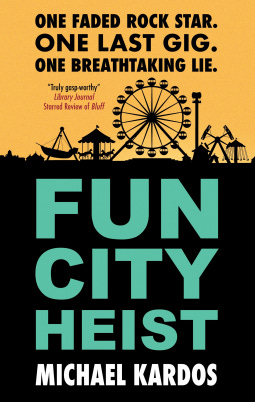
Fun City Heist by Michael Kardos (Severn House, Dec.) Fun City Heist is a Reese’s peanut butter cup kind of story in which two very different things —
A rock biopic! A heist caper! — are mashed together in a very satisfying way. There’s a little Almost Famous here, as well as a little Cobra Kai and a little Daisy Jones.
The story follows Mo Melnick, a washed-up drummer for the onetime hit band, Sunshine Apocalypse, who now spends his days renting beach equipment on the Jersey Shore. Then his childhood best friend-turned-bandmate-turned-nemesis, Johnny Clay, shows up with a dying wish: Reunite the band for one last gig at Fun City, the beachside amusement park where they started out a quarter century ago. It’s about to close after 70 years in business because the owner died, and his kids want to cash in on the prime oceanfront property.
There’s a twist: Johnny wants to rob Fun City in addition to playing there. The Fourth of July is the park’s biggest night of the year, and the take is all cash. It turns out Johnny has ALS, and he needs the money to pay for his health care. He also figures the rest of the band could use a little nest egg.
At the same time, Mo finds himself reconnecting with Janice, the daughter he never really knew, after she shows up on his doorstep to spend the summer with him before her senior year in high school. Mo doesn’t know how to parent, but father and daughter connect over music, and eventually she gets dragged into the scheme with her dad.
The band’s history is vividly sketched out. The four members formed it as teenagers and stayed together until their early 30s. When we meet them in their mid-40s, the band has been broken up for more than a dozen years. Sunshine Apocalypse was somewhere between a top-notch bar band and one-hit-wonder stars. They had a record deal, a Billboard Hot 100 hit and opened for big bands like the Counting Crows. But that’s where they got stuck, never making more than enough money to get by. What’s that line from Almost Famous? “It’s a think piece about a mid-level band struggling with their own limitations in the harsh face of stardom.” I kept thinking of that as I was reading this book.
The four bandmates also make interesting characters. Mo has put music and the rock star life far behind, but it’s not like he’s gotten his life together. I mean, the guy rents umbrellas and chairs on the beach! But he’s trying to be an adult. Johnny, his childhood best friend, is the lead singer. He burned a lot of bridges at the end, and he’s squirrelly now, withholding information unless pressed. (For example, he might not really have ALS, and the money might be for a gambling debt. Emphasis on maybe.) The other two, Ricky and Ed, don’t hold the same grudge against Johnny as Mo does. Their memories of the band life are rosier.
The Mo-Johnny relationship evoked the Daniel LaRusso/Johnny Lawrence mid-life dynamic that made the first couple of seasons of Cobra Kai soar. Johnny and Mo’s regrets, grievances and friendship feel authentic. Think Casey Affleck or Ryan Gosling for Mo and Bradley Cooper for Johnny.
Fun City Heist falls into the Ocean’s Eleven category of heist movies thanks to its mix of outrageous caper and comedy. I really liked the story’s grounded stakes. These guys aren’t ripping off the Bellagio. They’re robbing a ramshackle amusement park. There’s plenty of twists and turns (old rivals unexpectedly show up to mess with their plans) and a poignant emotional climax (the final gig takes on real meaning for them in the lead up to the robbery). The heist part is well-plotted and would translate well to the screen. Between the band-reuniting plot that’s heavy on middle-aged ennui, the pull of old friendship and nostalgia for lost youth, and Mo reconnecting with Janice, there’s a lot of heart.
I think this would really appeal to the Dad TV demo. My only question is whether to do this as a movie (which probably serves the heist plot best) or as a limited series (which would allow the emotional beats of the reunion plot to really hit hard). Figure out the right pacing to serve both masters, and this could be a hit. REPS: Joel Gotler/IPG
Horror

For fans of: The Blair Witch Project and The Ring
Potential logline: A group of filmmakers accidentally opens a portal to another dimension while investigating a mysterious phenomenon in the Canadian backcountry.
The Underwood by Ian Rogers (Thunderstorm Books, Just out) The new novel from up-and-comer Rogers kind of begins where The Blair Witch Project ended. Then it doubles back to fill in the details of how we got there before shooting off in some really fun directions.
The book begins with cinematographer Ben Cassidy (think Lewis Pullman) dealing with the aftermath of a film he made with friends when they ventured into “the Bermuda Triangle of the Canadian wilderness.” They started with the idea of a doc and ended up releasing a found-footage film. It became a huge hit — one of the top-grossing movies of the year — but even its fans aren’t sure if the film was an accident, a stunt, or a meta-commentary on cult movies. All the filmmakers will say is, “We want the footage to speak for itself. It’s up to the viewer to decide what’s real.” But Ben also tells us right away that he watched the film just once because he lived it. He also says the crew paid a steep price for it: Two went to L.A. and became “overnight sensations,” one disappeared, and one ended up in a psych hospital after murdering some people.
As for Ben, he ended up in therapy. He’s sure that he was cursed by what happened in the Canadian woods. He receives strange texts on his disconnected cell phone, and he thinks he’s jamming certain kinds of electronic devices — the automatic doors at the supermarket, for instance, won’t slide open for him. On top of that, he’s having hallucinations of the Underwood—a creepy, bizarro version of nature that they encountered in the woods. More importantly, he thinks he’s brought something back from the Underwood: eggs that hatched a giant black spider that has taken over his bedroom.
His therapist, Dr. Sharpe, thinks this is all in his head, but Ben doesn’t trust him. He strikes up a relationship with Maddy, the girl who delivers his groceries — Ben is afraid to leave his house — and believes him. (Think Molly Gordon or Haley Lu Richardson) They start to investigate the mystery of the Underwood and figure out that it’s a portal to other dimensions. Ben and the others breached this barrier, and now they have to return to the Underwood to stop it.
Rogers plays with horror conventions in interesting ways. There’s the meta-commentary on found-footage films and the “is it real or not?” debate that’s part of the movie’s marketing hype. There’s also the supernatural portal trope (which has parallels to Stranger Things’ Upside Down), as well as the central mystery about what’s in Ben’s bedroom and what exactly the Underwood is.
I like Ben as a protagonist and as the audience’s POV. Seeing the world through his eyes (while not also knowing as much as he does) makes him an empathetic character. I was rooting for him. But what really helps is the relationship between Ben and Maddy. She humanizes him and makes him more likable. They have great chemistry on the page. Getting that on screen would be important to the movie working.
Rogers is a horror writer who’s on the verge of becoming more widely known. He’s got enough cred with the genre’s diehard fans to sell out a 200-copy $125 limited edition version of The Underwood. (A mass market version is being explored.) A short story from his award-winning collection Every House is Haunted is in development at Netflix with Sam Raimi producing. REPS: Peter Katz/Story Driven
Psychological Thriller

For fans of: Dead Like Me meets Single White Female
Potential logline: A woman grieving the death of her sister inserts herself into the life of a mother dealing with the death of a child in a creepy, unsettling attempt to cope with her own trauma.
Good Intentions by Marisa Walz (St. Martin’s Press, Feb.) This psychological thriller about trauma, grief and “good intentions” that go awry uses its claustrophobic atmosphere to deliver an entertainingly tense story of cringe behavior.
The story centers on Cady, a high-end event planner with a seemingly perfect life: She’s married to her high school sweetheart; she’s got a successful business; and she’s BFFs with her identical twin, Dana. Then Dana and her unborn baby are killed in a car accident. Cady is devastated, and she channels her grief into consoling Morgan, a woman she meets in the ER on the day Dana was killed. It turns out Morgan’s young son was also killed in a hit-and-run while riding his bike without a helmet. Cady inserts herself into Morgan’s life with the best of intentions, but her behavior then becomes increasingly aggressive and cringeworthy. Soon, Cady neglects her business and her own life to focus on Morgan, much to the alarm of her family and the discomfort of Morgan. Basically, Morgan becomes a vehicle for Cady to play out her own grief, but in toxic ways.
The story is narrated as a series of conversations Cady has with her dead twin, Dana. It’s a clever device that gets at Cady’s inner monologue, and it could work very well on screen. Having an imagined Dana talking to Cady at certain points in the story could be really interesting.
The book smartly unspools Cady’s mental state at the right pace, leaving readers uncertain about her motivation for a long time. As the story goes on, it becomes increasingly clear that Cady’s an unreliable (and unwell) narrator. The narrative ends on a twist — spoiler ahead — that’s both predictable and well-executed: In her rush to get to the hospital for Dana, Cady is the one who runs over Morgan’s son.
Predictable isn’t necessarily bad. And while the premise may be over the top, the overly aggressive, well-intentioned person who keeps insinuating themselves into situations is a concept we’re all familiar with.
I think this story will appeal to the demo that has fueled the boom in female-centric dramatic thrillers. But it also serves them something new in its Dead Like Me-meets-Single White Female cocktail of psychological suspense. You could carve a great short-season series out of this book. And that big twist, which literally comes in the last chapter, tees up what could be an interesting second season. REPS: Tom Ishizuka/Writers House
Drama/Thriller

For fans of: A Man Called Otto
Potential logline: When a neighbor dies, an elderly woman’s past as Australia’s youngest convicted murderer comes out. But is she really guilty this time?
Mad Mabel by Sally Hepworth (St. Martin’s, Apr.) The early buzz on Mad Mabel, which was just published in Hepworth’s native Australia ahead of a US release next year, is tremendous. She’s already a writer with multiple bestsellers under her belt, numerous titles under option and one — The Family Next Door — that just aired in her homeland this year. But her latest might be the book that takes her to another level, especially here in the States.
Even without all that, this is a fab story ripe for adaptation. It has an engrossing then/now mystery about two murders at its core, and it’s populated by a cast of interesting characters (highlighted by “Mad Mabel,” the main character). Older female protagonists in genre stories like thrillers and mysteries have been a mini-trend in publishing for a while, but this one is among the best I’ve read. And that’s mainly due to its complicated protagonist, who’s cranky and tender — a curmudgeon with a spiky sense of humor who’s wounded by life, but also resilient.
The plot centers on 81-year-old Elsie, a woman who’s lived on the same block for 60 years. She’s the kind of nuisance who’s always in everyone else’s business. Then a few things happen to turn her world topsy-turvy. Little Persephone moves in next door and won’t give up trying to make friends with Elsie. Meanwhile, her local nemesis Imhann dies under mysterious circumstances. It soon comes out that Elsie is, in fact, “Mad Mabel,” the girl who, back in the 1950s, became Australia’s youngest-ever convicted murderer. It’s a secret that Elsie’s kept hidden for six decades. Now suspicion turns to her for her neighbor’s death. At the same time, a pair of true-crime YouTubers turns up to interview Elsie, who, it turns out, is finally ready to tell her story.
The tale unfolds in alternating then-and-now chapters — young Mabel as a friendless, bullied child with a tough family life and the now-aged Elsie in the present, befriending young Persephone, interacting with her quirky neighbors and dealing with questions about Imhann’s death. This is a particularly clever dual-timeline structure because no one ever expects either young girls or old ladies to be murderers. Also clever is the way the two cases invert each other. In one, we know who did it but not who died; and in the other, we know who died but not who did it.
Mabel is an A+ main character. Initially, you’re unsure if you like her. By the end, you’re rooting for her. She’s also got a sarcastic, dry wit that will have you laughing. Her evolving friendship with Persephone is sweet, and it really helps to balance out the grimmer aspects of her own childhood. More importantly, as the two stories unfold, we learn more about how her life shaped who she is and the defenses she put up to deal with the world. Lily Tomlin and Helen Mirren would be great choices. But I can’t shake the idea of Meryl Streep as Mad Mabel, even if she’s five years younger in real life than the character.
Mad Mabel explores ideas about redemption and justice, as well as how childhood trauma can persist into old age. But it’s also a hopeful tale about friendship, found family, resilience and the possibility that you’re never too old to grow as a person. The world-building and character development here point toward a limited series adaptation. Viewers will enjoy hanging out with these characters. Not only do I think this will get bought quickly, but it feels like the kind of story that will have a quick trip to the screen. REPS: Rob Weisbach/Weisbach Creative Mgmt

Journalism
Drama
For fans of: Landman and Killers of the Flower Moon
Potential logline: The least-populated county in the U.S. is flooded with oil wealth, bringing corruption and reigniting longstanding feuds between its three most powerful families.
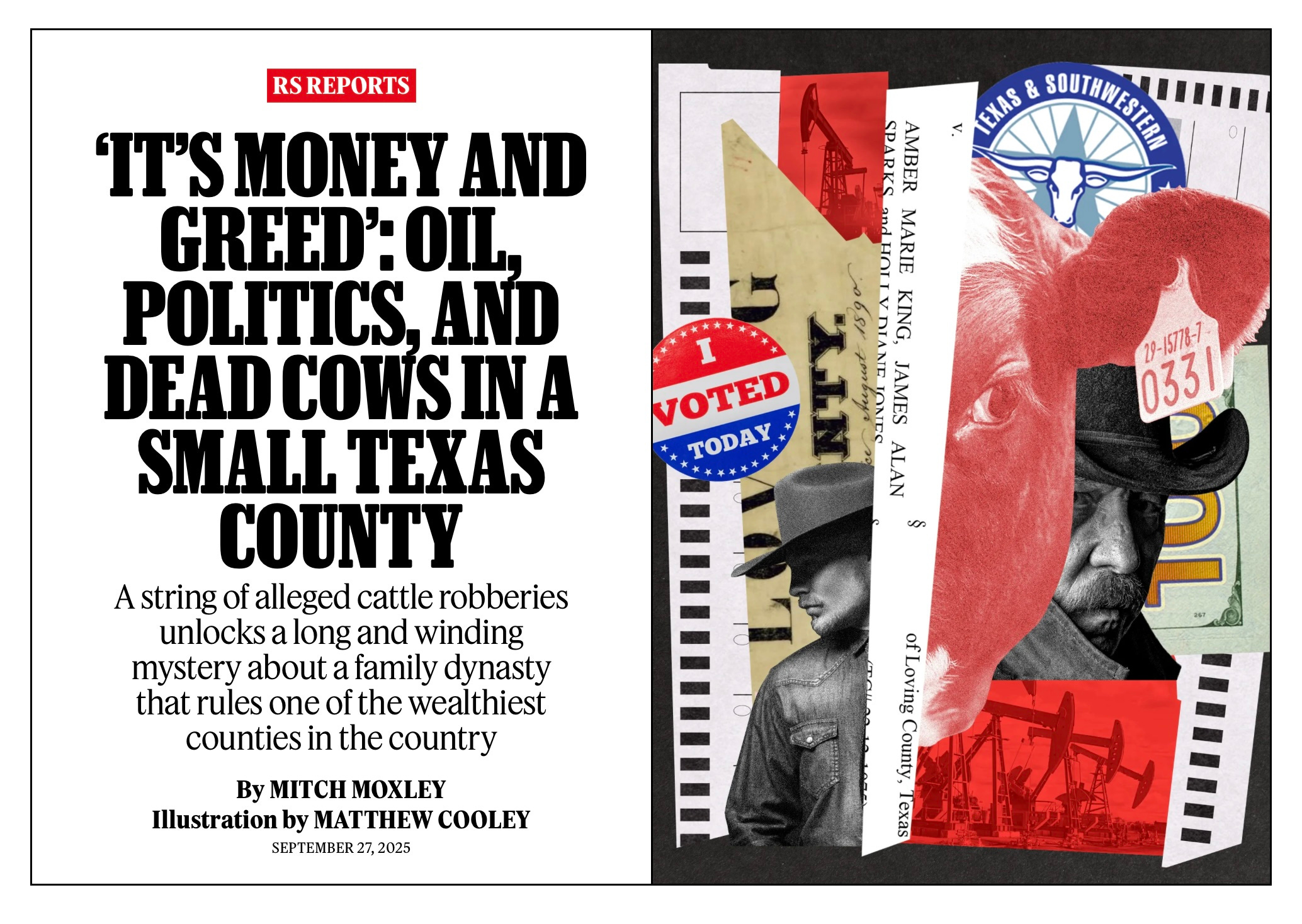
“It’s Money and Greed: Oil, Politics and Dead Cows in a Small Texas County” by Mitch Moxley (Rolling Stone, Sept. 27) This fantastic piece about crime and corruption in a rural Texas county, the smallest by population in the entire nation, sets a procedural against a Landman-meets-Yellowstone Taylor Sheridan canvas. It has all the raw materials for a terrific adaptation: A wealthy political boss who controls the county, a huge influx of corrupt fracking wealth, generations-old family feuds, stolen elections, a large cast of compelling characters and cattle rustling. Cattle rustling! When was the last time you saw cattle rustling as a plot point outside of an old Lone Ranger episode?
The story unfolds in Loving County, Tex., situated along the New Mexico border in the southwestern corner of the state. While it’s three-fifths the size of Rhode Island, Loving only has 50 or so full-time residents. What it has in spades, though, is billions in new oil wealth that’s been unlocked by fracking. All of a sudden, the county has more money than it knows what to do with. Its $50M annual budget is 20x that of some neighboring counties without oil.
For most of the last century, Loving County has been controlled by three powerful families — the Joneses, the Hoppers and the Creagers. And in a place this small, everyone’s related to everyone, and the grudges go back generations. For a while now, the Joneses, led by county political boss Skeet Jones, have controlled the local government. This doesn’t seem to sit well with anyone. As Steve Simonsen, the county attorney, married to Skeet’s cousin, said, “This is not quite the Hatfields and McCoys. It’s like the Hatfields and Hatfields, right? I mean, it’s brother against brother, uncle against nephew.”
The story starts with a cattle-rustling investigation led by Marty Baker, a straight-out-of-central-casting special ranger for — get this — the Texas and Southwestern Cattle Raisers Association. Skeet, one of the wealthiest men in the county and the owner of a sprawling ranch, is in a position to hand out well-paying jobs fueled by oil money (even the town janitor makes $126K a year). Skeet is backed up by his sister Mozelle, the county clerk, and the relatives of ranch hands who serve as county commissioners. His only real opposition comes from the town constable — what is it with these Texas public offices? — Brandon Jones, who also happens to be his nephew.
The cattle-rustling investigation leads to a broader inquiry into political corruption. It’s alleged that Skeet and his allies were cooking the voter rolls with people who didn’t actually live in Loving to maintain control. Of course, in a county this small, it’s hard to seat an impartial jury in any trial, which is why the neighboring county has prosecuted most of Loving’s cases.
I think this could be the raw material for a fantastic dramatic series about small-town tumbleweed politics. Visually, it would look like Landman. But narratively, it would be a mix of Yellowstone and a procedural.
While the stakes may seem small — it’s a war over who controls a county of 50 people — the oil money and the greed around it transform the story into something far bigger. That basic premise is what drove Killers of the Flower Moon to the top of the bestseller charts and led Marty and Leo to adapt it. While that movie didn’t quite stick the landing, I think turning this into an ongoing series with stronger nighttime soap elements might do the job better. REPS: Michelle Kroes/CAA
🫳 🎤 That’s a wrap for this week. Subscribe to The Optionist for more IP intel every week.
 | A guest post by
|