

Hollywood Money Gushed from the Gulf. Then Came War
Stalled projects, a ‘carefully constructed’ industry at risk — and even the biggest merger in entertainment industry history under threat


I cover global TV and film from London. I wrote about the antitrust challenges for Paramount-WB in Europe, Tubi U.K.’s success with Gen Z and Disney’s scramble to catch up with Netflix in global TV. I’m manori@theankler.com

With production at a standstill across the Gulf, cinemas shuttered or operating at reduced capacity, and high-profile films relocating for safety, a growing fear is taking hold in Hollywood: Its Middle East strategy may be unraveling — along with the billions that came with it.
As the U.S. and Israel’s war in Iran rounds out its third week — continuing to rage through Eid al-Fitr and the close of Ramadan on March 20 — the region’s meticulously planned soft power drive built around film and TV is taking a back seat. The expanding theater of war has now directly impacted at least 13 countries in what one source calls a “highly flammable” region.
“Business within the Gulf will slow down in the next six to nine months, and that is what it is,” says one producer also involved in venture investing between North America and the Middle East. “We’re going to keep doing our jobs, but we’re also going to probably pursue other international areas until we get more clarity.”
The stakes are significant. In the last two years alone, Gulf money has propped up some of the biggest deals in entertainment:
Saudi’s Public Investment Fund backed the $55 billion acquisition of Electronic Arts — until recently the largest leveraged buyout in history
Saudi-backed MBC Group led the $1 billion backing for ex-Lionsgate exec Erik Feig’s Arena SNK Studios, launched in October
Sovereign wealth funds from Saudi, Abu Dhabi and Qatar are backing Paramount Skydance’s debt-burdened $111 billion bid for Warner Bros. Discovery Paramount
A Qatari investor is part of a bid by Department M (founded in 2024 by former AGBO exec Mike Larocca and former New Regency president Michael Schaefer) to buy a sizable stake in Sentimental Value distributor Neon
Now, with oil prices softening and governments reassessing spending priorities, insiders expect a shift inward.
“Would the Electronic Arts deal happen today? That same deal at the same amount? I doubt it,” says Mazen Hayek, a longtime MBC spokesperson turned Dubai-based media consultant. “Security and defense come first.”
He adds, “I look at the pledged amounts of $2 trillion from Gulf countries in the U.S. tech companies’ AI and data centers. Are these going to be honored, or are they going to have to buy ammunition and new Iron Domes? Would you spend on things that can wait, or would you spend on priorities?”
I spoke with U.S. and Middle East-based producers, distributors, lawyers and investors to unpack the war’s impact on the industry and deals near and far term.
Today, I break down:
Where dealmaking goes next, and why smaller, more “pragmatic” partnerships may replace blockbuster bets
What happens to money already in big deals now
Which productions are already relocating, and the logistics nightmares underway
The war’s damage to Gulf nations’ “carefully constructed image” as production partners, investors and tax havens
Why Cannes has become a key battleground for MENA media — and why this year will look very different
What rising security risks and anti-American sentiment mean for box office in the region — and the surprise Oscar movie that’s a hit
I cover global TV and film from London. I wrote about the antitrust challenges for Paramount-WB in Europe, Tubi U.K.’s success with Gen Z and Disney’s scramble to catch up with Netflix in global TV. I’m manori@theankler.com
With production at a standstill across the Gulf, cinemas shuttered or operating at reduced capacity, and high-profile films relocating for safety, a growing fear is taking hold in Hollywood: Its Middle East strategy may be unraveling — along with the billions that came with it.
As the U.S. and Israel’s war in Iran rounds out its third week — continuing to rage through Eid al-Fitr and the close of Ramadan on March 20 — the region’s meticulously planned soft power drive built around film and TV is taking a back seat. The expanding theater of war has now directly impacted at least 13 countries in what one source calls a “highly flammable” region.
“Business within the Gulf will slow down in the next six to nine months, and that is what it is,” says one producer also involved in venture investing between North America and the Middle East. “We’re going to keep doing our jobs, but we’re also going to probably pursue other international areas until we get more clarity.”
The stakes are significant. In the last two years alone, Gulf money has propped up some of the biggest deals in entertainment:
Saudi’s Public Investment Fund backed the $55 billion acquisition of Electronic Arts — until recently the largest leveraged buyout in history
Saudi-backed MBC Group led the $1 billion backing for ex-Lionsgate exec Erik Feig’s Arena SNK Studios, launched in October
Sovereign wealth funds from Saudi, Abu Dhabi and Qatar are backing Paramount Skydance’s debt-burdened $111 billion bid for Warner Bros. Discovery Paramount
A Qatari investor is part of a bid by Department M (founded in 2024 by former AGBO exec Mike Larocca and former New Regency president Michael Schaefer) to buy a sizable stake in Sentimental Value distributor Neon
Now, with oil prices softening and governments reassessing spending priorities, insiders expect a shift inward.
“Would the Electronic Arts deal happen today? That same deal at the same amount? I doubt it,” says Mazen Hayek, a longtime MBC spokesperson turned Dubai-based media consultant. “Security and defense come first.”
He adds, “I look at the pledged amounts of $2 trillion from Gulf countries in the U.S. tech companies’ AI and data centers. Are these going to be honored, or are they going to have to buy ammunition and new Iron Domes? Would you spend on things that can wait, or would you spend on priorities?”
I spoke with U.S. and Middle East-based producers, distributors, lawyers and investors to unpack the war’s impact on the industry and deals near and far term.
Today, I break down:
Where dealmaking goes next, and why smaller, more “pragmatic” partnerships may replace blockbuster bets
What happens to money already in big deals now
Which productions are already relocating, and the logistics nightmares underway
The war’s damage to Gulf nations’ “carefully constructed image” as production partners, investors and tax havens
Why Cannes has become a key battleground for MENA media — and why this year will look very different
What rising security risks and anti-American sentiment mean for box office in the region — and the surprise Oscar movie that’s a hit

The Slowdown Is Already Here
Early results from the stress test are already visible.
Production across the region has largely ground to a halt, with multiple film and television projects either paused or relocating to safer territories. Sources tell me productions in Saudi Arabia, the UAE, Jordan and Lebanon are moving to Morocco, Turkey and Egypt, where infrastructure is more established and the geopolitical risk is lower.
One of the largest productions to relocate is Unbroken Sword, a Saudi state-backed English-language historical action film (with a budget reportedly over $200 million), which I understand is moving from PlayMaker Studios in Riyadh to Morocco. (PlayMaker did not respond to a request for comment by press time.)
The shift underscores how quickly confidence can erode when stability comes into question.
Even before the conflict, attracting large-scale international production to the region required aggressive incentives and heavy logistical support. Now, those challenges are compounding. Insurance costs are rising, freight and fuel expenses are increasing, and lenders are expected to apply greater scrutiny to projects operating in volatile environments.
“Any kind of geopolitical instability increases the insurance policy,” says one production executive familiar with the region. “Studios want to pay less and take advantage of rebates — but now, with everything happening, people are going to be more cautious. The logistics alone are getting more expensive.”
Exhibition is also under pressure. Cinemas in Saudi Arabia and the UAE are operating at limited capacity, while theaters in Kuwait shuttered entirely. With attendance already depressed during Ramadan, the added impact of the conflict is creating further uncertainty around box office recovery in the region.
For an ecosystem still in the process of proving itself, the timing is particularly difficult. “It’s always been a challenge to encourage people to come,” says the production executive. “It’s a shame, because we worked so hard to get that message out there.”
The exec notes that productions will likely look at more stable jurisdictions such as Morocco, which has been a “big competitor” to the Saudi outfits, and explains the Unbroken Sword exodus. “They’ve got an established crew base and generous rebates.”
Keeping international productions in Saudi, for example, will likely require hiking up the 40 percent tax rebate to 50 percent, adds the source, in addition to paying out the rebates much sooner.
“There’s been a massive push at all of the international film festivals, such as Venice, Cannes and London [to bring production to Saudi],” says the executive. “I think they’ll continue to push, because the region is resilient, and it’s got to diversify oil. The creative industries are an avenue for them to be able to achieve that. So I don’t think they’ll stop pushing, but they’ll need to sweeten the deal more for international productions.”
While international production won’t stop coming completely, “it’s going to be slower,” this person notes. “It’s going to take longer to close those deals.”
‘Damage to a Carefully Constructed Image’
The disruption goes beyond logistics. It strikes at the core of how the Gulf has positioned itself to Hollywood.
For years, countries across the region have marketed themselves not just as sources of capital, but as stable, business-friendly environments where international productions could operate efficiently and profitably. Generous tax incentives, government backing and a high standard of living for foreign crews were all part of a carefully constructed pitch: Come here, and everything will work.
That perception is now under strain.
“Whether this conflict ends tomorrow or takes a couple of months, it’s already done damage,” says one U.S.-based producer who works closely with film entities in the region. “There was this idea that these places were extensions of international business — comfortable, predictable, easy to operate in. That’s been shaken.”
The shift is particularly significant because the region’s ambitions extend far beyond servicing Hollywood productions. Gulf governments have been investing heavily in building domestic film and television industries — not just to generate revenue, but to diversify their economies and expand their cultural influence globally.
“It’s not just about line producing international films anymore,” says Amanda Turnbull, co-founder of Dubai-based Rise Studios and a former Warner Bros. Discovery MENA executive. “That’s part of it — but the bigger goal is building local IP and a sustainable creative economy.”
That long-term strategy is unlikely to disappear. Industry executives broadly expect Gulf governments to remain committed to media and entertainment as part of their post-oil future. Turnbull, riding the war out in Istanbul as she works to relocate a Beirut production, cautions against assuming a major pullback.
“The region is making a pivot,” she says. “Line producing is still important — it’s a way to generate revenue you can reinvest — but the focus is shifting.”
But perception matters. And for now, the image the region spent years cultivating is showing cracks.
Several sources say the damage has already been done. While few expect Gulf states to abandon what one executive calls a “multi-generational” strategy around entertainment, rebuilding confidence could take time.
Nick Grande, a longtime MENA strategist and founder of the Mena.tv platform, notes that the region is already entering a seasonal slowdown. “Business won’t really pick up again until late September,” he says. “So unless we see a resumption of normal activity very soon after Eid, that could have long-term implications for the industry.”
Cannes Litmus Test
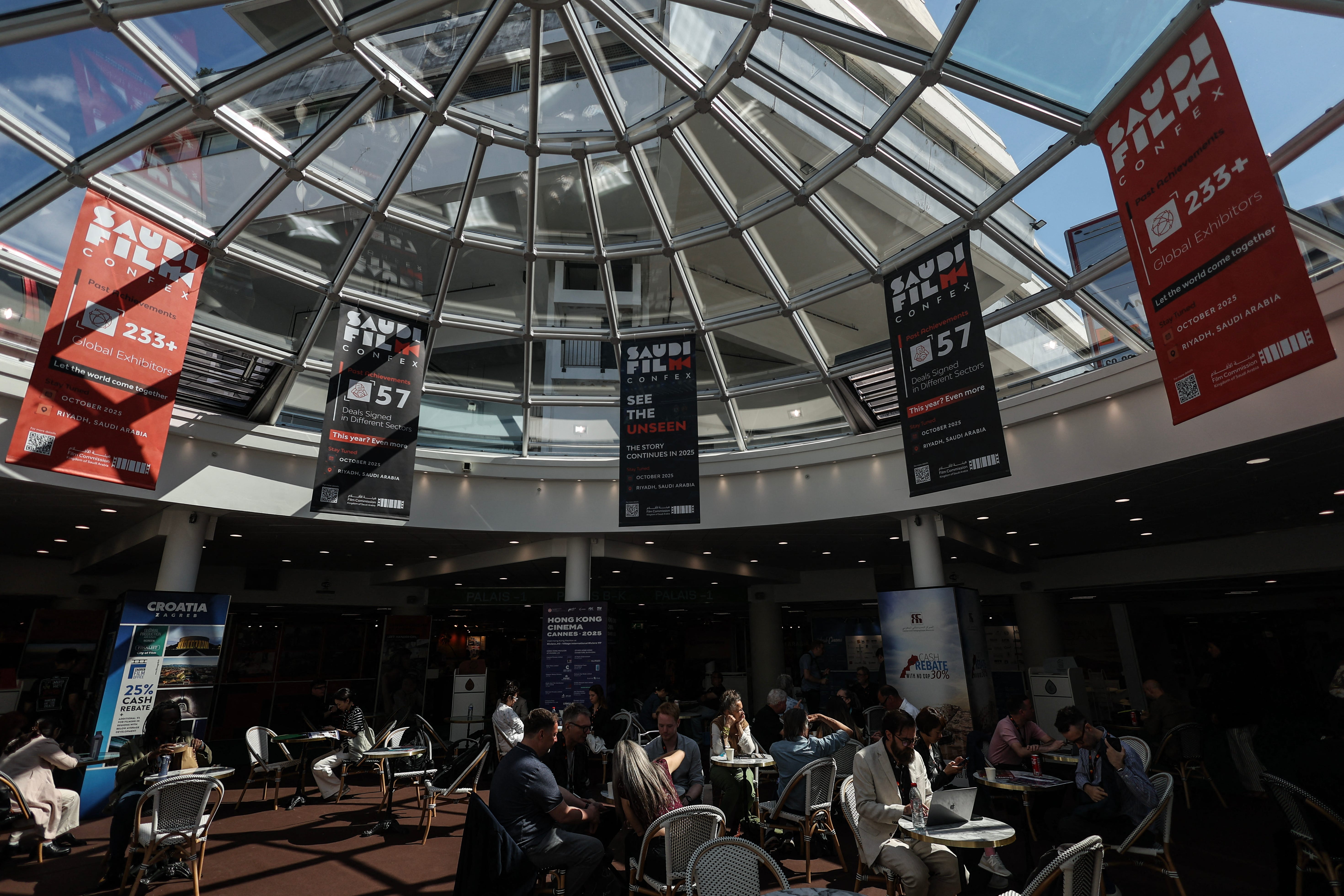
Cannes film festival, which runs from May 12-23, will surely reflect some of the fallout. While some of my sources expect national delegations, such as the Saudi Pavilion, which debuted at Cannes in 2018, to be back in force, others point out that travel disruptions could mean smaller teams make the journey.
Certainly, if the real estate market Mipim that took place in Cannes earlier this month is any indicator, don’t underestimate the Saudis: In a March 14 press release, the government-run Saudi Press Agency showed off its prominent placement and bustling activity at the Palais entrance and underlined Saudi’s “rising position as a global investment destination.”
Gianluca Chakra, CEO of Middle East film distributor and producer Front Row Entertainment, hasn’t missed a single edition of Cannes since setting up his company in 2003.
Like Turnbull, the Dubai-based exec has temporarily relocated (he and his family are living in Thailand), but in two months’ time, he fully intends to be pounding the Croisette. Chakra acknowledges, however, that “the Middle East is probably going to change, and it’s not going to have the value [as an investor and buyer] that it used to have” in Cannes.
Weakened Exhibition
Saudi is the largest exhibition market in the region, followed by the UAE and then Kuwait. It’s tricky to judge how cinemagoing will be impacted, as attendance traditionally drops by 80 to 90 percent during Ramadan, with Eid generally kicking off the return to theaters. But this year, movie theaters are operating at limited capacity in Saudi and the UAE, and are entirely shut in Kuwait. With countries in the Gulf as well as Syria, Jordan and more affected by the conflict, “You’re left with Egypt, which is a really small market,” Chakra says.
As for whether the war will impact cinema tastes in the region, Chakra points out that “there is a bit of anti-American sentiment” but that’s largely reserved for ultra-nationalistic titles, such as a Captain America tentpole. “If [audiences] sniff any sort of propaganda, like the ‘rah rah, U.S.!’ kind of thing, forget about it,” says Chakra. “But if it’s a regular movie, it’s fine. Look at Hamnet; it worked quite well.”
‘Hubris’: A Production Push Hits Reality
If there was a flagship example of the Gulf’s production ambitions, it was Desert Warrior.
You couldn’t make it up: The story revolves around a significant battle in pre-Islamic history in which Arab tribes went up against a tyrannical Persian force. It was the first major Hollywood production to shoot out of the Saudi government-backed Neom project, racking up a $130 million budget, and waves of bad press amid reported financial mismanagement and creative clashes between Saudi producer MBC Studios and director Rupert Wyatt (Rise of the Planet of the Apes). The result was spiraling costs — and a reality check for a region still building the infrastructure needed to compete at scale.
The $130 million Anthony Mackie-led epic was meant to showcase the kingdom’s ability to host large-scale international productions. Instead, it became a cautionary tale and exposed the challenges of mounting complex productions in a still-developing ecosystem.
That ordeal “was a lesson in the dangers of hubris when it comes to expensive film production,” one source close to the production tells me.
“There was insufficient recognition of how expensive and arduous it is to [make a high-budget film] in a part of the world where it hasn’t been done before,” says the source. “One of the reasons the production costs spiraled is because they were building the plane as it took off. On the ground, they were realizing, ‘Oh, we need to bring in 400 extras from Egypt. That’s going to be expensive.’ And ‘Oh, we need to bring in $15 million of equipment from the U.K..’ The costs just went up and up and up.”
The executive points out that other players in the region looked upon the debacle and learned from it for their own production drives.
Lately, it’s gone quiet on the Hollywood production front in Neom as the Saudi government’s budgets for Vision 2030 — the kingdom’s large-scale 14-year modernization plan — undergoes steep fiscal corrections.
While Neom’s international-facing operations were paused before war broke out, studios such as Saudi’s AlUla and Qiddiya City’s PlayMaker Studios alongside Abu Dhabi’s twofour54 (which supported the Dune franchise, whose third installment wrapped filming in November) and Dubai Studio City (Mission Impossible: Ghost Protocol) have all successfully hosted Hollywood productions. Newer bases such as Jordan’s Olivewood Studios and Media City Qatar are also courting U.S. studios.
Their ability to do so over the next year, however, is in question.

‘Committed Deals’ and Future Doubt

Where all of this leaves dealmaking with the Gulf moving forward is another question that will likely become clearer in the coming months. One partner at a London-based international media law firm tells me “it’s too unpredictable given the current geopolitical situation, too many possibilities.” The Financial Times reported that Gulf states are now reviewing their investment commitments to account for the economic strain of the war.
Meanwhile, asked whether the war and a possible retrenchment in U.S. investment could impact the Paramount-Warner deal or even Feig’s Arena SNK enterprise, one partner at a top U.S. law firm tells me, “I don’t think it affects either one.”
Indeed, former MBC executive Hayek agrees that ventures such as Arena SNK are “committed deals” that won’t be impacted.
Similarly, the Gulf contribution for Paramount-Warner is distributed across three sovereign wealth funds “that are known to honor their word,” says Hayek. “If the deal was sealed and the money was committed pre-war, then it will go through. I don’t see Abu Dhabi or PIF or Doha backtracking on a previous commitment.”
“But would they go into something similar in the near future, in 2026? I doubt it,” says Hayek, noting that they’re more likely to invest domestically than outwards in the future.
To this end, one senior producer source with ties to the Gulf notes that the kinds of deals being struck out of countries such as Qatar reflect the level of pragmatism you’re more likely to see out of the region in the future.
In November, the Qatar Film Committee struck a four-year co-development and co-production deal with Neon to develop films and series, and another multi-year pact with Sony Pictures International Productions.
“In truth, they were quite small deals,” says the insider. “These were not tens of millions of dollars. It’s a learning exercise.”
At this point, notes the source, the Qataris don’t need to invest in big Hollywood studios or start co-financing tentpole movies to learn about how to generate a premium that currently exists within the region. Those days are gone.
“What they need is people to make stuff there, and to train their local crew base and technicians, so all of those deals are aimed at absorbing information in the context of a partnership, and none of them involve huge amounts of money changing hands,” says the insider. “They’re moving at a much steadier, more pragmatic pace than that.”
 | A guest post by
|