

Gen Z Only Watches TV Through Social Clips. Hollywood is Scrambling
As millions of viewers scroll instead of stream, studios grapple with a new marketing dilemma: fight or join?

Matthew Frank previously wrote about Hollywood studios scrambling to capture Gen Z with IRL experiences, the AI wars at top film schools and where Participant execs landed a year after the company’s implosion. You can reach him at matthew@theankler.com

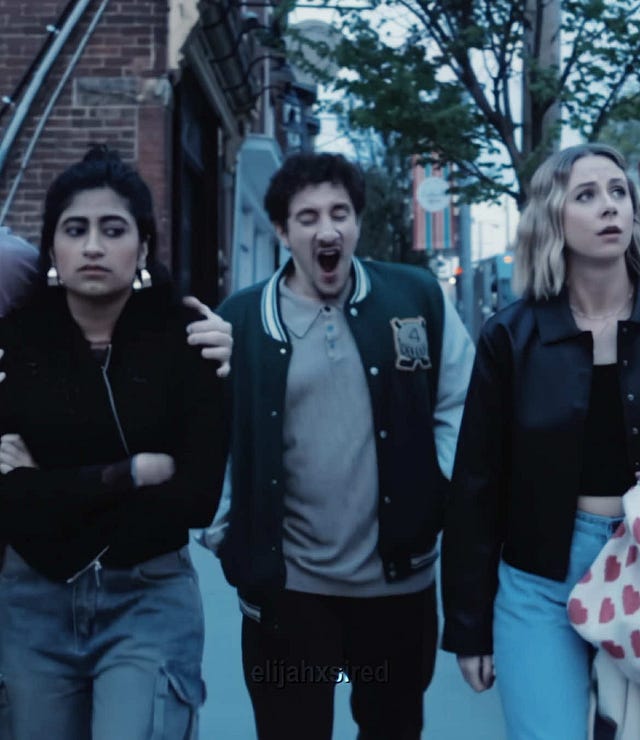
Even if you never watched FX’s Adults, you might have caught clips of it on TikTok or YouTube. The Gen Z-centric sitcom, created by Ben Kronengold and Rebecca Shaw, which premiered in May, cracked Hulu’s top 10 for just two weeks, and didn’t make any Nielsen charts. Still, it turned up in plenty of social media feeds, maybe yours.
That’s thanks to Max Peterson, whose company Clip was hired to disseminate clips from the show starting on May 31, three days after its debut. Peterson, 22, was hired not by FX or Hulu (where the show streams) but by a producer on the series who sought an out-of-the-box strategy for a series targeted at a younger, more online audience. The campaign commenced with just a $3,000 budget for clippers — hired and shepherded by Peterson — who could earn $1 per 1,000 views.
“We basically put the whole season one in a Google Drive folder and gave it to these editors and clippers to kind of go ham,” Peterson says.
 Tiktok failed to load.
Enable 3rd party cookies or use another browser
The initial $3,000 allowance expanded to five total rounds, all told amassing $15,000 paid out to the clippers, who put out 2,500 videos and scored 40 million views across TikTok, Instagram Reels and YouTube Shorts.
Clipping has become a huge part of the social media ecosystem — it’s studios and streamers doling out bite-size scenes from their libraries through official (and under-the-radar) means. It’s those same Hollywood players paying groups like Peterson’s to flood social media. It’s independent “creators” building up followings and cashing in themselves on Hollywood IP. And love it or hate it, clipping matters — especially to the 71 percent of Gen Z who find their TV and movie recommendations by flipping through shorts, according to research from Quickplay.
When Peterson and his business partner visited a Big Three talent agency recently, an agent told them, “I think I’m the only one in this building that knows what clipping is.” This agent (who recalls the duo downing Zyns) may be right, but his colleagues and the rest of Hollywood had better catch up, because clipping’s impact in building fandoms, marketing film and TV — and, on the other hand, possibly devaluing IP by chopping it up into sticky, viral bits that could undermine the whole — is immeasurable. It’s a massively common practice, but I couldn’t even find broad estimates of how many accounts are doing it.

How Clipping Made ‘Organic’ Irrelevant
Starting this past January, Peterson has gone all in on clipping — his Clip operation functions through Discord, which allows him to connect brands, series, films and other clients with his vast network of “clippers”: a cohort of 16,000 individuals between the ages of 14 and early 20s, the majority being in their late teens.
A few thousand dollars here and there, even $15K, doesn’t sound like much of a business. But since launching Clip in January, Peterson says he’s divvied up over $500,000 among roughly 1,300 clippers. The audio and video they’ve worked with is diverse, encompassing music campaigns for all three major record labels (Sony, Warner and Universal), stars like Jennifer Lopez, David Guetta and OneRepublic — even a podcast episode with guest Reid Hoffman, the founder of LinkedIn.
Peterson has successfully penetrated areas, like music and live streaming, where clipping is not only recognized but encouraged as a legitimate marketing strategy by people inside the business — and too much is never enough. “It’s a volume game,” he says of the social media ecosystem, and the companies and people who hire Clip are counting on him to help them reach all those Gen Z fans who find content by flipping through short videos.
Hailing from Seattle, where he built a network of approximately 22 million followers across several Instagram meme pages while in middle school, Peterson later dropped out of high school to move to Los Angeles and work in the music industry. He launched Clip in January and, while he won’t say exactly how much he earns from the practice, it’s his primary source of income.
Was the Adults campaign a success? It’s tough to say. The series, for what it’s worth, has yet to be renewed for a second season. So clipping is not a magic bullet — but it’s an increasingly integral part of marketing campaigns, and soon enough, there will be even more teenagers cashing in on disseminating clips. “Clip teams and individual clippers are going to really start to become a part of the conversation in the coming years,” the Big Three agent tells me.
For this story, I spoke with over a dozen players in the clipping space — industry insiders, clipping experts, agents, lawyers and the clippers themselves. Many spoke with me anonymously given Hollywood’s uneasy relationship with the practice. Creators and companies welcome organic virality and aren’t above trying to juice it a little — but they’re still uneasy about being caught trying to manufacture it wholesale.
Listening to insiders talk about it, though, that’s exactly what’s happening. “There is no organic anymore,” one prominent film marketing executive says.
From my reporting on this booming yet still under-the-radar world of clipping, you’ll learn:
The stakes: How clips are crucial to grabbing Gen Z, and the data behind it
The three ways clips find their way into your social feed — and who benefits from each one
What it means for talent — and reps — when anonymous clippers take control of their “digital aura”
When clipping works for Hollywood, and when it’s not worth the risk, according to a film marketing exec
The TV platforms getting it right with young audiences by moving beyond mere marketing
Hollywood’s dilemma: playing “whack-a-mole” to protect IP even as they join the fray
How clippers operate, monetize and maneuver around platform guardrails
The AI tech that will supercharge clipping and disrupt the disrupters