

Gen Z Is Huge. Their TV Shows Are Tiny. And Hollywood Is Panicking
Showrunners Nahnatchka Khan, Ben Kronengold & Rebecca Shaw, and top execs, on the industry's most-wanted demo miss


Whitney Friedlander is based in L.A. and writes about entertainment and culture for the Los Angeles Times, Variety, Cosmopolitan, The Cut, The Washington Post and others.

HBO’s I Love LA is the kind of comedy the brand does best: a clickbaity show about a niche demo that’s bound to get headlines and awards coverage, if not broad viewership. Variety put creator-star Rachel Sennott on its cover ahead of the show’s Nov. 2 debut, declaring her ode to the dreams, ambitions and clueless narcissism of a particular brand of 20- and early 30-somethings as “generational text” and labeling it a next-gen version of Lena Dunham’s polarizing 2010s HBO series, Girls.
Critics fell right into HBO’s clutches — either claiming that I Love LA made them feel seen or getting very, very angry about the show. While USA Today critic Kelly Lawler deemed it a “prestige TV fantasy of the chronically online,” Vulture’s Nicholas Quah wrote that, if nothing else, the show will be a “time capsule for this peculiar moment in culture when Los Angeles teems with influencers chasing clout.”
Underlying the discussion: the uneasy reality that TV once defined young adulthood. Now Gen Z defines culture — and TV is struggling to keep up. Viewership data backs this up: 65 percent of what 16-to–34-year olds watch is library TV, not new series. In other words, the dominant youth audience isn’t discovering new Hollywood shows — they’re rewatching old ones.
HBO is bullish on I Love LA — on Thursday it announced a second season renewal for the series, calling it “among the fastest-growing” of its original comedies, averaging nearly two million cross-platform viewers in the U.S. These are hardly It: Welcome to Derry numbers, but we can’t all be genre series based on blockbuster IPs.
When I asked Sennott, 30, at the show’s pre-premiere press conference what exactly it means to be a quintessential Gen Z comedy, she laughed. Even she had no idea.
I Love LA draws inspiration from not just Girls, she said, but also HBO’s Sex and the City and Entourage and FX’s Atlanta. “Ideally, what we wanted to create was our own unique tone — something that felt unique to us and was very specific to now,” she added.
Sennott’s co-star Jordan Firstman, 34, whose own résumé includes several shows in this genre (Search Party; English Teacher), highlighted one key distinction between today’s learning-to-adult TV and the previous generation’s version. “The ethos of a lot of what was going on in that millennial Renaissance was very self-effacing, like, ‘I’m just gonna rip into myself and show that I’m depressed and show my depression,’” he said at the presser. “And I think Gen Z has a bit of a sillier, more fun approach.”
For those who spark to it, I Love LA’s unhinged energy is definitely fun — but for those who don’t, there aren’t many alternatives in the quest to be the archetypal Gen Z comedy. The show’s closest contemporary is FX’s Adults, about a chosen family of 20-somethings squatting in one of their (Malik Elassal’s Samir) childhood homes in Queens. Some put Overcompensating, 32-year-old creator-star Benito Skinner’s much-beloved coming-out story on Prime Video, in this category — but it focuses on college kids. While ABC’s Abbott Elementary from creator-star Quinta Brunson, 35, is a ratings and Emmy hit with young adults front and center, its ensemble and themes are multigenerational.
So the question is… why, after decades of network phenoms like NBC’s Friends, Fox’s Living Single and New Girl, and CBS’ How I Met Your Mother and The Big Bang Theory, zeitgeisty HBO entries Girls and creator-star Issa Rae’s Insecure, and cult hits from Comedy Central’s Broad City and TBS’ Search Party to ABC’s Happy Endings, is there so much less TV these days about being young and single and just figuring it all out with a little help from your friends?
Numbering nearly 70 million, Gen Z is the country’s second-largest demographic (after millennials), an audience Hollywood’s future depends on. And yet, the marketplace for shows geared toward 20-somethings is almost wide open. I talked to creators — Adults’ Ben Kronengold and Rebecca Shaw, Laid’s Nahnatchka Khan and Stumble’s Jeff Astrof — and current and former development execs including FX EVP Kate Lambert and NBCU’s exec vp of comedy development Jeff Meyerson, to dig into the state of the Gen Z comedy, what this cohort is watching (and not) and why their very specific, extremely online vibe and influencer-shaped cultural worldview makes them so tough to pinpoint — and to please.

What’s Funny About Becoming Adult?
Friends, Living Single, How I Met Your Mother — these shows connected because they’re about love and work and how things change when the first of the crew has a baby, buys a house, gets a new job… relatable milestones to deconstruct, laugh about and celebrate.
But Gen Z doesn’t have much to celebrate in these arenas. Unemployment rates for young workers hit 10.8 percent over the summer, compared to 4.3 percent overall. And when they are on the job, they’re miserable and feel undervalued. AI and other forces mean, as a source recently told New York magazine, “there’s just no reason to deal with the headache of having young employees who frequently do the wrong thing, who frequently, you know, take up time and space.” As for love: Not only are fewer of them dating than in previous generations, but — according to a recent survey from DatingAdvice.com and Kinsey — nearly half of Gen Z adults have never even had sex.
It’s also harder than ever to figure out exactly what Gen Z is into, or to keep up with it as the smallest screens increasingly drive the culture. Jeff Astrof, 59, an alum of the Friends writing room and co-creator of the new NBC cheerleading mockumentary Stumble, points out — speaking with authority as a parent of two 20-somethings — that if David Crane and Marta Kauffman’s series “took place now, Chandler would go on his phone the entire episode.”
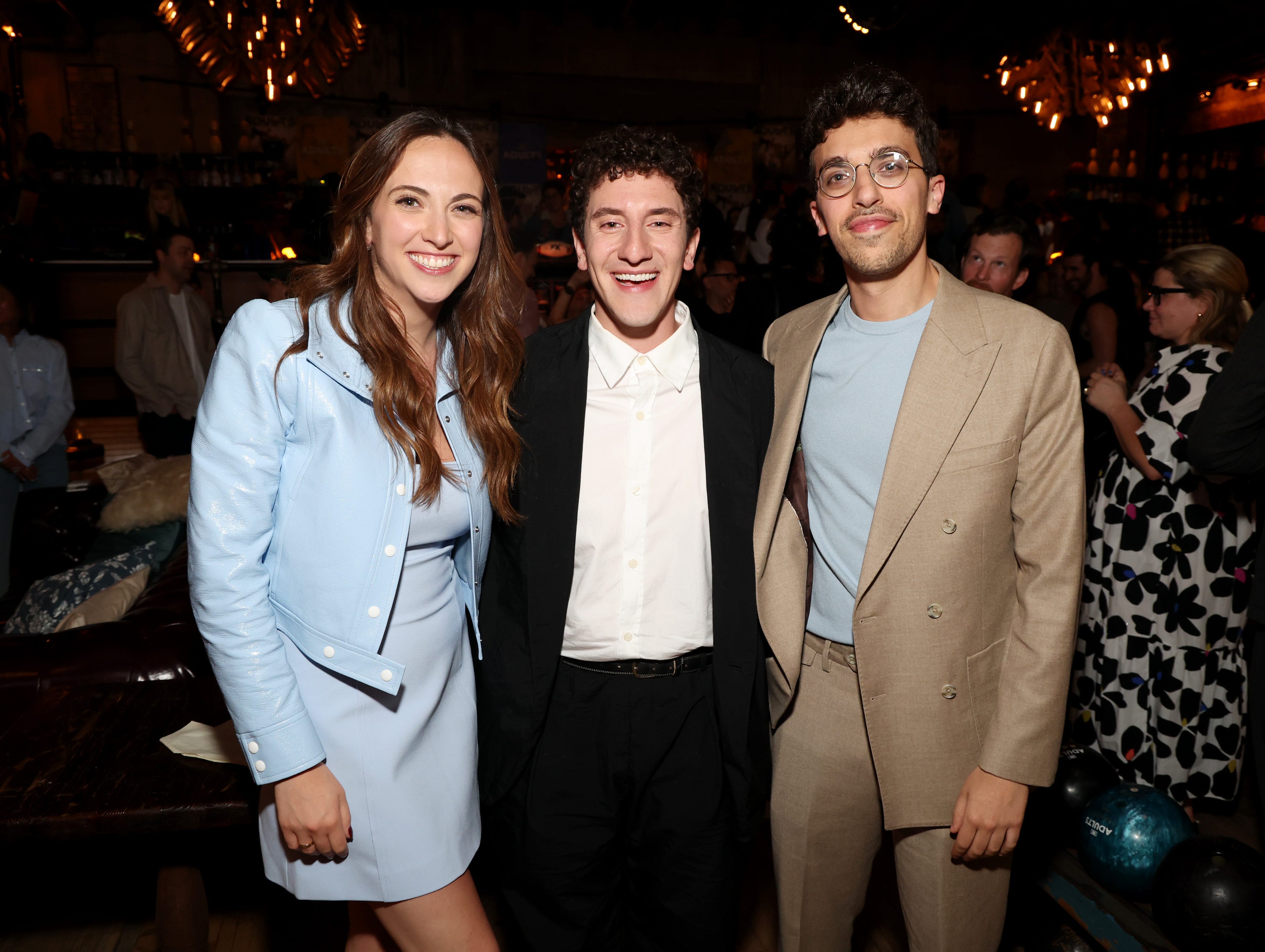
There’s no way a TV show can match the speed at which language, trends and conversations happen online — nor can those cultural forces be ignored. Adults creators Kronengold, 29, and Shaw, 30, tell me they get around this by creating their own in-show language, invented and shared by the central friend group. When a character wants to get something off their chest but doesn’t want it to be a thing, for example, they’ll preface it with a “mind-wipe.” (A big part of Friends’ legacy is its lasting coinages: Remember “on a break”? “Lobster”? “Friend zone”?)
Kate Lambert, EVP of development at FX Entertainment, says she bought Adults in a pitch meeting, not necessarily because it featured young characters but because she was looking for an ensemble comedy. And, in a world where anyone can become a named influencer online — also coming out of a Peak TV bubble when many talents still have their own deals that were largely intended to set them up for star vehicles — it’s hard to create and cast an ensemble series.
“We’re always looking for really specific characters and really specific voices,” she says. “But hopefully there’s something universal in that character, in that story, in that show, that latches on to a larger audience.”
Is Gen Z Worth the Chase?
There’s also a more existential problem for TV: The most vibrant Gen Z comedy right now isn’t on TV at all. It’s playing out on TikTok and YouTube, where 22-year-olds narrate their dating disasters, roommate betrayals and quarter-life freakouts directly to millions of followers. The creator economy didn’t just steal young viewers’ attention — it stole their genre. For this generation, the funniest shows about being young are made by people their own age, on their own phones, in formats that evolve by the hour.
Related:

Overcompensating and Adults found audiences (each series hit the top 10 on Prime Video and FX streaming home Hulu, respectively, but neither cracked Nielsen’s streaming charts) and were given second season renewals (eventually), but a senior development exec at a separate platform tells me that that “the broad youth ensemble is trickier at the moment.” So tricky it might not be worth targeting, no matter how desirable the 18-34 demo remains for advertisers.
“Everything is cyclical,” the development exec says. “But I don’t see in the short term that I’m telling the creative community that I’m looking for a young ensemble as the prototype of what we’re trying to do next.”
Related:

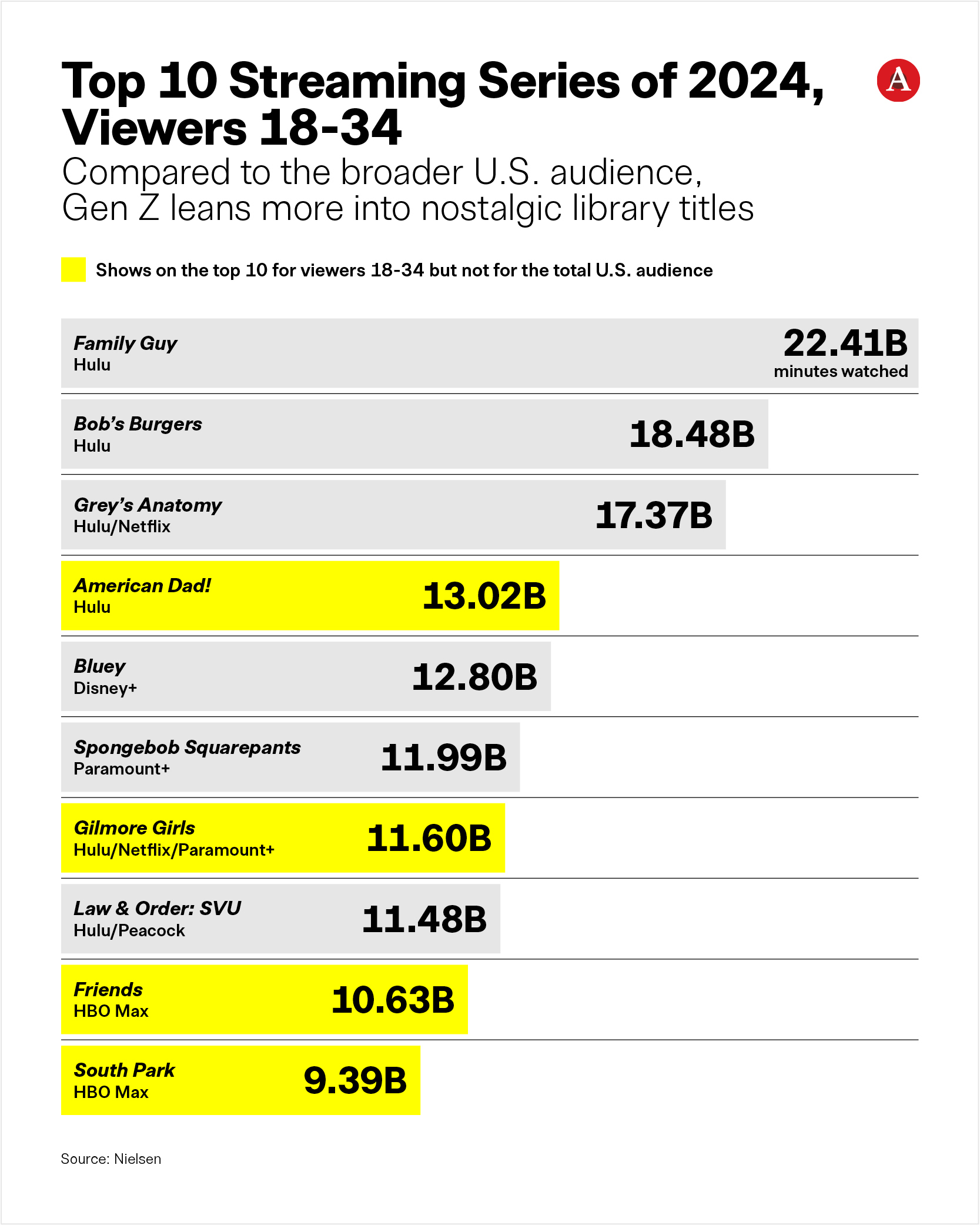
Matthew Frank wrote in September about the company Clip and how it bombarded social feeds with Adults snippets to raise awareness about the show, if not actually boost viewership. It’s hard for a new show to break through when, according to the Hub Research Group’s November 2025 Conquering Content report, 65 percent of the TV consumed by people ages 16-34 is made up of older shows that have been on for several seasons. And numbers obtained from Nielsen Media Research show that the top streaming shows in 2024 for viewers 18-34 in 2024 were ongoing broadcast stalwarts like Family Guy or Grey’s Anatomy (which also made Nielsen’s 2024 top 10 for all viewers) or contemporary classics like Gilmore Girls and Friends (which did not):
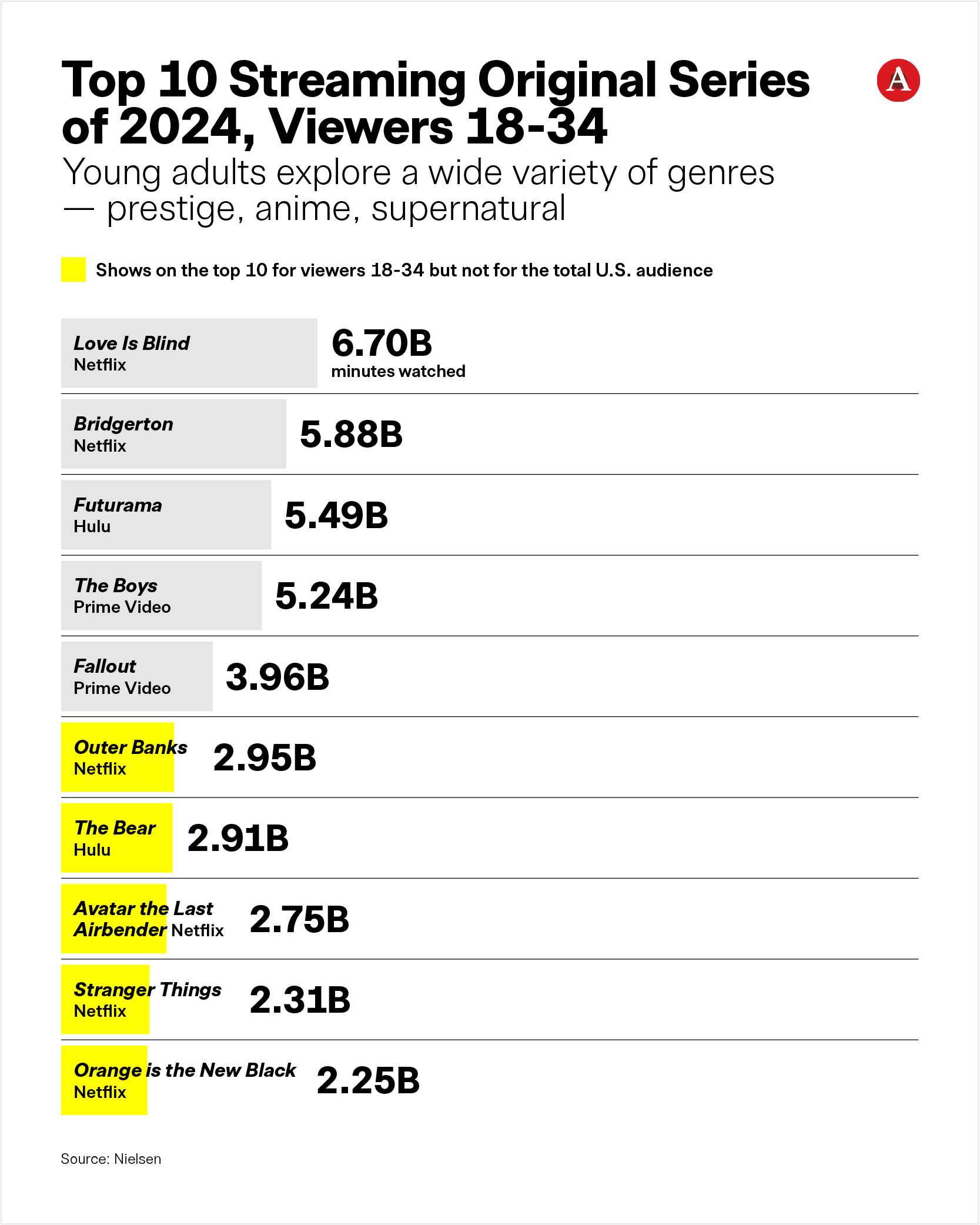
Gen Z likewise diverges from genpop when it comes to streaming originals, with 18-to-34 viewers leaning more into prestige (The Bear) and formats like anime (Avatar: The Last Airbender):
However, there is evidence that a new scripted show can crack the Gen Z zeitgeist. Nielsen reports that the one of the most-streamed shows for people 18-34 during the second week of October (the most recent weekly data available at press time) was the latest installment in Netflix’s Monster anthology, which dramatizes the life and crimes of serial killer Ed Gein, the inspiration for Psycho’s Norman Bates. Expanding the cohort a little more to include ages 12-34 (the youngest members of Gen Z turn 13 this year) brings in Netflix’s Boots. The final show made by the late, legendary Norman Lear, it follows a closeted gay Marine going through basic training just before the institution of “Don’t ask, don’t tell.”
Even on shows that feature young characters, they often are moved to the background. Astrof’s Stumble is based on the Netflix docuseries Cheer, which ended up making household names out of small-town college athletes (Stumble is executive produced by Monica Aldama, Cheer’s failing-is-not-an-option coach with the fetishizable boot collection). Still, Astrof says he and his sister/co-creator, Liz Astrof, were directed to drive the story toward the adult characters.
This is partly because the show tested well with older audiences ahead of its premiere, he adds. It now follows the Reba McEntire sitcom Happy’s Place on NBC’s Friday-night lineup, and the hope is to build a connection for those viewers who still watch linear TV on the primetime schedule.
He notes that the push-pull to highlight one demo while also trying for broad appeal isn’t new, especially on broadcast. “Back in the ’90s when Don Ohlmeyer ran NBC, he was worried that Friends was too young,” Astrof recalls. So the writers developed an older character nicknamed Pat the Cop who was supposed to ground the group. Pat never had to report for duty.
When I ask Astrof if he thinks things would be different if Stumble had premiered on Peacock — or if the kids could become the breakout characters as they did with Fox’s Glee — Astrof laughs and says, “If I could answer any of these questions, I’d be [retired].”
When I ask NBCUniversal’s head of scripted comedy development, Jeff Meyerson, the same question about Stumble, he says NBCU is looking for shows with broad appeal for the biggest possible audience, regardless of the platform. The difference between NBC and Peacock isn’t their targets, he continues, but rather the storytelling and how it aligns with cadence and viewing habits on broadcast (appointment TV, more episodes) vs. streaming (shorter seasons on demand).
“When we’re developing [with creators], it’s much more about the urgency of storytelling on Peacock versus on broadcast,” he says. “We feel like there’s more of a rhythm to having the St. Denis Medicals or the Stumbles of the world have a higher episode count where you can fall in love with these characters and it’s much more episodic by nature.”
Narcissistic Youths: Never Out of Style
Lots of pixels have been spilled over how self-involved Friends’ sextet were or why Neil Patrick Harris’ Barney on HIMYM was problematic, actually. In the 2010s, with more female-led stories like Fox/Hulu’s The Mindy Project, Fox’s New Girl and ABC’s Don’t Trust the B---- in Apartment 23, the narcissism became more self-aware — and unapologetic.
The B---- was the first show that Nahnatchka Khan got on the air as a creator. Premiering in 2012, it was a dark and sardonic program about a fresh-off-the-bus ingénue (Dreama Walker’s June) who moves in with a manipulative roommate (Krysten Ritter’s Chloe). There are so many reasons why this show shouldn’t have worked, from its very title to a scene in the pilot when Chloe gets a kid drunk. But Khan, 52, says she had the full blessing of Paul Lee, then the president of ABC Entertainment (he’s now CEO of Wiip) and himself a bit of an outlier in the industry, though The B---- lasted only two seasons. (Although 20th Century Fox Television produced the show, The B---- doesn’t stream on either Disney+ or Hulu in the U.S.)
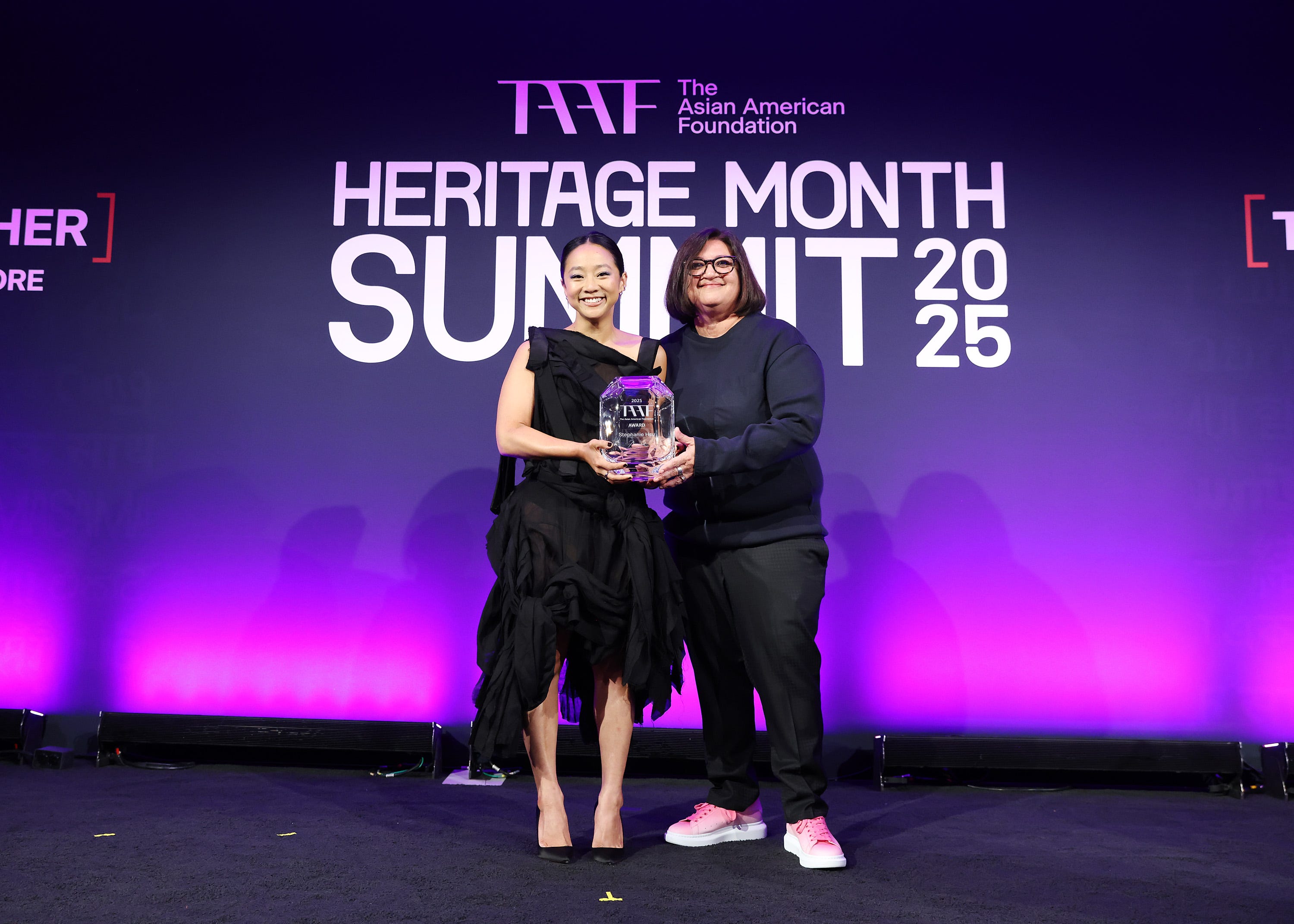
Last year, Khan and Sally Bradford McKenna created Laid for Peacock. Adapted from an Australian format, it has a procedural structure — each episode randomly kills off a former paramour of its lead, the 30-something event planner Ruby (Stephanie Hsu).
“The humor of Laid for that specific audience is you wanted to take something relatable and familiar — this girl just can’t find the one that she’s been searching for — and then bring in this sort of heightened element of people start dying one by one,” Khan says. “In a way, Don’t Trust the B---- also had that heightened element for that same target audience.”
Laid was released as a binge watch in December and was later canceled after one season.
Related:

Debbie Liebling’s storied producing career includes several years in comedy development at Comedy Central, where she was instrumental in shepherding in then-unknowns Trey Parker and Matt Stone’s South Park. She also executive produced Maya Erskine and Anna Konkle’s Emmy-nominated Hulu comedy about the hell that is junior high, Pen15 (2019-2021).
Liebling blames the dearth of edgy young-adult-focused comedies on the demise of cable that has gutted platforms like Comedy Central and TBS — once staffed by young execs looking to nurture and develop young talent and stories for young-skewing audiences.
“People try to plan on having hits, but hits happen by throwing the net wide and taking some chances,” she says, adding that Pen15 went under the radar at Hulu because executives were focused on more expensive projects. This gave it time to find its niche audience of millennials nostalgic for the days of crushes and algebra. “So often, people are afraid of diverting from what they think people want,” Liebling says — but she also concedes that for a show to grab new audiences now requires something “that is so viral to get that kind of commitment.”
So is it that young adults aren’t watching TV? Or that they’re just not watching what the industry is selling? Fifty-seven percent of “tweens, teens and young adults… watch TV and movies more than older generations think they do,” the Center for Scholars & Storytellers (CSS) at UCLA found in its annual Teens and Screens Report, released in October. They’re increasingly interested in “content with relatable stories more than fantasy [and] real-world issues or aspiration stories,” and 61 percent of those surveyed would rather see romantic relationships that depict a friendship between a couple — not just sex.
Both Adults and I Love LA have sex scenes (so does Overcompensating, while Abbott keeps things pretty G-rated), but intimate relationships aren’t the A storyline. The friend groups are also an intersectional mix of genders, races and sexual orientations without making any of these things really an issue. Everyone is “woke” even if they may hate that word’s connotations, and characters are aware of their privileges (that True Whitaker’s Alani is the wealthy daughter of a famous actor runs as an undercurrent on I Love LA; and Adults doesn’t really engage with how much longer the group can go on living rent-free in Samir’s family home).
Both shows also lean into the fact that young people are just, inevitably, conceited and narcissistic jerks. On I Love LA, Odessa A’zion’s influencer Tallulah has phone sex in her friend’s bed. On Adults, Owen Thiele’s Anton and Amita Rao’s Issa become convinced they caused their shared therapist to end his life (he actually slipped in the shower).
“We always say they’re not good people,” Adults co-creator Shaw says. “But they’re getting there.”
 | A guest post by
|
I think a lot about how HBO isn’t responsible for what happens *before* their demo viewers discover HBO shows. Co-viewing is an extremely essential part of how kids and teens learn to watch television (fall in love with the act of watching narrative or sitcom). Kids spend so much time with their parents in this gen, but if their parents aren’t interested in the programming —it’s too niche, it’s too sophomoric—they might not share the screen with their kids. Thinking about how FRIENDS was uncomfortable to watch with parents in the 90s, but many of us were “allowed” to because of its broadness. Then, we watched shows like Sex and The City or years later, Girls, without our parents (because that would have been awkward.)But the point is that coviewing linked us to a behavior: I watch tv. If family programming isn’t helping serve the model viewing habit, we have a missed link between caring about turning on shows, and primarily caring about our social screens. I think the best example of a coviewing show right now is The Pitt because it juggles adult/teen/world issues in a very nuanced way, and it’s tonally captivating enough to keep us locked in.
This is an awesome piece Whitney! So much detail.