

Day 8: Hollywood Ghosts Cannes — and the World Notices
No studios, no streamers, just Dior: What happened to American film's hegemony?

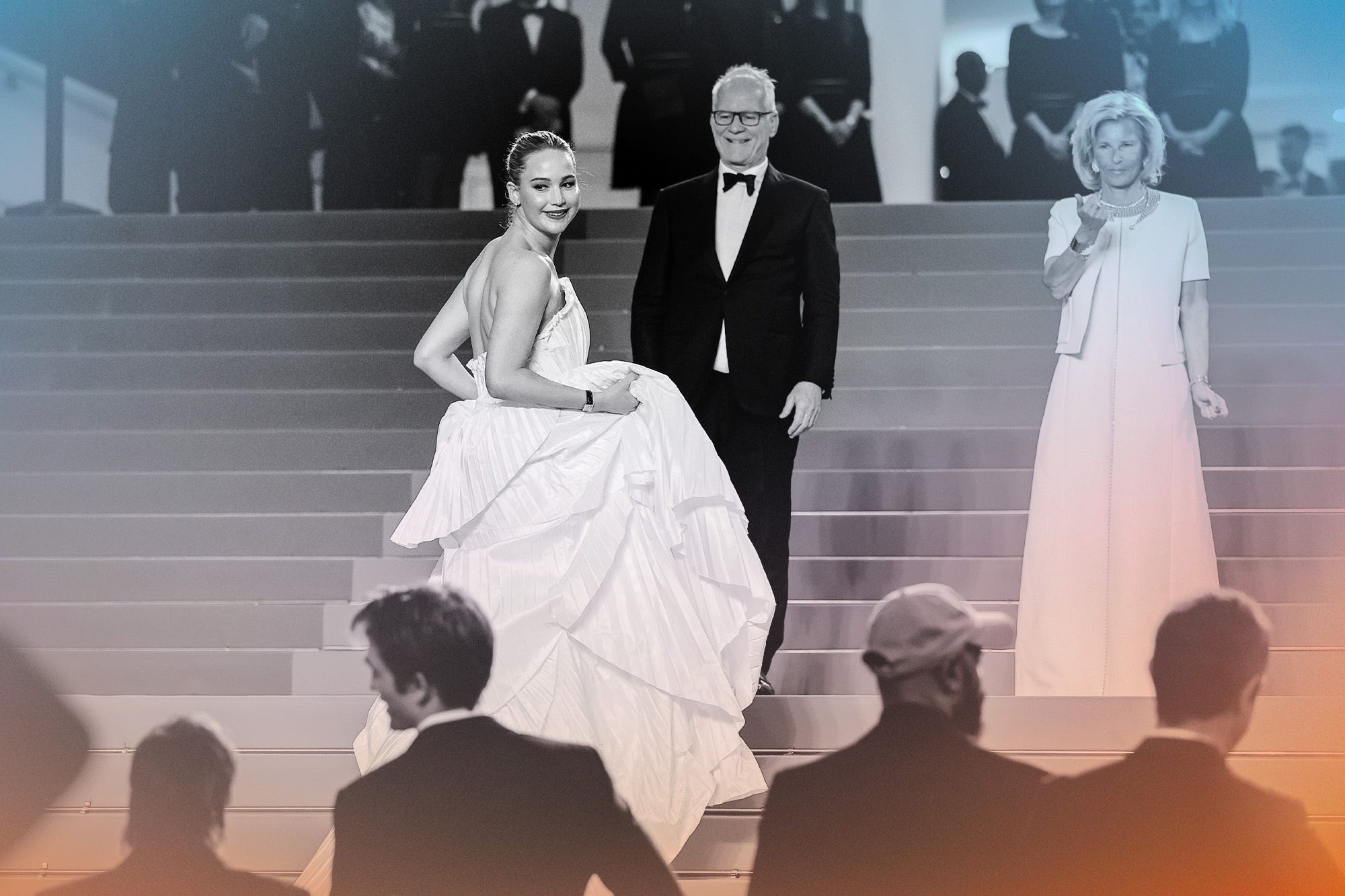
If there was clearer evidence needed that America’s grip on the global movie business has loosened, then the Cannes Film Festival is surely it. One single billboard for Tom Cruise’s final Mission: Impossible was all I saw, at least. A top events producer told me that the chaotic geopolitical moment, fraught with fears of tariffs and a gyrating stock market, caused major U.S. companies (and also some from China too) to cancel bookings. The market has been soft, with no sales making big headlines bar Mubi’s acquisition of Die, My Love from Scottish filmmaker Lynne Ramsay. (The film is also generating early Oscar buzz for star Jennifer Lawrence’s all-in performance as an unhinged young mother.)
Sure, we get it: You are hiding from Trump, and celebrating celebrity hedonism isn’t a good look when you’re in the throes of cutbacks. But being largely absent from the stage — when even Nigeria’s film industry is blossoming and Saudi Arabia is announcing a new studio in Riyadh — feels like a tremendous miss. Cannes is the world’s most famous film festival, and Hollywood studios were invisible. Netflix too, once a champion of art house movies like Roma, cares less about films today; wrestling and sports do better with advertisers. Thankfully, IMAX CEO Rich Gelfond was in town to represent the home team. (He spoke with my fellow Ankler contributor Gregg Kilday about his company’s recent wins.)
Perhaps knowing full well that the 78th edition of Cannes was around the corner, President Trump made sure his name would be on everyone’s lips with a May 5 proclamation on Truth Social proposing a 100 percent tariff on movies produced in “Foreign Lands.” As unrealistic as the idea may be in its particulars, it sent shudders around film commission offices around the globe.
Note to White House chief of staff Susie Wiles: This would have created more frenzy if you’d dropped it on the first day of the festival. The White House gave everyone time to workshop their responses into a collective, “Until we know more, we can’t comment.” The Trump attack suddenly gave culture ministers validation for their expense accounts as they rushed to the aid of the national filmmakers with words of encouragement.
I chatted with some young American filmmakers in Cannes and asked them what help they would want from the administration. One of them, John Fitzgerald, who has an AI-driven project, Beyond the Vivid Unknown, in the festival’s Immersive Competition at the Carlton Hotel, told me he just had his NEA grant cut. “France, it’s a really dynamic way that they facilitate an industry to really experiment,” he said. “The French CNC is a big funder of big progressive, experimental work. There are small pockets of things that allow you to create stuff in the U.S., but it’s really hard to find.” (Richard Linklater, at the fest with his well-received Nouvelle Vague — itself centered on the iconic French filmmaker Jean-Luc Godard — likewise commented at his film’s press conference on France’s support for its film industry. “They make sure it’s healthy, and they nurture it,” he said. “And our country, the U.S., could use a little bit of that.”)
While it's hard to see a MAGA movie office backing a gay biker film about BDSM, as the publicly funded BBC Film did with Pillion. Sam Pressman, the son of legendary producer Ed Pressman, told me that American-made movies have been a source of national influence on the world. “A massive way that America created its identity was through the spheres of influence, in the way we had corridors of distribution,” he said.
Pressman was just back from a trip to Japan, where he saw a population turning away from American fare. “Tariffs, as they were first announced, would be a terrifying reality for global cinema,” he said, but he’d welcome other kinds of support from the government. “A federal tax credit for film would be incredible,” he said. For all the absurdity of the tariffs on movies, he added, “The idea that we make it easier to film and enhance and incentivize spending in America should be done.”
Where the studios have pulled back on their marketing here, largely French-owned luxury goods firms have stepped up. Dior ads followed me all over the internet this week after I admired a reworked vintage Dior dress on actress Natalie Portman. Two other brands were unmissable this week. Unilever’s Magnum ice cream treats popped up on my phone every time I ordered an Uber. The brand spent big on its beachside event space, drafting Charli XCX to DJ parties populated by giraffe-like models. At the brand’s “Wherever Pleasure Takes You” soiree on May 16, ice creams were served on platters with sparkling fireworks. And the Italian maker of Campari hired Danish bad guy Mads Mikkelsen to mix up a Mads Negroni cocktail at its own beach set-up. The festival finale is the amFAR gala and auction on Thursday night, with Duran Duran, Ciara and Adam Lambert performing and Taraji P. Henson hosting. I checked the website for tickets and you can get on the waitlist for $25,000. A “Grand Philanthropist” table is a cool $350,000, but you can party until 3:30 a.m. at the Hotel du Cap-Eden Roc.

But back to what Cannes is about — the movies. From every corner, I heard this year’s selection were quality choices, and I was surprised that even by Tuesday afternoon, a full week into the event, the red carpet was still lit up with high wattage actors like Adrien Brody and girlfriend Georgina Chapman. Screen International’s critics’ jury grid had only two movies with four stars from all the top reviewers, both from early in the fest: Ukrainian director Sergei Loznitsa’s Two Prosecutors, about a frustrated lawyer who is seeking justice in Stalin’s Russia, which scored some pre-fest sales to European territories, and Sound of Falling, about a set of haunting events that affect a family over the course of a century from German director Mascha Schilinski.
The film market and festival of off-beat, edgy and sometimes dodgy films from all over the world is just one layer of Cannes. There’s also the Cannes of the freelance photographer trying to sell photos on the streets, the Cannes of the social media players hoping to juice their stats and the Cannes of the unseen, behind-the-scenes people who sweat the details: the cars, the clothes, the hotel bookings, the late night burger and fries room service for their clients.
I spoke to Charles Richez, manager of The Majestic, who wore all the stress with a smile despite 15-hour days. He was overseeing check-ins, an army of hair and make-up people, flower deliveries, security teams, restaurants and bars and the suites rented by the likes of Chanel, Louis Vuitton, and actresses including Angelina Jolie, Portman and Catherine Deneuve. “We are one of the last owned by a French family,” he said of major hotels on the Croisette. The Carlton is owned by the Qataris, the Martinez by the Hyatt.
When asked about the biggest challenge of the week, Richez said, “It’s very intense for everybody, but it’s one of the nicest times.” When I pressed him again, he shared that the requests for immediacy can put a strain on the proceedings when they come from all quarters, and the late night parties keep the hotel guests out until the early morning, which means they want to stay beyond check-out time to sleep in. And who would want to check out of this cinematic bubble on the Riviera and face jobs and families and the reality of the news cycle back home?
If only there was time for the emotional readjustment required to make the transition from the high-octane week to workaday life. One attendee told me, “I just need some time to re-tune.”


News
Producers Call for Investigation After Palm Tree Injury
A team member on the Japanese film Brand New Landscape was struck by a falling palm tree on the Croisette. → Click here to keep reading
Ukrainian Team Makes Red Carpet Action, Statement
The team behind Militantropos wore dark outfits with mirror panels attached to walk the red carpet. → Click here to keep reading

Deals
Mubi Acquires 4K Restoration of Amores Perros
Alejandro G. Iñárritu’s film launched in Cannes Classics this week, 25 years after its original fest debut. → Click here to keep reading

Reviews
Fuori Zooms in on Art Of Joy Author Goliarda Sapienza
Critic Lee Marshall says the film’s plot is “threadbare in places.” → Click here to keep reading
Jafar Panahi Confronts Iranian Justice System
His film, It Was Just An Accident, was called “an impassioned and forthright condemnation of the regime.” → Click here to keep reading
A Private Life Stars Jodie Foster as Parisian Therapist
Rebecca Zlotowski directs Foster in her first French-speaking role. → Click here to keep reading
Scarlett Johansson’s Eleanor the Great Deemed “Warm”
The film, starring the 94-year-old June Squibb, marks Johansson’s directorial debut. → Click here to keep reading

Features
Jafar Panahi on His New Film & Being Imprisoned
The filmmaker discusses the Iranian sense of humor and why nothing can diminish his passion for cinema. → Click here to keep reading

Today’s Screen Jury at Cannes
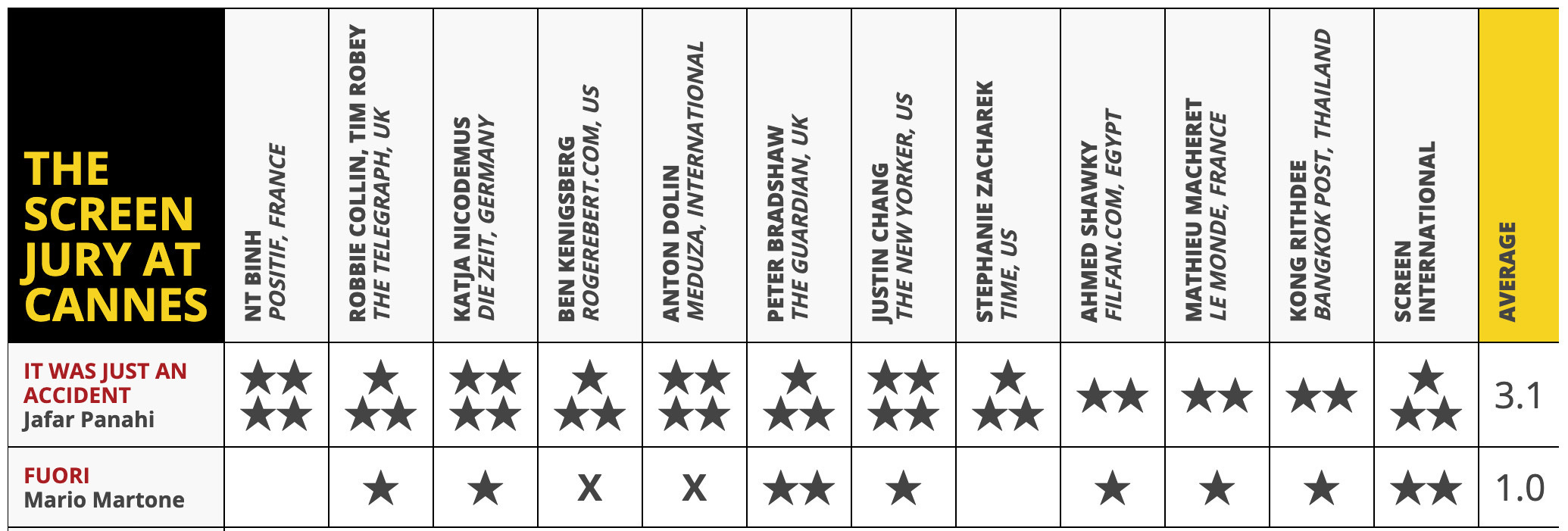
The long-running Screen International Jury Grid is a critical ranking of competition films in Cannes, according to an assembled jury of 12 international film critics, including Screen’s reviewers (four stars is the top rating; an X means zero stars). Iranian drama It Was Just An Accident joins Sergei Loznitsa’s Two Prosecutors in first place with a 3.1 average from the critics. → Click here for the full grid.
The Ankler x Screen International's Cannes Daily
Day 1: ‘Art Is a Threat’ as Oscar Race, the Resistance, Begin
Day 2: ‘Prices are Crazy’; Cruise ❤️
Day 3: KStew Debut; IMAX CEO on Nolan; Screen Jury Grid Starts!
Day 4: Eddington Divide; Fashion’s Film Dollars; $6K Tix Black Market
Day 5: RFK Jr. & the Dr.: Doc Seeks Buyer; Linklater’s Godard Pic Charms
Day 6: Wes' Circus; JLaw Pic's $24M Mubi Sale; Skarsgård's BDSM
 | A guest post by
|