

5 Burning Questions Hollywood Should Ask After Trump’s AI Executive Order
From guilds to Gavin Newsom: what studios and creatives need to reckon with now

I cover the intersection of Hollywood and AI for paid subscribers. I dove into Disney’s deal with OpenAI, how AI search is disrupting Hollywood discovery, what AI performer Tilly Norwood means for actors and how the tech is threatening other jobs across Hollywood.

If you thought Hollywood’s AI drama was already hot — writers arguing with chat-bots, actors replaced by digital doubles, VFX artists watching their craft slip into code — wait till you see what’s unfolding in the West Wing.
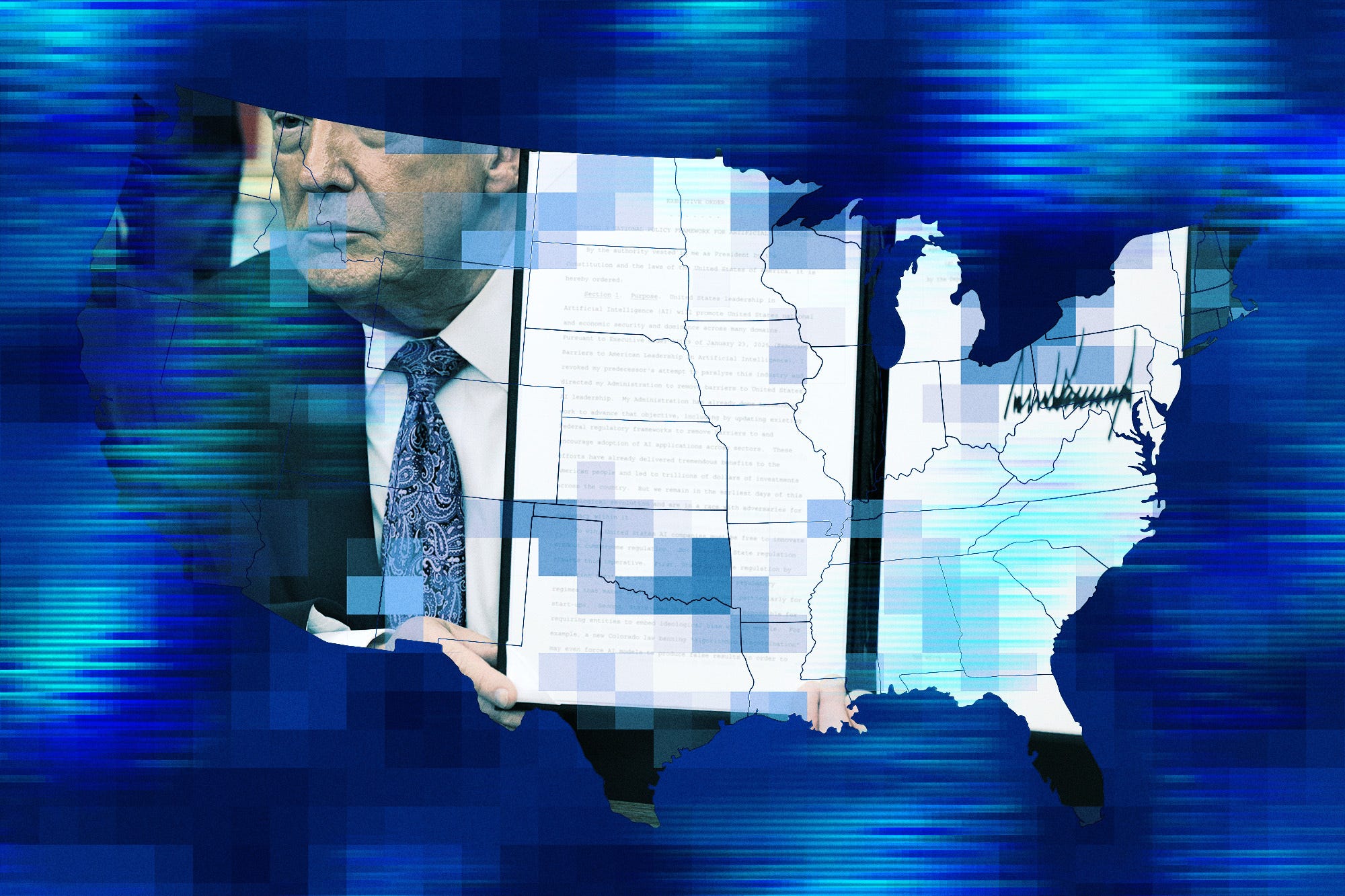
Last Thursday, President Trump signed an executive order designed to create a “national AI policy framework” and challenge state AI laws across the country. Critics call it a legal Hail Mary, constitutional overreach and a recipe for courtroom gridlock. But there’s an uncomfortable truth beneath the political theater: If the U.S. doesn’t innovate and set the rules, others — notably China — could, and those aggressive moves abroad could have direct consequences for studios and the film and television industry writ large.
Throughout 2025 Trump has stressed that the U.S. must reduce regulatory “red tape” so that American AI companies don’t have to navigate “50 different approvals from 50 different states” every time they want to innovate — with California being ground zero for both Trump’s political acrimony and also where Big Tech and Big Media will inevitably collide on this issue.
When not busy rage-tweeting at California’s governor, Trump has painted state AI rules as a drag on competitiveness, insisting a national standard is necessary to “win the AI race.” That phrase — win the AI race — sounds like campaign sloganeering until you look at the facts: AI is already a cornerstone of economic growth (as seen through the massive acceleration in AI search and AI video content), military modernization as seen through drone piloting and surveillance systems like Palantir’s Foundry, and industrial transformation for nations around the world through predictive maintenance of farm tools (to give just one example).
It’s also (mostly) what the stock market is hanging its hat on these days. If AI is perceived as a bubble, and it pops, it will surely take the entire stock market down with it, as the “magnificent seven” (Google parent Alphabet, Amazon, Apple, Meta Platforms, Microsoft, Nvidia, Tesla) account for the majority of stock appreciation this year.
Meanwhile, across the Pacific, China is not twiddling its thumbs. Chinese models and AI applications — bolstered by Jensen Huang effectively lobbying Trump to overturn a ban on selling Nvidia’s H200 chips to Beijing — are gaining traction faster than many expected, and breakthroughs like competitive large language models from firms like DeepSeek and meme-creators like Kling have rattled Silicon Valley and Hollywood.
OpenAI — not the most obvious Trump ally — sent a policy letter in October noting that Chinese AI advancements are closing the gap on U.S. capabilities and urging shifts in training data policy to keep American models ahead. And bipartisan lawmakers are even trying to block Chinese AI systems from federal use altogether, citing national security concerns.
So yes, on one level Trump, when not tweeting awful things about Rob Reiner, is not wrong to frame AI leadership as a global competition. If the U.S. loses its innovative edge, the economic, cultural and strategic costs could ripple outward — from national defense to every industry touched by AI, including Hollywood.
In today’s newsletter, I’ll get into five urgent questions for Hollywood in the wake of Trump’s move:
What should Hollywood and Gavin Newsom be fighting for now?
What does Trump’s Executive Order mean for California’s laws?
What’s the impact on dealmaking and production?
How will this play out in the upcoming guild negotiations?
What does the industry need to protect its creative culture from AI?