

$100 Million Hate-Watch: Inside Hulu’s ‘All’s Fair’ Trainwreck — and How It Turned Around
SCOOP: I have the budget, cast paydays and behind-the-scenes drama from Kim Kardashian’s critically-savaged series that’s gone ‘zero to hero’

I cover TV from L.A. I interviewed Universal Content Productions chief Beatrice Springborn and wrote about the mood at Warner Bros. Discovery as insiders anticipate a sale and how a combined Paramount-Warners could challenge Netflix. I’m lesley.goldberg@theankler.com

How do you become a show of the moment in 2025? Hulu’s Kim Kardashian vehicle All’s Fair makes an interesting case study.
The series hails from Ryan Murphy, the writer, showrunner and director who has mastered the art of cutting through with a résumé packed with global phenoms including Glee, American Crime Story: The People v. O.J. Simpson and Monster, among others. The prolific creator conjured All’s Fair alongside Jon Robin Baitz and Joe Baken, marking the latest collaboration for the trio following ABC’s cruise ship drama Doctor Odyssey, Hulu’s FX horror entry Grotesquerie and the episodic anthology American Horror Stories.
Few showrunners aim bigger than Murphy. The money, as they say, can be seen on screen with his trademark stars, fashion and gloss. He single-handedly reinvented the seasonal anthology with FX’s American Horror Story (season 13 is due next Halloween) and has parlayed that format success into other genres with American Crime Story (season 4 is in the works), American Sports Story (awaiting word on a second season) and American Love Story, which is due next year. While not every season hits the zeitgeist in the same way, the franchises have something rare in the streaming era: staying power.
Peppered among Murphy’s numerous successes, including Netflix anthologies The Watcher (season 2 is in the works) and Monster (season 4 is in production) are shows with promise that just didn’t work, including Hulu’s Mid-Century Modern, ABC’s Doctor Odyssey and my personal favorite, NBC’s The New Normal, all of which were axed after a single season. Into this mix saunters All’s Fair, which has all the Murphy trappings — a killer cast, slick production values including high-end fashion, jewelry and cars — but doesn’t seem to fit precisely into either of the two buckets that most often define his shows: prestige (People v. O.J.) or populist (Ratched).
The premise of All’s Fair is simple: Kardashian — easily one of the biggest stars on the planet with her 354 million Instagram followers alone — leads the cast as a divorce attorney who owns an all-female law firm. (Kardashian modeled her character, Allura Grant, after her own high-powered matrimonial lawyer, Laura Wasser.)
Murphy revealed at one of the multiple premieres for All’s Fair (more on those later) that the show came together when Disney co-chair of entertainment Dana Walden facilitated a meeting for him with Kris Jenner and Kardashian. After initially pitching a reality show for the trio to team on, Jenner urged Murphy to write a scripted series for Kardashian, which led to her role in 2023’s American Horror Story: Delicate. From there, Jenner and Murphy reportedly pitched Hulu on a legal drama starring Kardashian as a divorce attorney. Hulu, Murphy recalled, said yes immediately.
To say All’s Fair was highly anticipated would be a significant understatement. Packing Kardashian’s global star power and Murphy’s creative clout, the drama is owned and produced by Disney and marks one of the first projects to stem from his return to the company under the nine-figure exclusive overall deal he signed in 2023 (after his five-year detour to Netflix).
But now All’s Fair is here and, four episodes in, the series has become the talk of the town — though likely not in the way Murphy, Kardashian or anyone at Disney intended. As The Wrap recently opined, “Ryan Murphy is getting the worst reviews of his career. It doesn’t even matter.” Despite those terrible reviews, Hulu is boasting record viewership (“the biggest Hulu Original scripted series premiere in three years, driving 3.2M views globally after 3 days streaming”), Kardashian and company are leaning into the camp factor and people are certainly talking about the show more than a week after its premiere, which is a feat in itself.
So, is All’s Fair a model of how to cut through in 2025? Was the series worth the millions Disney and Murphy spent to make it? Do the reviews even matter? Does hate-watching help Hulu draw subscribers?
I spoke to multiple sources familiar with the show’s development and production, as well as other stakeholders in television, about this drama’s wild and glamorous ride so far.
In my column today, I’ve got:
The real budget math: what Hulu shelled out per episode — and what Kardashian, Sarah Paulson, Naomi Watts, Glenn Close and Niecy Nash-Betts were paid
How a California tax credit and some classic Ryan Murphy magic made the nine-figure production possible
How Kim K and Co. spun the worst reviews of the year into a viral marketing win
Disney’s master plan to use All’s Fair as the glossy face of Hulu’s new global streaming brand
And the question haunting exec suites: Did this $100 million hate-watch actually move the needle for Hulu?

Price of a ‘Ratings Juggernaut’
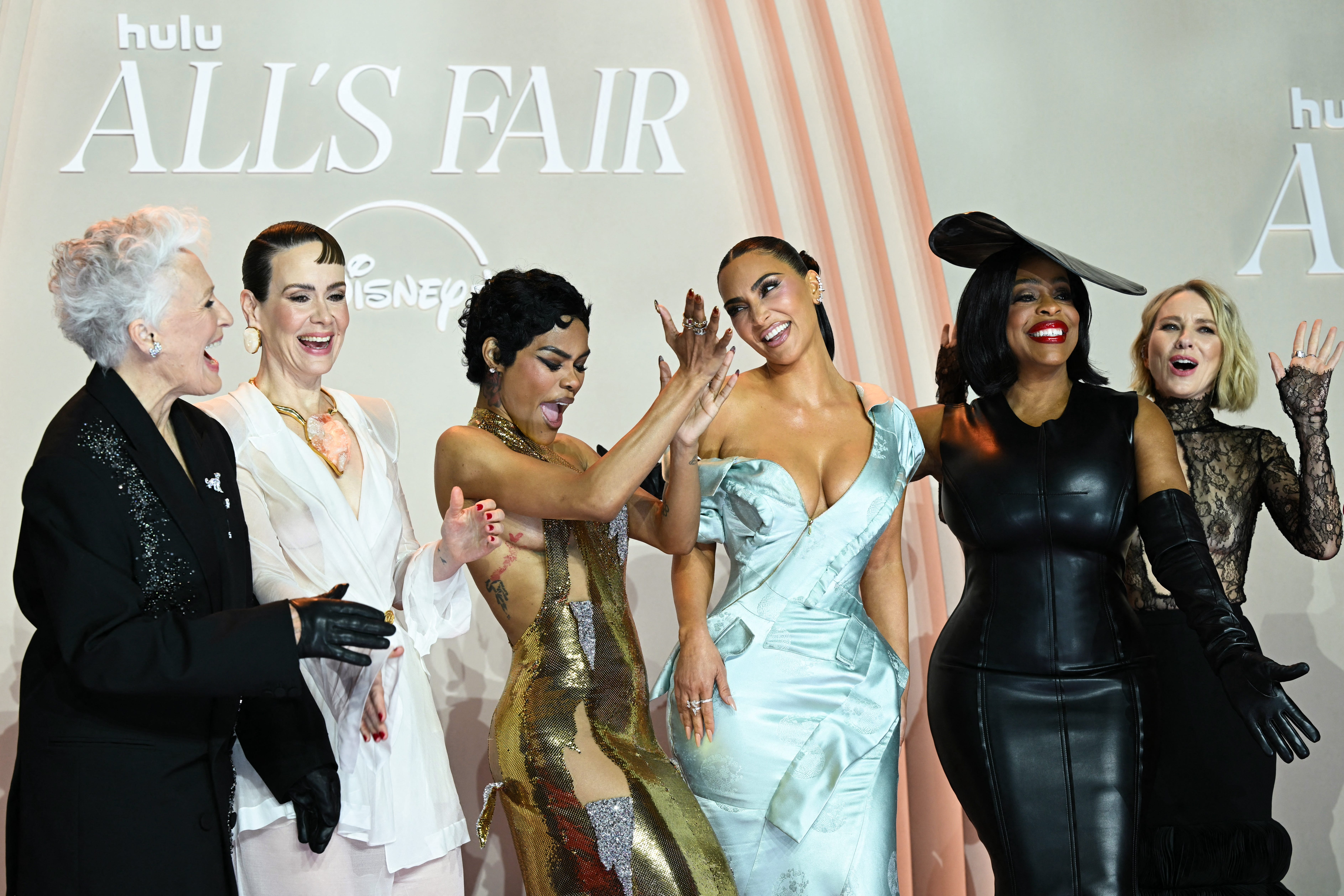
While All’s Fair is considered an above-average spend for Hulu, the costs to make it — including talent paydays — aren’t stratospheric. The all-star cast — including previous Murphy collaborators Paulson, Nash-Betts and first-timer Close — signed on based on Kardashian’s pull paired with the show’s premise, and sources say these five earn an average of $350,000 per episode. Halle Berry was originally poised to co-star in what would have been her first TV regular role in a decade but dropped out a week after news of her involvement broke, citing a scheduling conflict, though sources say she wasn’t prepared for the rigors of a Murphy show.
Production costs on the nine-episode first season, sources say, clock in between $11 million and $12 million per hour. All’s Fair is also one of five shows to earn a sizable sum from the California Film Commission as the drama was awarded $14 million in tax credits for filming in the Golden State. One source called the budget on the series “the high end” of what Hulu spends on scripted originals but still less than what other streamers like Apple and Amazon have been known to shell out on average.
All’s Fair will bow new episodes every Tuesday through Dec. 9, when its final two installments of the season will debut. While sources say there never was a script for a 10th episode, scheduling issues surrounding some key cast members arose and certain storylines were condensed to make the first season a total of nine installments, which is uncommon even in today’s streaming landscape. “It raises a red flag when you see nine episodes,” says one longtime development exec. “You do eight or 10 episodes because that’s what platforms prefer, because algorithms tell them people can’t handle more than eight episodes; but with 10, your amortization comes down.”
Sources say Disney greenlit All’s Fair to be a “ratings juggernaut” that appealed to a global audience. On Oct. 8, Disney+ replaced the tile for Star, its general entertainment streamer outside the U.S., with Hulu, making the brand that Disney acquired full control of earlier this year the company new global home for general entertainment programming (this all comes as Disney phases out Hulu as a standalone app and fully integrates its programming into Disney+). All’s Fair launched its first three episodes less than a month after the Star-to-Hulu changeover.
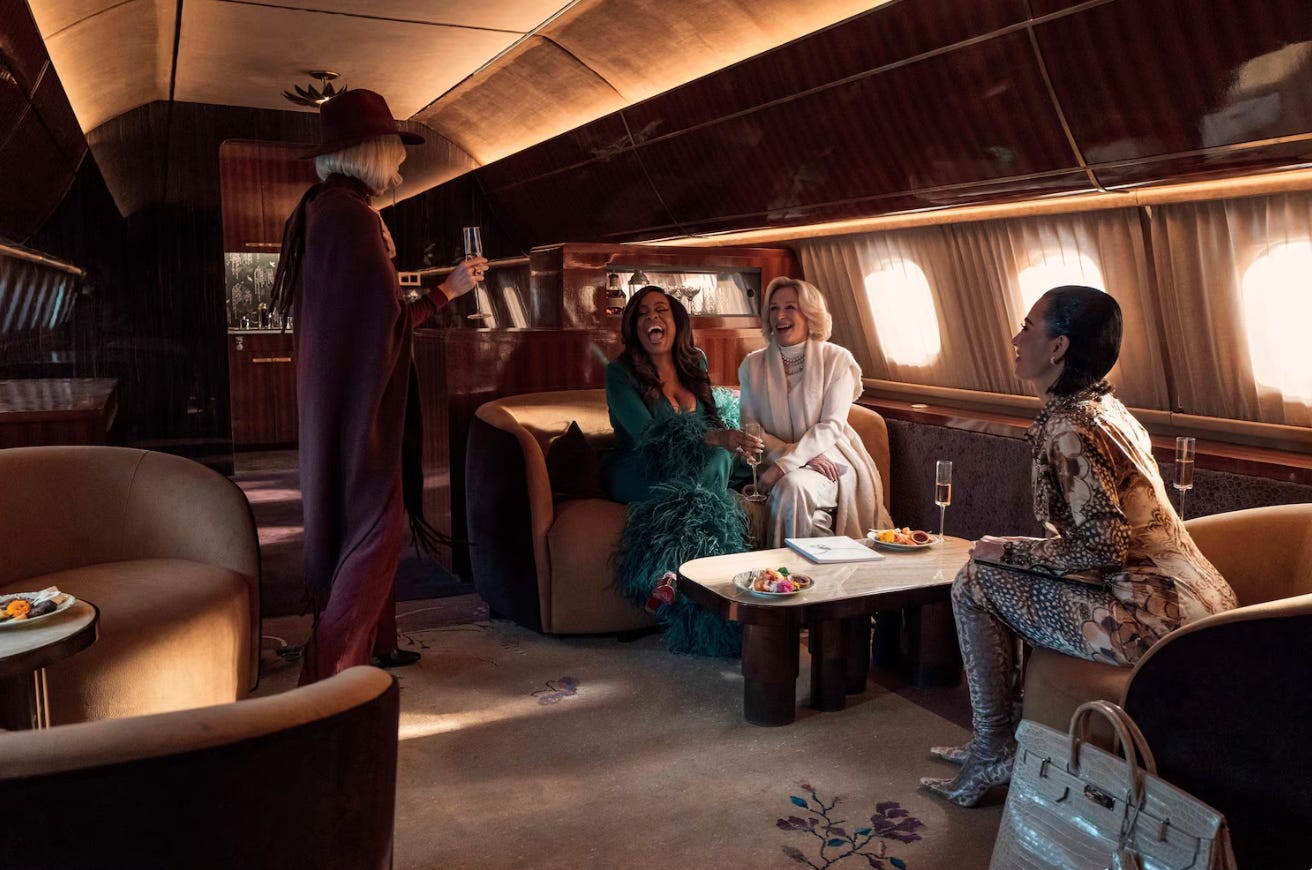
As part of the global launch plans for All’s Fair, Disney hired Jennie Wilkes, a former longtime Netflix marketing executive who worked on Murphy’s Monster: The Jeffrey Dahmer Story, to bolster the creative for promotional efforts, signaling its plans to go far above and beyond the standard marketing push for a new scripted drama. The aggressive and extravagant campaign that followed included premiere events in Los Angeles, New York, Paris, London and, most recently, Brazil. Such a push for a scripted original — certainly amid the industry’s economic challenges — is rare.

‘A Crime Against Television’
Then came the reviews. Sources say Murphy declined to provide advance screeners to critics, who were left to watch the series with the rest of the world. (Murphy has long abandoned the process of providing screeners to the press, though there have been exceptions from time to time.) The Hollywood Reporter dubbed All’s Fair “unforgivably dull.” The Guardian said the series was “fascinatingly, existentially terrible.” The Daily Telegraph went further, calling it “a crime against television,” while The Times (of London) went for it and said All’s Fair “may be the worst TV drama ever.”
For its first few days, All’s Fair had a zero percent fresh score among critics on Rotten Tomatoes — that’s where it was the first time I looked, around 3:30 p.m. PT on premiere day, when it had a 48 percent rating with viewers. The rare zero score became headline news as outlets across the globe piled on. (It’s now up to 4 percent and 66 percent, respectively.)
From there, the All’s Fair campaign shifted almost immediately. Kardashian took to Instagram with a playful defense of the series: “Have you tuned in to the most critically acclaimed show of the year!?!?!? All’s Fair streaming now on @hulu and @disneyplus,” she posted Nov. 7 alongside slides illustrating how viewers were leaning into the negative and campy reviews.
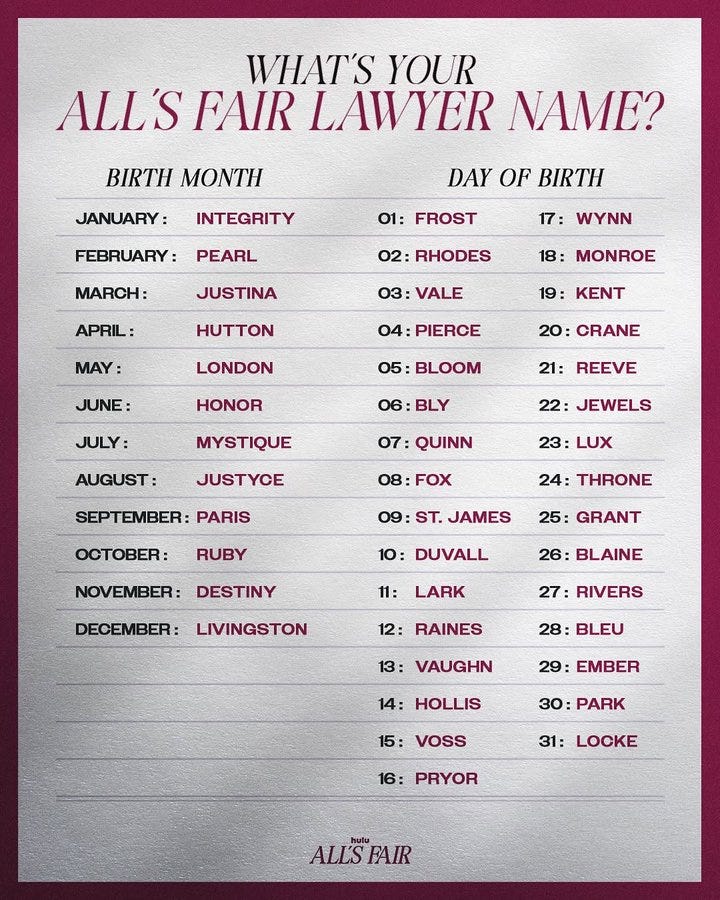
Kardashian’s approach has landed, too, as All’s Fair continues to drive the conversation. Hulu’s own social channels (and fans alike) have joined the fray, posting “zero to hero” and sharing the All’s Fair lawyer name meme and the show’s often raunchy one-liners as viewers, encouraged by the bad reviews, flock to the series (some ironically). At the same time, critics are also extending the narrative. THR’s chief film critic, David Rooney, went down the rabbit hole and ranked the show’s 20 most jaw-dropping lines. L.A. Times culture critic Mary McNamara wrote that All’s Fair is the first show to “truly embody the culture of the Trump presidency” as it celebrates “the 1 percent, personal feuds and financial vengeance.” (Last night’s episode, centering on the aftermath of a sexual assault, expands the show’s tonal range.)
It all adds up to one critic-proof certainty: The series is breaking through.

Bad ‘Reviews Are Free Press’
“It’s very early, but all signs point to accomplishing the goal of being a ratings juggernaut domestically and internationally,” says one source with knowledge of the show’s performance after its first week. Hulu, which has not issued any formal press release touting the show’s performance despite its strong showing atop the platform’s top 15 most-watched chart, has only provided information on its social performance and claims that it’s the biggest original scripted series premiere on the service in three years, with 3.2 million global views in its first three days.
What matters most is whether All’s Fair is driving subscribers to pay for the service. Is it bringing international awareness to Disney+ and its new Hulu general entertainment tile? How many viewers completed all three episodes in its first week? What are the drop-off rates going to be for subsequent episodes for its nine-episode order? As much as creatives and reporters (ahem) would love the answers to those questions and more details about streaming consumption, transparency is something we have been trained not to expect.
As one source put it, “How much did All’s Fair improve the platform’s value?”
The success of All’s Fair — which was designed to be an ongoing series and will most likely earn a second season renewal — has raised a number of questions for execs working in the TV development trenches. Specifically, did Disney know how bad this show was before it launched? Was the camp factor part of the original marketing strategy?
“I don’t think I was quite prepared for how bad it truly is,” says one development exec at a well-known production company. “It’s frustrating because we have a script about a family of divorce lawyers that’s so good, and I worry I won’t be able to sell it now because of this stupid show. I’m hoping it doesn’t get a season two because people are not going to stick around, but I think I’m being crazy in thinking that.” Adds another senior exec, pondering what insiders may have known or believed about the show’s quality: “If Ryan Murphy normally gets torched, and then you add Kim Kardashian as an actress on to it, isn’t that asking to get the s— kicked out of you?”
The source familiar with the show sums up its zero-to-hero journey: “The intention was for this to be a global hit, that’s why it was greenlit. The reviews are free press,” and that’s true whether they are good or bad — in this case, perhaps even more so when they are bad.
“The worst thing for a show is when people are indifferent.”